Poetic Edda
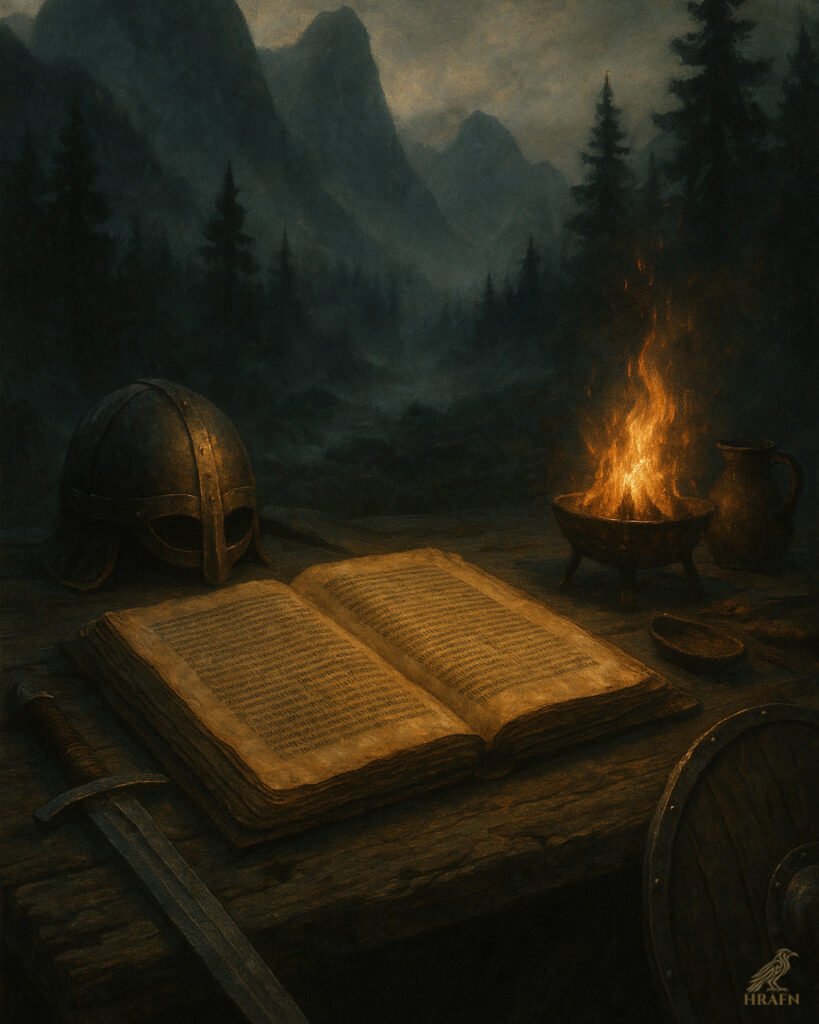
In 1643, a manuscript reaches the hands of Brynjólfur Sveinsson, Bishop of Skálholt. Forty-five sheets of parchment with poems about gods and heroes.
He knows at once what this is. And he is wrong about almost everything.
Brynjólfur takes the manuscript for the lost work of the scholar Sæmundr fróði and names it Sæmundar Edda. Both assumptions are wrong. Sæmundr had been dead for more than a century and a half when the sheets were written, and he has nothing to do with this collection.
The man saves the most important text of Norse mythology — and gets every assumption about it wrong.
The manuscript is known today as the Codex Regius. For most of the poems it contains, it is the only medieval witness.
What the Poetic Edda Is
Not a narrative, not a textbook, not the work of a single author. The Poetic Edda is a collection of poems — anonymous, of varying age, of varying preservation, without a connecting plot.
Roughly, it falls into two groups. The mythological poems deal with Odin, Thor, Loki, and the end of the world. The heroic poems tell of Sigurd the dragon-slayer and the downfall of his lineage.
The poems are dense and allusive. They explain nothing. Whoever fails to grasp an allusion is left outside — and that is precisely why Snorri Sturluson wrote his textbook on the subject in the 1220s.
The Manuscript
The Codex Regius was written in Iceland in the 1270s. It bears no title, no author’s name, and no date. What we know about its age comes from the handwriting and the language.
And it is not the original composition. The paleographic evidence shows that the scribe copied from an older, now-lost exemplar — probably from the first half of the 13th century.
This is not a detail for manuscript specialists alone. It means: between the spoken poetry and the text we read lies at least one further stage of copying. What was lost or altered there can no longer be determined.
The poems themselves are older than both manuscripts. How much older is the most debated question of the field. Some are dated to the 9th or 10th century, others are regarded as younger. There are no certain datings — only arguments from linguistic form, meter, and motifs.
The Great Gap
In the heroic section, eight leaves are missing. This is a complete gathering — not the accidental loss of individual pages, but a quire torn out.
The gap sits between the end of the Sigrdrífumál and the beginning of the Brot af Sigurðarkviðu. The text thus jumps from Sigurd’s awakening of the valkyrie directly to a fragment about his death. What is missing in between is exactly what the whole saga turns on: betrayal, marriage, jealousy, murder.
Probably two to four poems stood there, including a complete Sigurðarkviða. We know roughly what was in it only because the Völsunga saga retells the lost poems in prose.
What Is Not in the Codex Regius
This is where popular accounts regularly diverge from the evidence.
The Codex Regius does not contain the entire Poetic Edda. Several poems that appear in every modern edition are entirely absent from it:
- Baldrs draumar — preserved only in AM 748 I a 4to, a fragment of six leaves from around 1300
- Rígsþula — in the Codex Wormianus, a manuscript of the Prose Edda
- Hyndluljóð, together with the inserted Völuspá in skamma — only in the Flateyjarbók
- Grógaldr and Fjölsvinnsmál, jointly known as Svipdagsmál — only in early modern paper manuscripts
- Grottasöngr — in manuscripts of the Prose Edda
For this group there is a technical term: Eddica minora, after the title of the edition by Andreas Heusler and Wilhelm Ranisch from 1903.
What appears in a given edition of the Poetic Edda has therefore been decided by the respective editor. There is no fixed boundary of the work.
Conversely, six poems of the Codex Regius are additionally transmitted in AM 748 I a 4to, including Grímnismál, Vafþrúðnismál, and Hymiskviða. And the Völuspá has a second medieval witness in the Hauksbók.
Where two versions exist, they differ from one another. This is uncomfortable and revealing at the same time: it proves that scribes really did make changes — and lets us guess at what may have happened to the poems for which no comparison exists.
The Most Important Poems
Four texts carry the bulk of what is regarded today as Norse mythology.
The Völuspá — the prophecy of the seeress — is the foundational text. A seeress tells Odin of the creation of the world, of the war of the gods, of Baldr’s death, and of the downfall at Ragnarök. And of what comes after.
The Hávamál is not a unified poem but a compilation of several originally independent poems: worldly wisdom and rules of conduct, the Loddfáfnismál, the Rúnatal with Odin’s self-sacrifice on the world tree, and the Ljóðatal with eighteen spells. Whoever quotes from the Hávamál is therefore quoting not from a single text but from a collection.
The Grímnismál is a catalog — Odin, bound between two fires, names the dwellings of the gods, their names, and descriptions of the world. Here it also states that the fate of the slain is divided, and half falls to Freyja.
The Lokasenna is a flyting in which Loki confronts the assembled gods with their misdeeds. A text that shows the gods as anything but exalted.
Why It Is the More Important Source
Because it is closer.
Snorri wrote a textbook with a purpose: to explain, to order, to make things comprehensible. The eddic poems have no such purpose. They presuppose rather than explain — and to presuppose is to reckon with an audience that already knows the matter.
Then there is the form. Alliterative poetry is difficult to alter without it being noticed: the meter holds the words fast. Prose can be rephrased; a poem, less so.
This does not make the poems original pagan documents. But where poem and Snorri diverge, the poem carries more weight.
What Still Must Be Kept in Mind
It, too, was written down by Christians. Iceland adopted Christianity around the year 1000; the codex was produced in the 1270s. More than two and a half centuries lie between the official adoption of the new faith and the surviving text.
The selection is not neutral. Someone decided which poems entered this collection and which did not. Who that was, and by what criteria, we do not know.
Usually only one textual witness. For the majority of the poems there is no second manuscript for comparison. Where the scribe misread or altered something cannot be detected.
And the question of Christian coloring. Especially regarding the Völuspá, it has long been debated whether the renewal of the world after Ragnarök is pre-Christian or a later addition. Sophus Bugge saw Christian influence; others disagreed.
One finding belongs here: the most striking passage — the stanza about the mighty one who comes from above and judges over all — is not even in the Codex Regius. It appears only in the Hauksbók version. Of all things, the line that sounds most Christian is missing from the main manuscript.
There is no certain verdict.
Where the Name Comes From
The term “Edda” originally referred to Snorri’s work. Brynjólfur took the poetic manuscript for its older source and transferred the name — along with the attribution to Sæmundr, for which there is no support.
Both assumptions have long since been discarded. The name remained.
Hence today: Poetic Edda or Elder Edda for the poems, Prose Edda or Snorra Edda for Snorri’s textbook. Two entirely different works that share the same name only because a bishop was mistaken in the 17th century.
The Manuscript’s Journey
In 1662, nearly twenty years after its discovery, Brynjólfur sent the Codex Regius as a gift to the Danish king Frederick III. Included in the package: the Flateyjarbók and the Codex Regius of the Prose Edda.
This decision probably saved the text. In the great Copenhagen fire of 1728, a substantial portion of the Icelandic manuscripts in the city burned. The Codex Regius survived because it was kept in the Royal Library and not in the University Library.
It remained in Copenhagen for three hundred and nine years.
On April 21, 1971, it returned to Reykjavík. Air transport was considered too risky for such cargo at the time, so it traveled by ship, aboard a Danish naval vessel and under military escort. The Codex Regius of the Prose Edda did not follow until 1985.
Today the manuscript is held at the Árni Magnússon Institute in Reykjavík.
Sources
Manuscripts. Codex Regius, GKS 2365 4°, 1270s, 45 leaves, eight of them lost — the main witness for the majority of the poems. AM 748 I a 4to, around 1300, six leaves — a second witness for six poems, the only one for Baldrs draumar. In addition, the Hauksbók (Völuspá), the Flateyjarbók (Hyndluljóð), and the Codex Wormianus (Rígsþula).
Citation practice. By poem and stanza number, not by page number. The stanza numbering is the same across all editions; the pagination is not.
German editions. Unlike with the Prose Edda, the situation here is good. Arnulf Krause’s edition at Reclam, in two volumes for the mythological and heroic poems, is the most useful reading edition. Felix Genzmer’s translation in the Thule collection is widely circulated and free in tone. Karl Simrock’s 19th-century verse rendering imitates the meter and sounds correspondingly archaic — pleasant to read, unsuitable for questions of exact wording. Scholarly apparatus: the multi-volume Kommentar zu den Liedern der Edda, edited by Klaus von See and others. The textual-critical basis is the edition by Gustav Neckel and Hans Kuhn.
Bilingual and freely accessible. Edward Pettit (ed.), The Poetic Edda. A Dual-Language Edition, Open Book Publishers, Cambridge 2023 — Old Norse text with English translation and manuscript description.
Open questions. The age of the individual poems, the extent of the original collection, and the content of the Great Gap cannot be determined.