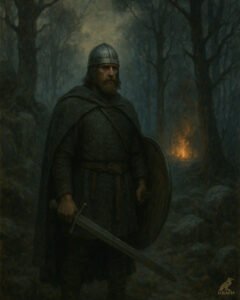
"Viking" was not a people but an activity. You did not belong to the Vikings, you went raiding — and the vast majority of Scandinavians never did. They stayed home and ploughed.
Between 793 and 1066, Northmen left their mark on Europe from Newfoundland to Constantinople. This page separates what the sources support from what the nineteenth century and the television series added.
The Old Norse word víkingr denotes a person who goes on a voyage — usually a raiding voyage. Víking is the voyage itself. It describes an activity, not a nation, and in the sources it is rarely meant as a compliment.
Those who lived in Scandinavia at the time did not call themselves Vikings. A man was Danish, Swedish, Norwegian, Gotlandic — or simply a farmer. The idea of a unified "Viking people" arose only in the nineteenth century, in the orbit of Nordic romanticism, and it has produced more images since than any medieval source ever did.
This is not a footnote about vocabulary. It settles what to expect from this page: not the tale of a nation of warriors, but of a society in which a few were away for months at a time while most remained at home.
The Viking Age conventionally begins in 793 with the raid on the monastery of Lindisfarne and ends in 1066 with the Battle of Stamford Bridge. Both dates are conventions: trade and voyages began earlier, and they did not stop afterwards.
What lies between is not one continuous history of raiding but a sequence of phases — first raids, then overwintering, then settlement and state-building, finally Christianisation and absorption into medieval Europe.
The full chronology with dated events is set out in the timeline of the Viking Age.
The best-known names of the Viking Age are also the least certain. Ragnar Lothbrok appears only centuries later in the Icelandic sagas; whether he lived at all is open. Lagertha rests on a single source, the Gesta Danorum of Saxo Grammaticus, written around 1200.
Others are well attested. Harald Hardrada demonstrably died at Stamford Bridge in 1066. Leif Erikson reached North America around the year 1000 — confirmed by the excavation at L'Anse aux Meadows in Newfoundland.
Each of these profiles states what it rests on and how firm that footing is.
Scandinavian society of the Viking Age was neither a democracy nor pure warrior rule. It knew free men, the unfree and an upper class; it knew assemblies — the thing — and a law built on settlement and compensation rather than punishment by the state.
Women ran the farm, managed stores and appeared in legal transactions. Whether they also fought is the most debated question in the field — more on that below.
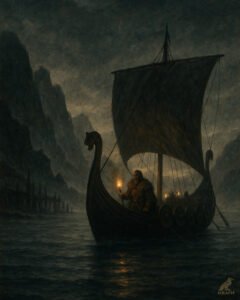
Without the ship there would have been no Viking Age. The clinker-built hull with keel and square sail was shallow enough for rivers and seaworthy enough for the North Atlantic — a combination with no equal in Europe.
The voyages ran in both directions across the map: west by way of Iceland and Greenland to Newfoundland, east along the Russian river systems to Constantinople and into the Caliphate. Arab silver coins found in Swedish graves are the tangible proof.
This is where most of the myths sit. The blood eagle as an execution ritual has been questioned by scholars for decades — it may rest on a misreading of skaldic poetry. The berserkers are attested, but what exactly they were remains disputed.
And the shield-maiden: grave Bj 581 at Birka, read as a warrior's grave for over a hundred years, was shown by DNA analysis in 2017 to be that of a woman. What follows from this is still debated — the burial proves a role, not necessarily a life lived as a warrior.
The reputation for raiding obscures the fact that the Viking Age was above all an age of trade. Hedeby, Birka and Ribe were centres of exchange with workshops, long-distance contacts and a currency of hacked silver.
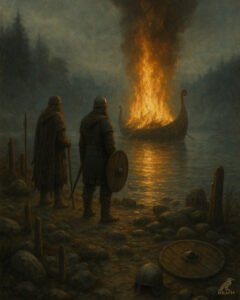
What people believed shows less in texts than in graves. Ship burials, cremations, grave goods, amulets — more can be drawn from these than from the sagas, all of which were composed after Christianisation.
The best-known outside account comes from Adam of Bremen, who around 1075 described the temple at Uppsala: sacrificial animals and men hanging in the trees. Adam was never there. He wrote from hearsay, about a religion he despised, decades after it had ended.
What remains of the Viking Age lies in the ground — and in some places it can be visited. Hedeby near Schleswig, Ribe and Jelling in Denmark, Birka in Sweden, Jórvík in England.
The archaeological account of these places is given here; how to visit them today is set out under Travel & Explore.
Horned helmets, blood eagles, bloodthirsty barbarians, noble children of nature: the image of the Vikings has been reinvented more than once — in the nineteenth century by romanticism, in the twentieth by völkisch circles, in the twenty-first by series and games.
These pages take individual notions and test them against the evidence. Not to spoil the fun, but because the gap between what is attested and what was invented is the most interesting thing about the subject.
An uncomfortable order of precedence applies to the Viking Age. Most reliable are contemporary witnesses: runic inscriptions, archaeological findings, coin hoards. Then come outside accounts — the Anglo-Saxon Chronicle, Frankish annals, Arab travellers such as Ibn Fadlan. These are close in time, but external and often hostile.
Only after them come the Icelandic sagas and the Gesta Danorum. They are the most vivid sources and the latest: written down in the twelfth and thirteenth centuries, two hundred years and more after the events, by Christian authors, with literary intent.
Most popular Viking stories come from this last group. That does not make them false. It only means knowing where one stands.
As of: September 11, 2026
Early trading hubs such as Ribe and Hedeby expand rapidly. Scandinavian seafaring and shipbuilding (longships) advance quickly — the technical foundation of the Viking Age takes shape.
Raid on the monastery of Lindisfarne on the English coast — in Western European tradition, this event is conventionally seen as the start of the Viking Age.
First recorded Viking raids on the Frankish coast.
Vikings establish a permanent settlement on the site of present-day Dublin.
First Viking raids along the Iberian coast.
First attack by the Rus (Vikings active in the eastern trade networks) on Constantinople.
The “Great Heathen Army” campaigns across England; large parts of eastern England fall under Danish control (the Danelaw).
Systematic settlement of Iceland begins, traditionally associated with Ingólfur Arnarson as the first settler.
Battle of Edington: Alfred the Great defeats the Danish leader Guthrum, laying the ground for an uneasy peace between Anglo-Saxons and Danes.
Treaty of Saint-Clair-sur-Epte: the West Frankish king grants the Viking leader Rollo land at the mouth of the Seine — the beginning of Normandy.
Founding of the Alþingi in Iceland, one of the oldest still-existing assemblies in the world.
Harald Bluetooth is baptised and claims on the Jelling stones to have converted the Danes to Christianity.
Erik the Red settles Greenland after being exiled from Iceland.
According to Icelandic tradition, Leif Erikson is among the first Europeans to reach North America (“Vinland”).
Sweyn Forkbeard and his son Cnut the Great conquer England.
Cnut the Great rules a North Sea empire spanning England, Denmark and Norway.
The Battle of Stamford Bridge (death of Harald Hardrada) and the Battle of Hastings (Norman conquest of England) — traditionally mark the end of the Viking Age in classical historiography.
The Vikings were Scandinavian seafarers who, between roughly 793 and 1066, travelled as warriors, traders and settlers across large parts of Europe, Asia and North America, though most lived at home as farmers and craftsmen.
It derives from the Old Norse word víkingr or the phrase fara í víking, literally “to go on a viking”, meaning to set out on a raiding or trading expedition.
Key sources include Icelandic sagas, the Gesta Danorum by Saxo Grammaticus, runic inscriptions, and archaeological finds such as ship burials and settlement remains.
Profiles of well-known figures such as Ragnar Lodbrok or Lagertha are found in the Famous Personalities subcategory.