Lagertha
Lagertha appears for the first and only time in a single historical source: the Gesta Danorum, the “Deeds of the Danes,” written by the Danish scholar Saxo Grammaticus around 1200 – roughly 400 years after the events it claims to describe.
The Campaign to Avenge Norway
Saxo frames Lagertha’s first appearance within a backstory full of violence: the Swedish king Frø had killed the Norwegian king Siward and subjugated his land. As a particular humiliation, Saxo reports, Frø forced Norwegian noblewomen into a brothel. Siward’s grandson Ragnar Lodbrok raised an army to avenge his grandfather and free Norway. Numerous Norwegian women, Lagertha among them, took up arms themselves, dressed as warriors, and fought in the front ranks against the occupiers.
Saxo’s Warrior
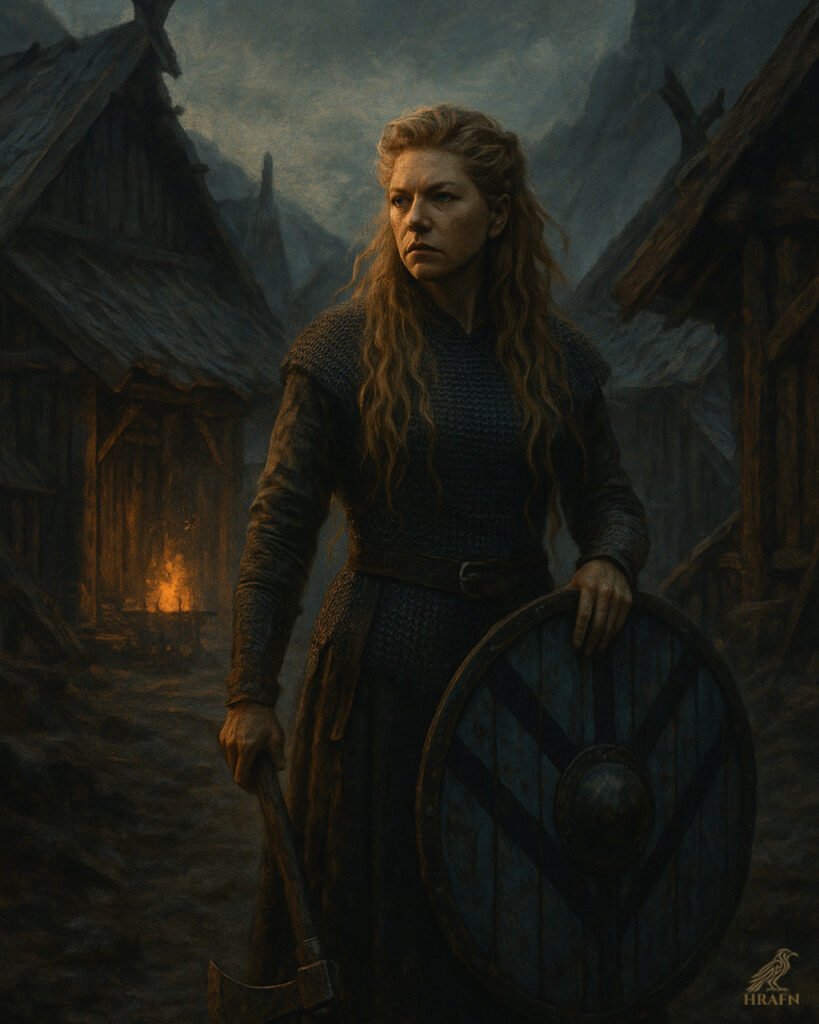
Saxo portrays Lagertha as a warrior who fights in men’s clothing, hair loose over her shoulders, avenging murdered relatives. Among all the warrior women, she stands out to Ragnar in particular: her courage in the front ranks, Saxo writes, was what made the victory over the Swedes possible in the first place. Ragnar, the story goes, falls for her courage in battle and courts her. But the courtship does not go untested: Lagertha sets a bear and a hound to guard her house to test Ragnar’s resolve. Only after he kills the bear with a spear and strangles the hound does she let him in – and grant him her hand. The two marry and have several children, including, according to Saxo, a son named Fridleif.
Separation and Rescue in Battle
The marriage does not last. Ragnar later leaves Lagertha to marry Thora Town-Hart, the daughter of a Swedish nobleman he had earlier freed from a giant serpent. What Saxo recounts years later is all the more remarkable: when Ragnar is pushed into a dangerous battle by rebels in Denmark, his former wife comes to his aid with a fleet of 120 ships of her own. Her intervention decides the battle in Ragnar’s favor – a display of loyalty that outlasts the separation and, in Saxo’s telling, cements her reputation as a warrior once and for all.
Ruler of Norway
After this episode, Saxo relates one final, darker chapter: back in Norway, Lagertha discovers that her second husband is plotting against her. She strikes first and kills him with a spear concealed beneath her clothing. She then takes sole control of his realm. With this turn, Lagertha’s story in Saxo ends with her as an independent ruler, not as an appendage to any man.
One Source, Many Questions
Outside Saxo’s work, Lagertha appears in no other medieval source – not in the Icelandic sagas, not in the Poetic or Prose Edda. Historians therefore mostly classify her as a literary figure, possibly inspired by the Valkyrie and shieldmaiden tradition of Norse mythology, blended with local legends Saxo collected for his chronicle. Some historians further suspect that Saxo also intended her story as a moral example – a warning against women taking on male roles, paired with admiration for their bravery.
From Chronicle to Pop Culture
Outside academic circles, Lagertha owes her popularity mainly to the TV series Vikings, which makes her one of its central characters and expands her story with numerous fictional elements not found in Saxo. The historical Lagertha remains exactly what Saxo Grammaticus wrote about her: a single, uncorroborated account – but one that still resonates today.
Sources
The only medieval source on Lagertha is Saxo Grammaticus’s Gesta Danorum (Book IX, written around 1200). She is not mentioned in any Icelandic saga or in either of the two Eddas. Because Saxo wrote his work roughly 400 years after the events it claims to describe, blending oral tradition with his own literary embellishment, scholars mostly regard Lagertha as a legendary or literary figure rather than a historically confirmed person.