Horned Helmets
- Five finds, no horn
- Horns from the Bronze Age: the Veksø helmets
- The Celtic trail
- Bird heads instead of ox horns
- The Oseberg tapestry – a Viking Age exception
- The silent texts
- A second case of the same kind
- Hjálmr – the concealing thing
- Bayreuth 1876: the birth of the horned helmet
- Who put the horns on first?
- A brand without a history
- Sources
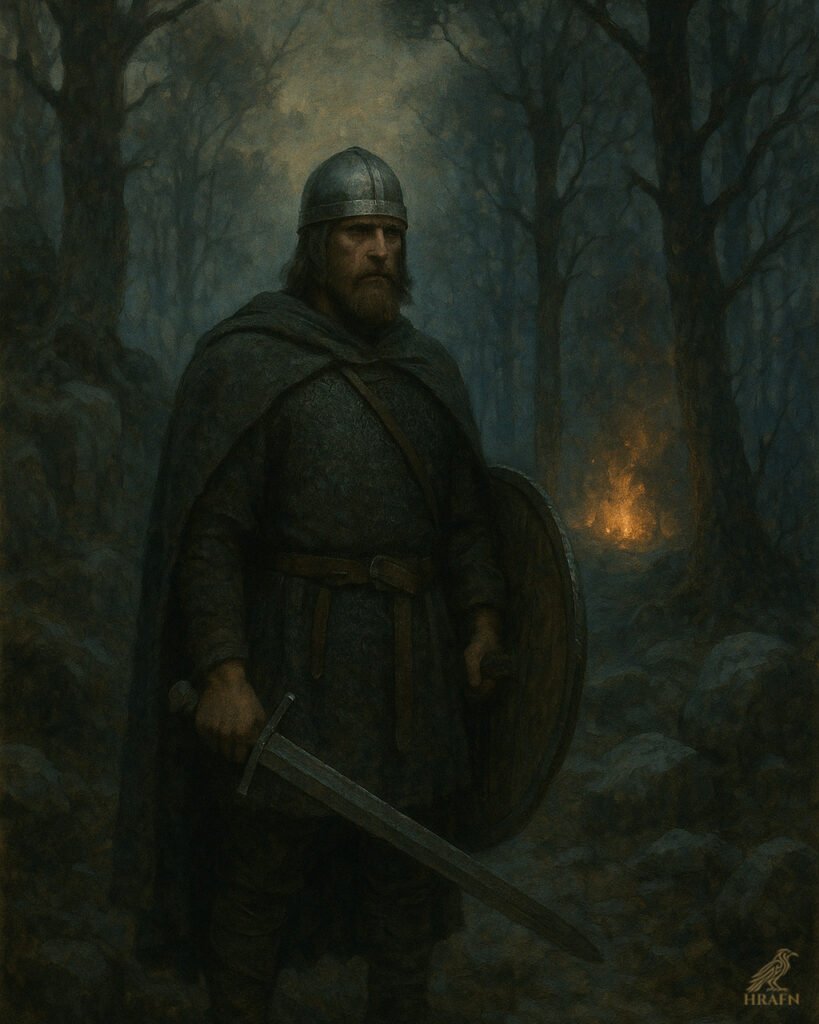
From the entire Viking Age, from 793 to 1066, not a single horned helmet is archaeologically attested. Research knows only five helmet finds from this period altogether: the Gjermundbu helmet from Norway, the Yarm helmet from England, the Tjele fragment from Denmark, the Lokrume fragment from Gotland, and a fragment from Kyiv. Only two of these can be reconstructed at all. None bears horns.
The horned helmet that every Viking costume wears today does exist as an object. Just not in the Viking Age – and not among the Vikings.
Five finds, no horn
The most important of these five is the Gjermundbu helmet. It was discovered in 1943 during fieldwork on the Gjermundbu farm near Haugsbygd, Ringerike, and is dated to around 900. It consists of a round iron cap made of four plates with a “spectacle” guard for eyes and nose, and it now resides at the University of Oslo.
It comes from a cremation burial with complete equipment: sword, mail shirt, shield boss, spurs. That is precisely what makes it the reference find. It is not an isolated piece but the outfit of a man – and it contains everything except horns.
The helmet is not complete: only about 25 to 30 percent of the original was recovered; the rest is reconstruction.
The Yarm helmet is regarded as the only other nearly complete find from this period. Chris Caple described it in detail in 2020 in the journal Medieval Archaeology 64 and classified it as Anglo-Scandinavian, 10th century – a solid basis, but a single study.
The remaining three are fragments. The Tjele fragment is dated to 950 to 970 and was identified as a helmet part by Elisabeth Munksgaard – the find was made in the museum, not in the field. The Lokrume fragment from Gotland was first described in 1907 and comprises only the eyebrow and nose section. From Kyiv comes another fragment, likewise too small for reconstruction.
Five finds from roughly 270 years are few. But they suffice to make one statement with certainty: none of the five shows even the beginnings of horns.
Horns from the Bronze Age: the Veksø helmets
Horned helmets did in fact exist in Scandinavia – only roughly 1700 years before the beginning of the Viking Age.
The Veksø or Viksø helmets, a pair of Bronze Age ceremonial helmets, were found in 1942 in a peat bog called Brøns Mose near Veksø on Zealand. In 2021 a team led by Helle Vandkilde of Aarhus University radiocarbon-dated birch pitch from one of the horns: the deposition took place around 900 BC.
The horns are modeled after the aurochs; at the front sit the beak and eyes of a bird of prey. Crest and groove once held feathers and a horsehair mane. The object thus reads more as a ruler’s or priest’s insignia than as combat equipment.
Comparable headgear appears on rock art and figurines in western Iberia and on Sardinia. Vandkilde and her co-authors also point to a long tradition of horned figures in the Near East, associated with divine rulership and war. A related group of finds comprises the Grevensvænge hoard from Zealand, roughly 800 to 500 BC, as well as the finds from Fogdarp and Kallerup.
Vandkilde herself has explicitly rejected the popular confusion: for decades, popular culture has linked the Viksø helmets with the Vikings. That is nonsense – the horn motif stems from the Bronze Age.
The Celtic trail
Between the Bronze Age and the Viking Age lies a second root that is almost always missing from popular depictions – even though it explains why “barbarians” got horns at all in the 19th century.
The Waterloo Helmet was dredged from the Thames near Waterloo Bridge in 1868. It is a bronze ceremonial helmet in the La Tène style, dated to roughly 150 to 50 BC, and now resides in the British Museum. It was unusable for combat: too thin a sheet metal, too small for an adult head – possibly made for a statue.
It is one of the very few surviving horned helmets of the European Iron Age. The images are more numerous than the finds. Diodorus Siculus describes Celtic helmets with horns in Book V, 30. The Arch of Orange, around 55 BC, shows Gauls with horned helmets. And on the Gundestrup Cauldron, a figure wears a horned helmet and holds a wheel.
This shifts what the horned helmet actually is. It is not an invention out of nothing but a confusion between peoples. Celtic ceremonial helmets, Roman descriptions of Gallic warriors, and the Nordic Bronze Age flowed together into a single image in the 19th century – and this image was then placed on the Vikings.
One date is worth setting alongside another: the Waterloo Helmet entered the British Museum in 1868. The Bayreuth costumes were created in 1876. Eight years.
That the costume designer knew of it is not documented, and this is not being claimed here. But the image of the horned ancient barbarian was demonstrably present in these years – in museums as well as in classical texts.
Bird heads instead of ox horns
Immediately preceding the Viking Age lies the Vendel period, the 6th and 7th centuries. From it come the four cast bronze dies from Torslunda on Öland. One shows a dancing man with horn-like headgear next to a figure with a spear and wolf skin.
The horned figure conspicuously lacks the right eye. A laser scan has confirmed this one-eyedness – strong evidence for Odin, the one-eyed god.
A detail that is lost in popular retellings is decisive here: the supposed horns end in bird heads. They are not ox horns but stylized bird beaks.
The same motif appears repeatedly. The decorative plates of the Sutton Hoo helmet, around 600, show spear-bearing dancers with bird-headed attachments, quite similar to the Torslunda figure. The same pictorial type appears on a pendant from Ekhammar in Uppland and on an 8th-century find from Staraja Ladoga. Another “horned” Odin is found on the Finglesham buckle in Kent.
What these figures mean remains interpretation, not proof. One explanation sees in them warriors who disguised themselves as Odin to signal trance capability or to emulate his role as seiðmaðr, as one versed in magic – as, for example, Michael P. Speidel argues in Ancient Germanic Warriors from 2004.
Only this much is certain: bird-head attachments on cult images are something other than combat equipment.
The Oseberg tapestry – a Viking Age exception
The only Viking Age pictorial source that actually shows a horn-bearing figure is the Oseberg tapestry. It comes from the Oseberg ship burial and shows, in a procession scene, a disproportionately large figure with a horned helmet, alongside a second figure with an animal mask.
Scholarship reads this scene not as real combat gear but as ritual or mythological – as a funerary scene or a procession of gods. Anne Stine Ingstad interpreted the depicted birds as Huginn and Muninn, Odin’s ravens, above a shrouded wagon bearing an image of Odin in a horned helmet. She drew a comparison here to the goddess Nerthus, as recorded by Tacitus.
On a further textile fragment from the same burial chamber, the horned figure holds crossed spears and faces a man wearing what looks like a bearskin.
This leaves a contradiction that cannot be smoothed over. The statement “Vikings did not wear horned helmets” is correct as a statement about combat equipment. Whether it also applies to ritual occasions is open – cult object, status symbol, image of a god, or artistic license are all possible; no interpretation is certain.
The silent texts
Neither the Poetic Edda nor Snorri’s Prose Edda, composed around 1220, know a horned helmet. That is the philological finding behind this topic: the horned helmet has no textual basis, neither in the old poems nor in Snorri.
Attested is only the helmet as such, Old Norse hjálmr, and a single mythical special case: the terror-helmet Ægishjálmr from the Fáfnir material. It belongs to the hoard guarded by the wyrm Fáfnir; in Fáfnismál 16 and 17, Fáfnir boasts of having worn the helmet over the gold, and Sigurd answers him. The material also appears in the prose introduction to the Reginsmál and is elaborated in the Völsunga saga.
The name is composed of a first element usually connected to Old Norse ægir or agi, “terror, awe,” and hjálmr, “helm.” It is occasionally confused with the sea giant Ægir – these are two different words, though a common origin is discussed.
Ægishjálmr is an image for overwhelming, fear-inducing presence, not a concrete headpiece with horns. The sources do not describe it as an object with a recognizable form.
A second case of the same kind
The eight-armed symbol that circulates today as the “Ægishjálmur” on tattoos and pendants is not this literary terror-helmet. It is an Icelandic magic staff whose oldest known pictorial form comes from the manuscript Lbs 143 8vo from around the middle of the 17th century – a good four hundred years after the Fáfnismál. More on this in the article on the Vegvísir.
This is the same mechanism as with the horned helmet, only with reversed signs: there, a young image without an old name; here, an old name to which a much later image has attached itself.
Whoever searches for a textual passage that mythologically grounds the horned helmet searches in vain in any case. This gap is itself a finding.
Hjálmr – the concealing thing
The Old Norse word hjálmr simply means “helmet.” It goes back to Proto-Germanic *helmaz, “protective covering, cover,” and this in turn to the Indo-European root *kel-, “to cover, conceal, shelter.”
Related are Old English helm, Old High German and German Helm, and Gothic hilms. Connected to the same root are also Proto-Germanic *helaną, “to shelter,” and Latin clam and celo, “to conceal.”
Linguistically, then, the helmet is a concealing thing, a sheltering thing – not an ornamental form and certainly not a trophy.
For “horned helmet” itself there is no Old Norse word. The term is a modern coinage of the 19th and 20th centuries. This alone shows: the notion it describes is younger than the language it seems to stem from.
Bayreuth 1876: the birth of the horned helmet
Today’s myth has a birth date. Roberta Frank showed in 2000, in her essay “The Invention of the Viking Horned Helmet,” that Vikings with horned helmets first appeared on stage at the Bayreuth premiere of the complete “Ring des Nibelungen” in 1876. Costume designer Carl Emil Doepler, 1824 to 1905, painter and illustrator for the Bayreuth Festival, put the horns on them.
Before 1876 things looked different. “Viking helmets” in illustrations mostly bore wings; horns were reserved for depictions of ancient “barbarians” – from the Celtic pictorial tradition described above.
After the Bayreuth premiere, the horns spread rapidly. Frank also shows that on Nibelung heads themselves they represented a break with tradition: up to 1878, not a single illustrated edition of the courtly epic showed horned figures.
Doepler’s costumes are thus regarded as the origin of the myth, even though there is not a single archaeological piece of evidence for it. A stage prop from a Wagner production became, within a few decades, a supposedly historical detail.
Who put the horns on first?
Even this story is not entirely clear-cut. Alongside Doepler, a Swedish illustrative tradition is occasionally cited: a member of the Malmström family is said to have drawn kings with small side horns and dragon wings for Esaias Tegnér’s “Frithiofs saga.” The year 1820 that circulates for this, however, is difficult to reconcile with Tegnér’s actual publication dates – this point is regarded as insufficiently documented.
Even within the Doepler story there are two irreconcilable versions. One holds that he gave horns to the evil figures and feather wings to the heroes. The other holds that he reserved wings for the valkyries and put harmless cow horns on the men, from which dramatic bull horns emerged only later. Both versions circulate side by side; neither can be identified as the documented one – they are stated here, not smoothed over.
A related but distinct error stems from an entirely different time. The Danish antiquarian Ole Worm translated, in 1636, an Old Norse kenning for drinking horns – literally “curved branches of skulls” – in such a way that it turned into a hero who drank from the skulls of the slain. This image, too, remains popular today, even though it rests on a translation error.
It shows that antiquarians of the 17th century produced images of Vikings just as costume designers of the 19th did.
An explanation circulating on the German-language internet, according to which the missionary Rimbert saw heathen priests with horned helmets and misunderstood the sight, is found, by contrast, only in popular blogs, not in the scholarly literature. This point, too, remains undocumented.
A brand without a history
The horned helmet has taken on a life of its own, moving from the stage into the present. The logo of the Minnesota Vikings bears a horn on each side; comic figures such as Asterix’s Viking opponents or Hägar the Horrible show the same image.
Howard Williams considers it futile to keep trying to refute this myth: the horned helmet will remain, regardless of how often archaeologists disprove it. Today it functions as a brand mark, not as a historical claim.
This yields an unusual reckoning. The genuine horned helmets of Scandinavia, those from Veksø, are roughly 1700 years older than the beginning of the Viking Age. The Celtic ones are roughly 900 years older. And the famous horned helmets, as Doepler invented them, are roughly 800 years younger than its end.
The object regarded today as the epitome of the Viking has, chronologically, the least to do with the Vikings themselves.
Sources
Viking Age helmet finds. Gjermundbu: found in 1943 on the Gjermundbu farm near Haugsbygd, Ringerike, cremation burial with complete weapon equipment, dated around 900, now at the University of Oslo. Yarm: Chris Caple, “The Yarm Helmet,” Medieval Archaeology 64, 2020, pp. 31–64. Tjele fragment: 950–970, identified by Elisabeth Munksgaard. Lokrume fragment: first described in 1907. Fragment from Kyiv.
Horned helmets of other periods. Veksø/Viksø helmets: found in 1942 in Brøns Mose near Veksø, Zealand; dating of the birch pitch to around 900 BC by Helle Vandkilde and team, Praehistorische Zeitschrift, December 2021. Waterloo Helmet: British Museum, inv. 1988,1004.1, found in 1868 in the Thames, dated c. 150–50 BC. Also Diodorus Siculus, Bibliotheke V, 30; Arch of Orange, around 55 BC; Gundestrup Cauldron, plate C.
Pictorial sources. Torslunda dies, Öland, 6th/7th century. Sutton Hoo helmet, around 600. Ekhammar pendant, Uppland. Find from Staraja Ladoga, 8th century. Finglesham buckle, Kent. Oseberg tapestry and further textile fragments from the burial chamber, interpretation among others by Anne Stine Ingstad.
Written sources. Poetic Edda and Snorri’s Prose Edda, around 1220: no evidence for horned helmets. Ægishjálmr: Fáfnismál 16–17, prose introduction to the Reginsmál, Völsunga saga. On the young pictorial form of the symbol: Lbs 143 8vo, mid-17th century.
Scholarly literature. Roberta Frank, “The Invention of the Viking Horned Helmet,” in: International Scandinavian and Medieval Studies in Memory of Gerd Wolfgang Weber, ed. Michael Dallapiazza et al., Trieste: Edizioni Parnaso 2000, pp. 199–208. Michael P. Speidel, Ancient Germanic Warriors, Routledge 2004. Helle Vandkilde et al., Praehistorische Zeitschrift, December 2021.
Unconfirmed information. The Swedish illustrative tradition surrounding the Malmström family and the year 1820, as well as the Rimbert-Ansgar legend concerning heathen priests, stem from popular rather than scholarly sources and are marked here as open. For the laser scan of the Torslunda die that confirmed the one-eyedness, the publication could not be verified for this article. A direct connection between the Waterloo Helmet and Doepler’s costumes is not documented and is not claimed here.