Mjölnir
- Etymology: a name without a hammer
- The stolen hammer: Þrymskviða
- The forging by the dwarfs: Skáldskaparmál 35
- What else Thor carries
- A hammer that hallows: Baldr’s pyre
- Útgarða-Loki and the limits of strength
- Ragnarök and the hammer’s line of succession
- Mjölnir on rune stones
- Amulets and hammer rings
- Why precisely in the 10th century?
- Sources
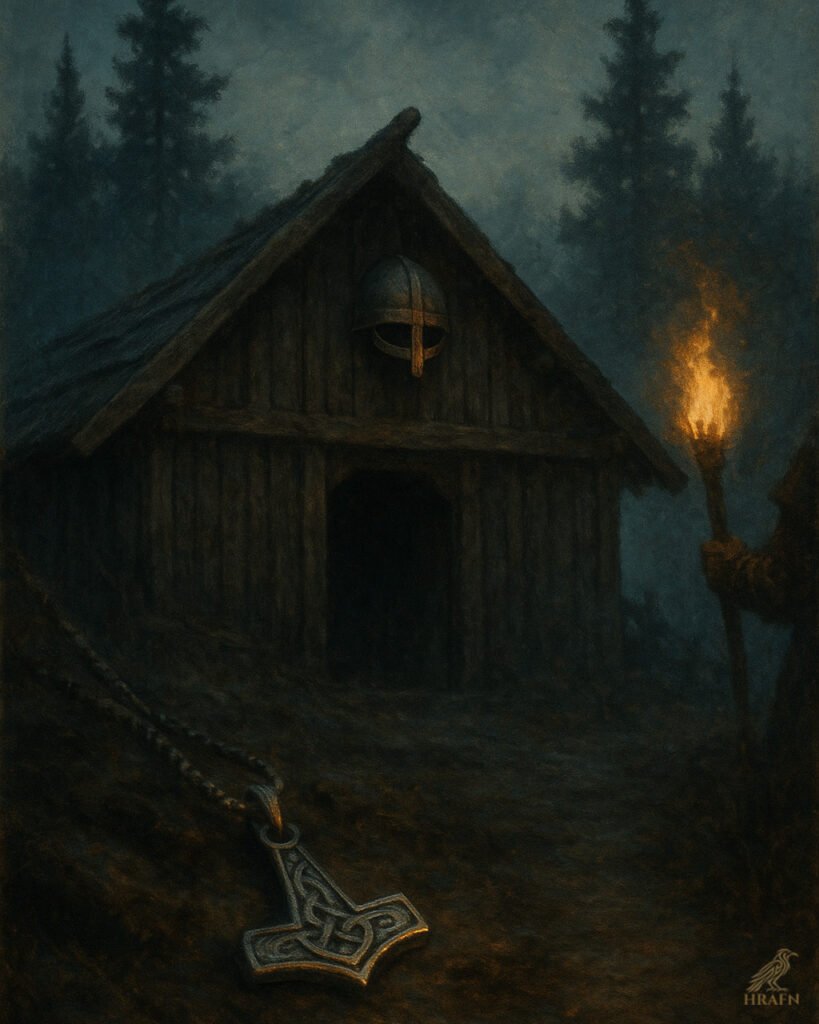
On a small silver pendant from the Danish find site of Købelev, runes spell out: hmar x is – “this is a hammer.” The pendant dates from the 10th century and was found on Lolland in 2014. To this day it remains the only known Thor’s hammer amulet that names itself.
An object that supplies its own name is rare enough. What that name means, in the case of the most famous hammer in Norse mythology, remains unresolved to this day. In no widely accepted interpretation does Mjǫllnir mean “hammer.”
Etymology: a name without a hammer
Old Norse Mjǫllnir (genitive Mjǫllnis), in modern Icelandic Mjölnir, can be explained linguistically in three ways. None of them leads to the word “hammer.”
The lightning. Rudolf Simek connects the name with Old Slavic mlunuji or Russian molnija, “lightning” – Mjǫllnir would accordingly be “the one who makes lightning.” The linguistic reconstruction posits Proto-Norse *meldunjaʀ and Proto-Germanic *meldunjaz, going back to the Indo-European root *melh₂-. Related forms are Old Norse myln (“fire”), Welsh mellt (“lightning”), and Latvian milna, the hammer of the Baltic thunder god Pērkons.
The gleam. Simek names a competing derivation: from Old Norse mjǫll, “fresh snow,” and Icelandic mjalli, “white color.” In that case Mjǫllnir would not be the lightning itself, but “the gleaming lightning weapon.”
The crushing. Older scholarship connected the name with Gothic malwjan and Old Norse mala, “to grind, to crush,” and read it as “the crusher.”
Three theories, none decided. And in none of them does the name of the most famous hammer in Norse mythology mean “hammer.”
The stolen hammer: Þrymskviða
The oldest coherent narrative about Mjǫllnir comes from the Þrymskviða of the Poetic Edda.
Thor wakes, and the hammer is gone. The giant Þrymr has buried it eight leagues deep in the earth and will only give it back on one condition: the goddess Freyja must be given to him as a bride. At the end of the poem the wedding takes place – but the bride Þrymr expects is in truth Thor himself, veiled and adorned.
In stanza 30, Þrymr commands that the hammer be brought in, laid on the bride’s knees, and the couple bound together by the hand of the goddess Vár. In the Old Norse original: brúði at vígja – “to hallow the bride.”
At exactly this moment the scene turns. As soon as Mjǫllnir lies within Thor’s reach, he recognizes his tool, slays Þrymr, the entire race of giants, and finally the giant’s old sister, who had earlier demanded a bridal gift with such impudence.
The phrase vígja is more than incidental. It shows that Mjǫllnir, in the world of the Poetic Edda, is not merely a weapon but a tool of consecration. This motif recurs in Snorri – and, more importantly, on rune stones.
The forging by the dwarfs: Skáldskaparmál 35
How the hammer came to be is told only by Snorri Sturluson, in the Prose Edda, Skáldskaparmál chapter 35.
Everything is set in motion by Loki: he has cut off the goddess Sif’s hair and must make good the damage. The sons of Ívaldi craft three pieces – golden hair for Sif, the ship Skíðblaðnir, and the spear Gungnir.
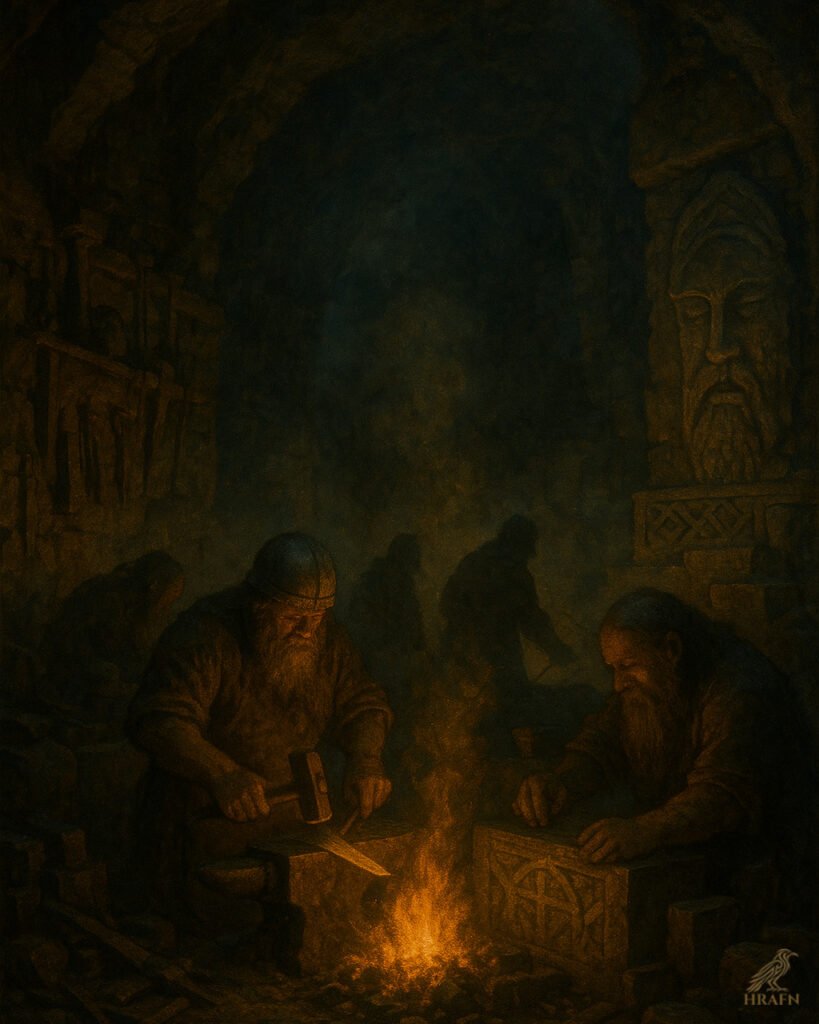
Then Loki wagers his own head that the dwarf Eitri cannot produce anything better. Eitri’s brother Brokkr takes the bet. Eitri forges, Brokkr works the bellows and must not let go.
Loki turns into a fly and stings three times. The third time he hits the eyelid, blood runs in, Brokkr wipes it away briefly – and the handle of the hammer, which is just then being made, comes out too short. Snorri names this expressly as a flaw in the piece.
Even so, the brothers win. Their three works are the boar Gullinbursti, the self-replicating ring Draupnir, and Mjǫllnir. The gods judge that this hammer above all is the best of the gifts, because it will be the most useful in the fight against the Hrímþursar, the frost giants.
The two properties everyone knows today also come from Snorri: the hammer always hits, and it returns to the hand.
This entire origin story – dwarfs, contest, short handle, the never-missing throw – appears in no stanza of the Poetic Edda. It is Snorri’s contribution from the early 13th century, not older tradition that can be independently verified.
On the name of the second dwarf: Snorri calls him Eitri. Sindri appears in Völuspá 37 as the name of a dwarf lineage; that he became Brokkr’s brother goes back to later retellings, at the latest to 19th-century handbooks. In present-day depictions and video games, both names therefore appear.
What else Thor carries
The hammer is part of a trio that Snorri lists in Gylfaginning 21 – in a different place than the forging contest, which is often conflated with it.
Alongside Mjǫllnir come the belt of strength Megingjarðar, which doubles Thor’s strength, and the iron gloves Járngreipr, without which the hammer’s shaft cannot be grasped.
The short handle from the forging chapter and the gloves from the equipment chapter are thus two separate pieces of information, joined together only by later retellings. Snorri never states in the same breath how Thor grips the hammer.
A hammer that hallows: Baldr’s pyre
Snorri takes up the motif of hallowing from the Þrymskviða again in Gylfaginning 49, in the story of Baldr’s death.
As the corpse lies on the funeral pyre, Thor hallows the pile of wood with Mjǫllnir – and in doing so kicks the dwarf Litr, who runs in front of his feet, straight into the fire.
Here the hammer appears not as a weapon against an enemy, but as an instrument that ritually seals a transition. A wedding, a burial. The same function reappears further below in the formulaic language of the rune stones – and there it is not a literary motif but practice carved in stone.
Útgarða-Loki and the limits of strength
In the account of Thor’s journey to Útgarða-Loki, Mjǫllnir is shown to be both mighty and capable of being deceived.
At night Thor strikes the sleeping giant Skrýmir three times with the hammer. Later it turns out that the giant had slipped a mountain underneath, and the blows have left deep valleys there.
The hammer does not fail. It is the one who wields it who is deceived.
This episode, too, belongs to Snorri’s elaborated prose. That the journey to Útgarða-Loki was known is shown by Lokasenna 60, where Loki mocks Thor for having cowered inside the thumb of a glove. The contest itself, with its unwinnable tasks, appears only in Snorri.
Ragnarök and the hammer’s line of succession
Here a careful distinction is needed, because popular accounts regularly credit Snorri with too much at this point.
What the Poetic Edda knows: Vafþrúðnismál 51 names the line of succession – Thor’s sons Móði and Magni will inherit the hammer when Thor falls in battle. And Völuspá 56 depicts the death itself: Thor slays the Midgard Serpent Jörmungandr, walks nine steps, and falls, struck by the venom.
The duel, the nine steps, the inheritance – all of this is eddic and thus older than Snorri.
What Snorri adds: the elaborated scene in Gylfaginning 51, the sequence of events, and the orderly arrangement of the individual combats side by side. He systematizes what the poems leave standing in separate stanzas.
The famous number nine, then, does not belong to him. It stands in the Völuspá.
Mjölnir on rune stones
Independent of the literary sources, rune stones from the 10th and 11th centuries confirm that Mjǫllnir was already regarded as a protective sign during the lifetime of the last pagan generations. Two forms must be distinguished.
The hammer as image. On a number of stones it appears as a small carved sign – for instance on DR 120 from Spentrup, on Stenkvista (Sö 111), and on Läborg (DR 26).
The hammer as formula. Other stones invoke Thor to hallow the inscription. Glavendrup (DR 209) reads Þórr vígi þessi rúnaR, Virring (DR 110) Þórr vígi þessi kuml; Sønder Kirkeby (DR 220) and Velanda (Vg 150) carry the same phrase in shorter form. On the Rök stone (Ög 136), Thor is named, but embedded in the narrative text and without reference to the hammer.
Linguistically, this protective formula is the same word as the vígja from the Þrymskviða. Here, too, the hammer is meant to hallow, not merely to smash – and not within a story, but on a monument that someone actually erected.
And a finding that ties everything together: Thor is the only god invoked on Viking-Age rune stones. No Odin, no Freyr, no Tyr. In poetry, Odin dominates; in stone, Thor.
Particularly vivid is the Altuna stone in Uppland (U 1161). It shows Thor fishing for the Midgard Serpent, hammer raised, one foot punched through the bottom of the boat. The same myth appears in the Hymiskviða – the stone is thus not independent of the material, though it does appear to be independent of the written tradition.
Amulets and hammer rings
Alongside the rune stones, a whole series of small, portable hammer depictions has survived.
The silver pendant from Købelev with its self-naming inscription opens this article. The Kvinneby amulet from Öland, dating from the 11th century, names the hammer explicitly: Þórr gæti hans meðr þeim hamri – “may Thor protect him with that hammer.” This is the direct counterpart to the hallowing motif, this time as a plea for protection. The reading of the Kvinneby inscription is, however, strongly disputed; individual words are resolved very differently by different scholars.
In addition, Thor’s hammer rings have survived: iron rings with small hammer-shaped pendants, found chiefly in Swedish cremation graves, among them Valsgärde. Jörn Staecker organized the amulets typologically in 1999.
Why precisely in the 10th century?
The number of hammer pendants rises sharply in the 10th century. This is exactly the period in which cross pendants spread through the North.
The widely held interpretation: the hammer is worn as a visible counterpart to the cross. The same applies to the Þórr vígi formula, which stands opposite the Christian consecration formulas on gravestones.
This shifts what the finds actually tell us. They do not simply show that the hammer was venerated. They show a symbol that appears in quantity only at the moment there is something to defend.
These artifacts are chronologically closer to the Viking Age than the manuscripts of the Eddas, which were written centuries later – and, unlike any literary source, they can be dated.
Sources
Poetic Edda. Theft of the hammer: Þrymskviða, especially stanza 8 (eight leagues deep), 30 (brúði at vígja), and 32. Line of succession: Vafþrúðnismál 51. Thor’s death after nine steps: Völuspá 56. Allusion to the Útgarða-Loki journey: Lokasenna 60. Fishing expedition: Hymiskviða.
Snorri. Forging contest, short handle, and the hammer’s properties: Skáldskaparmál 35. Thor’s equipment: Gylfaginning 21. Baldr’s pyre and the dwarf Litr: Gylfaginning 49. Skrýmir episode: Gylfaginning 45. Ragnarök scene: Gylfaginning 51. Wherever a narrative appears only in Snorri, this is noted in the article.
Rune stones with a hammer image: DR 120 (Spentrup), Stenkvista (Sö 111), Läborg (DR 26). With the Þórr-vígi formula: Glavendrup (DR 209), Virring (DR 110), Sønder Kirkeby (DR 220), Velanda (Vg 150); Sö 140 uncertain. Picture stone: Altuna (U 1161). Thor is the only god invoked on Viking-Age rune stones.
Finds. Silver pendant, Købelev, Lolland, 10th century, found 2014. Kvinneby amulet, Öland, 11th century, reading disputed. Thor’s hammer rings, among others from Valsgärde. Typology of the amulets: Jörn Staecker (1999).
Etymology. Rudolf Simek, Lexikon der germanischen Mythologie, Kröner – entry Mjǫllnir, with the lightning, gleam, and grinding theses.
Open questions. The meaning of the name, the age of the Þrymskviða, and the reading of the Kvinneby inscription cannot be settled.