Prose Edda
- What the Prose Edda Is
- Where the Name Comes From
- The Structure
- What We Owe to the Prose Edda
- What We Know in Greater Detail Because of It
- What Only It Preserves
- And What Is Wrongly Attributed to It
- The Manuscripts Differ from One Another
- What Hangs on the Upsaliensis
- Different Lines of Transmission
- What Must Be Kept in Mind
- The Relationship to the Poetic Edda
- Which Edition to Read
- Sources
- Editions and Literature Used
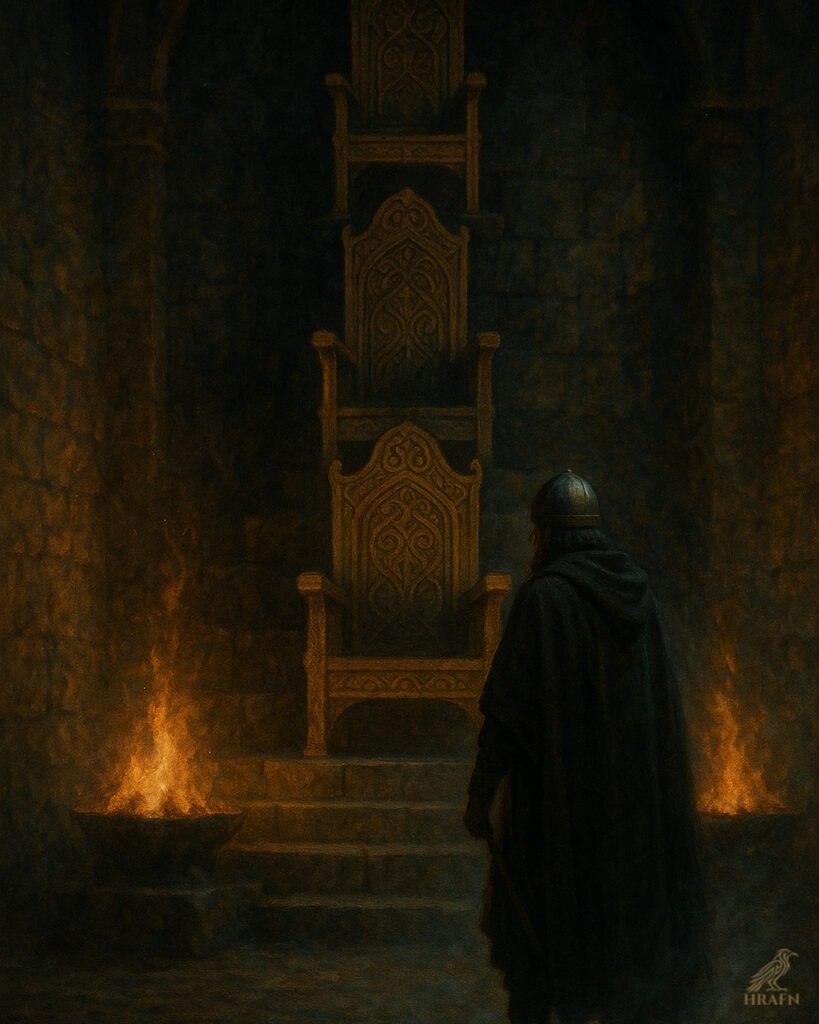
A king named Gylfi wants to know where the power of the Æsir comes from. He disguises himself, calls himself Gangleri — “the one weary of wandering” — and reaches a hall. There sit three figures, one above the other, on three thrones: High, Just-as-High, and Third.
Gangleri is a name of Odin’s. Grímnismál 46 lists it among the names Odin gives himself. Gylfi thus adopts, of all names, that of the very one whose deception he is walking into.
Gylfi is permitted to ask. They answer.
What follows is the most complete account of Norse mythology that we have. And it is framed as a deception — at the end the hall vanishes, and Gylfi stands in an open field.
The most extensive coherent account of the Norse pantheon thus reaches us, of all things, within a narrative whose frame is explicitly built as deception.
What the Prose Edda Is
A textbook for poets, written in the early 1220s by Snorri Sturluson.
That is the key to the whole work. The Prose Edda is not a book of belief. Its discernible purpose is to convey the inherited art of poetry — and the mythological knowledge needed to understand its imagery. Snorri states this himself at the beginning of the Skáldskaparmál: he wants to introduce young poets to the traditional skaldic craft.
This poetry worked with kennings — circumlocutions that presupposed mythological knowledge. Poetry can be called “Odin’s find,” because Odin fetched the mead of poetry from the mountain. Gold can be called “Sif’s hair,” because the dwarves forged golden hair for Sif after Loki had cut off her own. Snorri lists both circumlocutions in the Skáldskaparmál and supplies the story along with them. Whoever does not know it cannot read the verses.
As the distance from the pre-Christian era grew, this very knowledge threatened to become inaccessible. Not the art of poetry itself — that continued to be practiced, and Snorri was a skald who composed for Norwegian rulers. But the images rested on a foundation that could no longer be taken for granted.
This also explains the work’s emphasis. It deals with myths and poetic language. Systematic accounts of cult practice, sacrifice, prayer, or religious organization are not its focus — a poet did not need them. Anyone looking for cult in Snorri will find more in the Ynglinga saga than here.
Where the Name Comes From
No one knows.
Several derivations have been proposed. Edda means “great-grandmother” in the Rígsþula — the word is attested there, though that proves nothing about the book’s title. Second, a derivation from Oddi, the estate where Snorri grew up. Third, from Old Norse óðr, “poetry” — in which case it would simply mean “Poetics.” And fourth, a learned formation from Latin edo, “I compose.”
The óðr interpretation is regarded by many as the most plausible, because it fits the content. The question is not settled, and none of the proposals has prevailed.
What is certain is only what the name originally referred to: Snorri’s book. The heading of the Codex Upsaliensis begins with the words that this book is called Edda.
That the collection of poems in the Codex Regius is also called “Edda” today is a seventeenth-century transfer. It is connected to the early modern attribution of the poems to Sæmundr fróði — Bishop Brynjólfur Sveinsson believed him to be the compiler and named the manuscript accordingly. The attribution has long been rejected; the name remained.
Hence the confusing duplication: the Poetic Edda and the Prose Edda are two entirely different works that bear the same name. This one is also encountered as “Snorra Edda” or “Younger Edda.”
The Structure
Four parts that do very different things.
Prologue. The Æsir, it claims, were once men — emigrants from Troy whom the people of the North took for gods. “Æsir” is here derived from “Asia.” Such a euhemeristic model made pagan tradition compatible with a Christian view of history.
The unity and authorship of the Prologue have been debated in scholarship — Walter Baetke considered it a later learned addition, while Anthony Faulkes defended Snorri’s authorship. There is no text-critical evidence that would fundamentally exclude it from the original Edda. Complicating matters further, the manuscripts transmit it in differing versions.
Gylfaginning — “the deception of Gylfi.” The frame narrative with Gylfi and the three enthroned figures. Here stands the mythology: the creation of the world from Ymir’s body, the gods and their dwellings, Yggdrasil, Baldr’s death, Ragnarök. The most-read part — and the most coherent connected account of Norse cosmology that has come down to us.
Where Snorri cites evidence here, he quotes Eddic poems, above all Völuspá, Grímnismál, and Vafþrúðnismál.
Skáldskaparmál — “discourse on poetics.” A catalog of poetic circumlocutions, each with the story behind it. Here stand the mead of poetry, the treasures of the dwarves, Thor’s duel with Hrungnir, the cursed ring of the Niflung legend. For individual myths and narrative traditions the most productive part, because it contains material absent from the Gylfaginning.
What is quoted here is mostly skaldic poetry, not Eddic poetry. Skaldic stanzas are often older and more securely datable, because they are attributed by name and formally difficult to alter — that does not automatically make them securely dated Viking-Age sources, however.
Háttatal — “list of verse forms.” A praise poem by Snorri for King Hákon Hákonarson and his regent, Jarl Skúli Bárðarson, composed around 1222/23. 102 stanzas display roughly a hundred verse forms, accompanied by a prose commentary explaining them.
Unproductive for mythology. But probably the part written first: a widespread reconstruction sees in the Háttatal the early core around which the remaining parts grew.
This reveals an irony. What we read today primarily as a source for mythology probably originated as an accessory to a treatise on versification.
What We Owe to the Prose Edda
A great deal. But not everything in the same sense — and that distinction is the heart of the whole matter.
What We Know in Greater Detail Because of It
The Poetic Edda contains poems: condensed, allusive, often without connecting context. For many myths, Snorri supplies the narrative for material that already existed beforehand.
The creation of the world from Ymir’s body already appears in Vafþrúðnismál 21 and Grímnismál 40–41: earth from the flesh, sea from the blood, mountains from the bones, sky from the skull, clouds from the brain. Snorri joins the individual pieces into a continuous creation narrative.
Thor’s journey to Utgard-Loki was known. Lokasenna 60 mocks Thor for having cowered inside the thumb of a glove — that is the Skrýmir episode. The elaborated contest with its unwinnable tasks, however, appears in Snorri.
The binding of Fenrir is known from the Völuspá, and that Týr lost a hand in the process is presupposed by Lokasenna 38–39. The fetter Gleipnir with its six impossible ingredients comes from Snorri.
Baldr’s death appears in the Völuspá and in the Baldrs draumar. The oath sworn by all things, the forgotten mistletoe, Höðr’s blind throw, Loki’s role, and the giantess who alone refuses to weep — this connected elaboration we know from the Gylfaginning.
Sleipnir is not Snorri’s invention; the horse is attested earlier, and the building of the wall around Asgard is echoed in Völuspá 25–26. The story of how Loki turned into a mare, lured away the stallion Svaðilfari, and later gave birth to the eight-legged foal appears in Snorri.
What Only It Preserves
This list is shorter than popular accounts might suggest. After comparison with the Poetic Edda, skaldic poetry, and pictorial evidence, essentially three narratives remain.
The dwarves’ forging contest. How Sif’s hair, Gungnir, Skíðblaðnir, Draupnir, Gullinbursti, and Mjölnir came to be, and why the hammer has too short a handle.
Gleipnir. A cat’s footfall, a woman’s beard, mountain roots, bear sinews, a fish’s breath, bird spittle.
Hermóðr’s ride to Hel. Here a distinction is necessary: the figure Hermóðr is attested outside Snorri — Hyndluljóð 2 names him, and in the Hákonarmál Hermóðr, together with Bragi, receives the dead king in Valhalla. The narrative of the ride into the underworld to bring back Baldr, however, survives in comparable detail only in Snorri.
And What Is Wrongly Attributed to It
From the dependence on Snorri arises a common fallacy: because so much appears in him, he is also credited with what he merely passed on.
The great name-lists are not his. The catalog of dwarves stands in Völuspá 9–16. The names of the gods’ dwellings and of the world’s rivers stand in Grímnismál. Snorri takes them over, arranges them, expands them here and there. He did not invent them.
The nine worlds, too, are older: Völuspá 2 and Vafþrúðnismál 43 already know them. Snorri, incidentally, nowhere systematically states which nine are meant — no surviving source does.
This distinction is no small matter. It determines whether a given piece of information stems from the thirteenth century or from older poetry.
The Manuscripts Differ from One Another
A point rarely mentioned: there is no single “the” Prose Edda. Four manuscripts are considered the principal witnesses, along with three fragments. They differ in scope, arrangement, and wording.
The Codex Regius (GKS 2367 4°, early fourteenth century) — not to be confused with that of the Poetic Edda — is the most complete and serves as the basis for most editions. It lay for centuries in the Royal Library in Copenhagen, hence the name, and returned to Iceland in 1985.
The Codex Upsaliensis (DG 11) dates from the first quarter of the fourteenth century and is considered the oldest. The datings of U and R do overlap, however; the ordering is a paleographic judgment, not a hard fact.
The Codex Wormianus (AM 242 fol) was made around 1350 and additionally contains what is called the First Grammatical Treatise.
The Codex Trajectinus stands apart: a paper copy from the 1590s made from a lost manuscript of the late thirteenth century. A principal witness in scholarly terms, but not a surviving medieval codex. Anyone reading of “four surviving manuscripts” should bear this in mind.
What Hangs on the Upsaliensis
It is the leanest text of the four — and carries the most weight.
The explicit medieval attribution of the work to Snorri and the designation Gylfaginning are each attested, within the surviving manuscript tradition, solely here.
The most famous title in Norse mythology and the name of its most important author both rest on a single witness.
Different Lines of Transmission
Nor do the four stand on equal footing with one another.
Regius and Trajectinus share errors absent from the other two — they go back to a common exemplar, though T is not a copy of R. Wormianus shares further errors with both. The Upsaliensis stands apart and often offers a markedly different version.
So much for the findings. Their interpretation is open: whether U stands closer to what Snorri wrote, with the other three representing a longer version, possibly revised by Snorri himself, is one hypothesis among several. How the differences relate to the original form of the work remains disputed.
For the reader this shifts the question nonetheless: whoever opens a translation is not looking at four equivalent texts, but at a decision the editor has already made.
What Must Be Kept in Mind
Two hundred years of distance. More than two centuries lie between Iceland’s official adoption of Christianity around the year 1000 and Snorri’s Edda. Snorri lived entirely within a Christian society and no longer knew pre-Christian religion, from his own experience, as a socially determining cult system. He knew texts.
Snorri arranges. Where tradition was inconsistent, he smoothed it out. The comparatively closed order of the pantheon — fixed domains, continuous genealogies, a system rather than a collection — owes its surviving form to a considerable degree to his account. Lived religion is rarely so tidy.
The frame is Christian. Not only in the Prologue. The Gylfaginning, too, ends with the hall dissolving and everything being revealed as deception. In a Christian scholarly work of the thirteenth century, this frame can at least also be read as a distancing from the narrated material.
He was a good storyteller. This makes the Prose Edda readable and, as a source, awkward: good storytellers shorten, sharpen, and round off. The more self-contained an episode is in Snorri’s telling, the more important, therefore, is the question of which elements can be substantiated independently of his version.
None of these reservations devalues the book. They only determine what may be drawn from it: thirteenth-century narrative material that contains older tradition — not the creed of the Viking Age.
The Relationship to the Poetic Edda
Snorri knew Eddic poems and quotes them. The work known today as the Poetic Edda, as preserved in the Codex Regius, he could not have known: the manuscript was made around 1270, and Snorri was killed in 1241. Which written or oral versions were available to him, we do not know.
He knew the poetry, not the book.
Some material is preserved only through him. The Grottasöngr, for instance, owes its medieval textual transmission to the manuscript tradition of the Snorra Edda, along with individual stanzas and fragments from otherwise lost poems.
And where both works transmit the same poem, the wording does not always agree. The discrepancies may go back to a different textual version, to oral tradition, to deliberate adaptation, or to memory. In individual cases this usually cannot be decided.
Where he quotes, one can check. Where he narrates, one cannot.
From this follows the working rule for both works: if a motif is attested in an Eddic poem, we know that Snorri did not invent it. If it appears only in him, whether he transmitted it or shaped it remains open.
Note the wording: it does not say that the motif dates from the Viking Age. The Poetic Edda does not automatically mean pre-Christian. Rígsþula, Hyndluljóð, and Alvíssmál are dated by some scholars to the thirteenth century — that is, to Snorri’s own time or later. There is no consensus on the age of the collection as a whole.
This is no reason to avoid Snorri. Without him there would be no Norse mythology as a coherent system — there would be poems, inscriptions, and scattered mentions.
Which Edition to Read
Here things become inconvenient for German-speaking readers: a modern complete German edition that fully translates all parts and is annotated at the level of the authoritative scholarly editions is not available.
Gustav Neckel / Felix Niedner, Die jüngere Edda mit dem sogenannten ersten grammatischen Traktat (Sammlung Thule 20, Jena 1925) is one of the few largely complete German translations — without the Prologue and some later additions. It is freely translated, linguistically marked by the tone of its time, and not suited for questions of exact wording.
Arnulf Krause, Die Edda des Snorri Sturluson (Reclam, Stuttgart 1997, bibliographically updated 2017) is expressly a selection focused on the content-bearing, that is, mythological chapters. Well annotated, inexpensive, and the most sensible choice for beginners — the Háttatal is not included.
Arthur Häny, Prosa-Edda. Altisländische Göttergeschichten (Manesse, Zurich) is likewise an annotated selection, focused mainly on the Gylfaginning.
Gottfried Lorenz, Snorri Sturluson: Gylfaginning. Texte, Übersetzung, Kommentar (Texte zur Forschung 48, Darmstadt 1984) is the scholarly German reference — but only for the Gylfaginning.
Anyone needing the entire work must turn to English. The editions by Anthony Faulkes for the Viking Society for Northern Research cover all parts, including Skáldskaparmál and Háttatal, and are freely available as PDFs.
This difficult accessibility likely contributes to the fact that the Háttatal and large parts of the Skáldskaparmál are markedly less present in German-language popular accounts than the Gylfaginning.
Sources
Dating. No surviving statement names a year of composition. The anchor is the Háttatal: Snorri stayed in Norway from 1218 to 1220, and the poem presupposes this stay. Skúli is given the title of jarl in it — he became a duke only in 1237. From this follows a dating of around 1222/23 for the Háttatal and the early 1220s for the work as a whole. Individual parts probably originated at different times.
Authorship. Snorri’s authorship is generally accepted in scholarship. The explicit attribution within the surviving medieval manuscript tradition, however, is found solely in the Codex Upsaliensis. For the Prologue, authorship has additionally been debated.
Citation practice. Cite part and chapter, not page number. One pitfall: the chapter numbering of the Skáldskaparmál differs between editions. Whoever cites should also name the edition.
Editions and Literature Used
Text editions
- Snorri Sturluson: Edda. Prologue and Gylfaginning, ed. Anthony Faulkes, 2nd ed., Viking Society for Northern Research, London 2005.
- Snorri Sturluson: Edda. Skáldskaparmál, ed. Anthony Faulkes, Viking Society for Northern Research, London 1998.
- Snorri Sturluson: Edda. Háttatal, ed. Anthony Faulkes, 2nd ed., Viking Society for Northern Research, London 2007.
- Gottfried Lorenz: Snorri Sturluson: Gylfaginning. Texte, Übersetzung, Kommentar (Texte zur Forschung 48), Wissenschaftliche Buchgesellschaft, Darmstadt 1984.
German translations
- Die jüngere Edda mit dem sogenannten ersten grammatischen Traktat, trans. Gustav Neckel and Felix Niedner (Sammlung Thule 20), Diederichs, Jena 1925.
- Die Edda des Snorri Sturluson, selected, translated, and annotated by Arnulf Krause, Reclam, Stuttgart 1997 (updated edition 2017), ISBN 978-3-15-000782-2.
- Snorri Sturluson: Prosa-Edda. Altisländische Göttergeschichten, trans. Arthur Häny, Manesse, Zurich.
Reference works and scholarship
- Rudolf Simek: Lexikon der germanischen Mythologie, Kröner, Stuttgart.
- Rudolf Simek / Hermann Pálsson: Lexikon der altnordischen Literatur (Kröners Taschenausgabe 490), Kröner, Stuttgart.
- Walter Baetke: Die Götterlehre der Snorra-Edda, Berlin 1950 — on the Christian framing and the question of the Prologue.
- Anthony Faulkes: Pagan Sympathy. Attitudes to Heathendom in the Prologue to Snorra Edda, 1983 — a counter-position to Baetke.
- Jan Alexander van Nahl: Snorri Sturlusons Mythologie und die mittelalterliche Theologie, de Gruyter, Berlin/Boston 2013.
Manuscripts
- Skaldic Project (skaldic.org), overview of the transmission of the Snorra Edda — shelfmarks, datings, manuscript relationships.
- University Library Utrecht, description of the Codex Trajectinus (Ms. 1374).
Primary passages in the text
- Grímnismál 4–17 (dwellings of the gods), 27–29 (world rivers), 40–41 (creation of the world from Ymir), 46 (Gangleri as a name of Odin’s)
- Vafþrúðnismál 21 (creation of the world from Ymir), 43 (nine worlds)
- Völuspá 2 (nine worlds), 9–16 (catalog of dwarves), 25–26 (the builder), 31–33 (Baldr)
- Lokasenna 38–39 (Týr’s hand), 60 (Skrýmir’s glove)
- Hyndluljóð 2 and Hákonarmál (Hermóðr as a figure)
- Rígsþula 2 (edda as “great-grandmother”)
- Baldrs draumar
- Gylfaginning 34 (Gleipnir), 42 (Sleipnir’s birth), 49 (Baldr’s death, Hermóðr’s ride)
- Skáldskaparmál (the dwarves’ forging contest, kennings for poetry and gold)