Snorri Sturluson
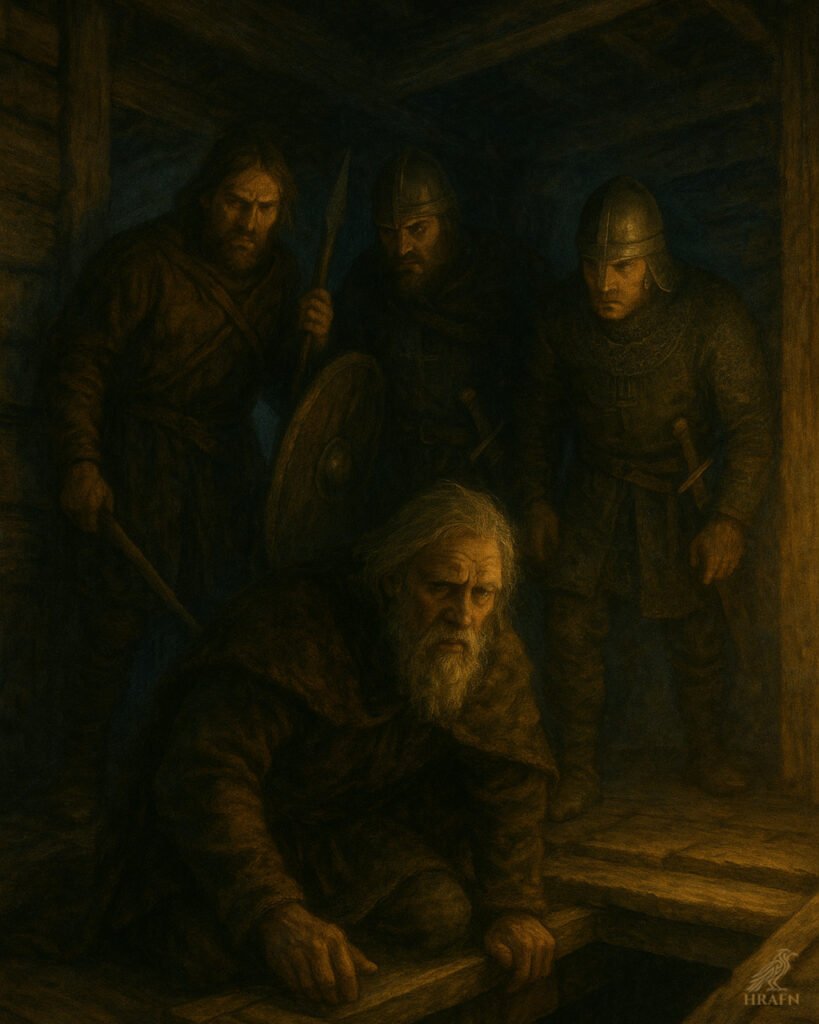
On the night of September 23, 1241, seventy armed men surround a farmstead in Reykholt. They break down the door to the bedchamber. The master of the house escapes and hides beneath the house, in the passage leading to his bathhouse.
Five of them climb down into the cellar. The Íslendinga saga names them: Markús Marðarson, Símon knútr, Árni beiskr, Þorsteinn Guðinason, Þórarinn Ásgrímsson.
According to the same source, the man in the cellar is the wealthiest man in Iceland. Twice lawspeaker of the assembly, poet, chronicler — and for two years a traitor in the eyes of the Norwegian king, because he left the country without permission.
Símon orders Árni to strike.
Eigi skal höggva, says Snorri. “Do not strike.”
Högg þú, says Símon. “Strike.”
Eigi skal höggva, says Snorri.
They strike.
The man’s name is Snorri Sturluson, and without him we would know only a fraction of what we believe we know about Norse mythology.
What Lies in These Last Words
Eigi skal höggva is constructed impersonally. Literally, it does not mean “do not strike me,” but “it shall not be struck.”
Snorri does not plead. He pronounces a legal formula. A man who twice recited the law of all Iceland before the assembly dies in the language of his office.
And this is exactly where source criticism must begin. The scene comes from the Íslendinga saga, written by Snorri’s nephew Sturla Þórðarson, decades after the deed. Sturla was a gifted storyteller. Whether these were the actual last words or the sharpening of an author who knew which sentence would stick cannot be determined.
We do not know what Snorri Sturluson said. We know what his nephew reports.
Who Snorri Was
Not a monk, not a scholar in a monastery, not a priest. Snorri was a politician.
Born in 1178 or 1179 as the son of the chieftain Sturla of Hvammur, he was given into fosterage at Oddi at the age of two or three — depending on the assumed birth year, he came to Oddi in 1181.
Oddi was no ordinary farmstead. Jón Loftsson, who ruled there, was regarded as the most influential man in Iceland. He was a grandson of Sæmundr fróði, to whom a Latin history of the Norwegian kings is attributed — not a word of it survives. And Jón’s mother Þóra was a daughter of the Norwegian king Magnús berfœttr.
That explains the rest of his career. Snorri grew up in a household with royal blood in the family line, whose gaze turned toward Norway. There he learned what an Icelandic magnate had to know: law, poetry, genealogy, power politics.
He married into wealth, inherited, litigated, and accumulated farmsteads. Twice he was elected lögsögumaður, lawspeaker of the Althing: 1215 to 1218 and 1222 to 1231.
This office is often misunderstood. It was the only office spanning the whole of Iceland’s commonwealth and carried high prestige — but it was not an office of power. The lawspeaker recited the law and presided over the Lögrétta. He had no troops, no enforcement power, no judicial authority. Real power lay with the goðar and their followers.
Snorri’s power did not come from the office. It came from farmsteads, marriages, and followers.
In 1218 he laid down the office and sailed to Norway at the king’s invitation. He moved in court circles, composed poetry for King Hákon and Jarl Skúli, became entangled in the power struggle between the two, and switched sides. In 1239 he left Norway against the king’s explicit prohibition.
Two years later the letter reached Gizurr Þorvaldsson: Hákon called Snorri a traitor and ordered that he be forced to return or be killed. Gizurr was Snorri’s former son-in-law. He chose the second option.
That it was precisely this man who wrote the authoritative account of the pagan world of the gods is the first circumstance a reader should keep in mind.
What He Wrote
Three works are attributed to him. On three very different foundations.
The Prose Edda, also called the Snorra-Edda, was written in the 1220s. It consists of a prologue and three parts: Gylfaginning narrates the mythology as a frame story, Skáldskaparmál explains the poetic circumlocutions, and Háttatal presents roughly a hundred meters across 102 stanzas.
The Heimskringla, around 1230, is a history of the Norwegian kings told in sixteen sagas — from mythical beginnings to the year 1177. It opens with the Ynglinga saga, in which the gods appear as early kings. The title, incidentally, is not medieval: it only arose in the 17th century, formed from the opening words of a manuscript, kringla heimsins — “the circle of the world.”
The Egils saga is frequently attributed to him. The arguments are stylistic and thematic, not documentary.
Three Degrees of Attribution
Precision is worthwhile here, because popular accounts regularly turn attribution into certainty.
Prose Edda. A single medieval manuscript names Snorri as the author: the Codex Upsaliensis, in its heading. No other witness does so. The attribution is regarded as certain, but it rests on exactly one piece of evidence.
Heimskringla. Neither the text itself nor any surviving medieval manuscript names an author — which was quite common for works of this period. The earliest surviving testimonies naming Snorri are two 16th-century Danish translations: Laurents Hanssøn in 1550 and Peder Claussøn Friis in 1599. Whether they used a manuscript now lost is disputed; Jon Gunnar Jørgensen examined the evidence in 1995 and found this assumption unconvincing.
The indirect medieval evidence is weaker than it appears. The Íslendinga saga reports that Sturla Sighvatsson had copies made “from the books that Snorri had compiled” — sögubækr, history books. Which ones is not stated.
Egils saga. No testimony at all. The attribution rests exclusively on style, structure, and thematic parallels with Snorri’s other works.
What remains is a finding remarkable for a medieval author: not a single work of Snorri Sturluson carries his name in the text of a contemporary manuscript.
This devalues nothing. Scholarship predominantly holds Snorri’s authorship of the Prose Edda and Heimskringla to be accurate, and there are good reasons for this. But “is regarded as certain” and “is documented” are two different statements.
Why He Wrote the Edda
Not to preserve the old faith. But to save the poetry.
Skaldic poetry worked with kennings — circumlocutions that presupposed mythological knowledge. Anyone who does not know that Odin fetched the mead of poetry from the mountain will not understand why poetry can be called “Odin’s booty.” Anyone unfamiliar with the story of Sif and her hair will not recognize “Sif’s hair” as gold.
Two centuries after the conversion to Christianity, this knowledge was fading. Not the art of poetry itself — that continued to be practiced, and Snorri was a skald who composed for Norwegian princes. What was fading was the knowledge that gave the images life. Young poets could no longer unravel the transmitted verses.
Snorri wrote a textbook: here are the stories you must know in order to compose poetry.
This is the second circumstance that colors everything. In Snorri, the myths appear with a specific purpose — arranged for clarity, brought to the point, prepared for practical use. Not as a testimony of faith, but as a reference work.
This also explains what is missing. No cult, no sacrifice, no prayer, no priests. Everything a handbook of religion would need to contain is absent — because a poet did not need it.
The Prologue: Gods as Men from Troy
The most striking passage stands right at the beginning. There it is explained that the Æsir were in truth men — emigrants from Troy who moved north and were taken for gods by the natives. “Æsir” is derived from “Asia.”
This interpretation is called euhemerism: gods as deified men. It is an ancient explanatory model, widespread in the Christian Middle Ages — and it allowed pagan material to be written down without risking the accusation of idolatry.
Whether the prologue is by Snorri at all is disputed. Walter Baetke considered it a later learned addition; Anthony Faulkes defended Snorri’s authorship. The manuscripts do not settle the question — they transmit the prologue in differing versions.
Whether Snorri believed this model or whether it was a protective claim likewise cannot be determined. Only this is certain: the framework does not come from pagan belief, but from the learned Christian tradition of his time.
And it is not confined to the prologue. The Gylfaginning, too, ends with the remark that everything was deception.
What We Would Not Know Without Him
A great deal. And some of it exclusively.
The Poetic Edda contains poems — dense, allusive, often without narrative context. Snorri supplies the stories that connect them.
How the world came into being from Ymir’s body. How Loki transformed into a mare, lured away the stallion Svaðilfari, and later gave birth to the eight-legged foal Sleipnir. How the dwarves forged Thor’s hammer. How Thor failed in a contest at Útgarða-Loki’s that he could not have won. How the gods bound Fenrir with the fetter Gleipnir and its six impossible ingredients.
The same is true of Baldr. That Baldr dies is stated in the Völuspá and in Baldrs draumar. But the oath of all things, the forgotten mistletoe, Höðr’s blind throw, Loki’s role, Hermóðr’s ride to Hel, and the giantess who alone refuses to weep — this narrative comes from Snorri.
Without Snorri, there would be no Norse mythology as a system. There would be poems, inscriptions, artifacts, and scattered mentions. He built the structure.
And What He Did Not
This dependence gives rise to a common shortcut: because so much appears only in Snorri, he is also credited with what he merely passed on.
The great name-lists are not his. The catalog of dwarves stands in Völuspá, stanzas 9–16. The names of the gods’ dwellings and the rivers of the world stand in Grímnismál. Snorri takes them over, arranges them, expands them here and there. He did not invent them.
This distinction is not a minor matter. It decides whether a given piece of information dates from the 13th century or from older poetry.
Where Caution Is Warranted
For exactly this reason, he is also the greatest problem in scholarship.
The temporal distance. Iceland adopted Christianity around the year 1000. Snorri wrote in the 1220s. Roughly two hundred years lie between the last person who openly believed in Odin and the author. He never witnessed a pagan cult, never attended a sacrifice, never questioned a believer. He knew texts.
His own systematization. Where the tradition was inconsistent, Snorri smoothed it out. Where something was missing, he filled it in. Whether he drew on older sources or formulated it himself usually cannot be determined. Lived religion is rarely as orderly as the world of the gods in Snorri.
The Christian framework. Not only in the prologue. The renewal of the world after Ragnarök and Baldr’s role as a suffering innocent have also triggered a long debate. Sophus Bugge saw Christian influence in them; Jan de Vries and others argued against this.
The current state of research is more nuanced: the underlying motifs are older than Snorri — Baldr’s death and the renewal of the world already appear in the Völuspá, and a Balder even appears in the Second Merseburg Charm. What remains open is not whether the motifs are pre-Christian, but how much of Snorri’s elaboration goes back to old tradition.
Literary intent. Snorri was a good storyteller. Good storytellers cut, sharpen, and build tension. That is appropriate for a textbook and inconvenient for a source. The very passages that work best are the most suspect.
How to Work with Snorri
Not: discard him. Anyone who sets Snorri aside has almost nothing left.
Instead: place him in context. In practice, this means asking three questions of every statement.
Does it also appear elsewhere? If a motif also appears in the Poetic Edda, in skaldic verse, or on picture stones, it is older than Snorri. This is the strongest case.
Does it appear only in him? Then it remains open whether he transmitted it or shaped it himself. That does not make it false — it makes it uncertain, and this should be stated.
Does it fit suspiciously well? Where a story mirrors Christian motifs or yields an all-too-tidy order, a second look is worthwhile.
An Example of How This Looks
Thor’s fishing expedition for the Midgard Serpent appears in Snorri’s Skáldskaparmál. But it does not stand alone there.
The Hymiskvíða tells it in full — Poetic Edda, hence older. Several skalds treated it: Bragi Boddason, Úlfr Uggason, Eysteinn Valdason. And it is preserved in images: on the Altuna rune stone in Sweden, on the stone at Hørdum in Denmark, on the fishing-trip stone at Gosforth in England.
Eddic poetry, skaldic verse, and picture stone, independently of one another, from several regions. This myth was known and widespread in the Viking Age. That much can be said without having to rely on Snorri.
By comparison: for Hermóðr’s ride to Hel, none of this exists. No poem, no skaldic stanza, no image. Only Snorri.
Both are good stories. But only one of the two may be called something “the Vikings believed.”
These three questions are the reason why, throughout this website, many statements note where they come from. This is not an end in itself — it is the only way to use Snorri without being at his mercy.
Sources
On his life. The account relies primarily on the Íslendinga saga of his nephew Sturla Þórðarson (1214–1284), transmitted in the compilation Sturlunga saga. It is close in time and detailed. Its perspective must be read with three considerations in mind: it comes from a relative who was himself a party to the conflicts. It was written after 1262/64, when Iceland already stood under the Norwegian crown and Sturla worked in the service of the same royal house that had ordered Snorri’s killing. And it is transmitted in a compilation that was not assembled until around 1300, that is, after Sturla’s death and under someone else’s editorial hand.
This does not make it useless. It makes it a source with a point of view. The names of the five men in the cellar and the wording of the dialogue also come from it.
On the attributions. Prose Edda: by the heading of the Codex Upsaliensis alone, early 14th century. Heimskringla: in no medieval manuscript, only through Laurents Hanssøn (1550) and Peder Claussøn Friis (1599). Egils saga: based exclusively on style and disputed.
On the dating. No transmitted record names a year of composition. The firmest anchor is the Háttatal: it presupposes Snorri’s stay in Norway in 1218–1220, and in it Skúli still holds the title of jarl — he did not become duke until 1237. From this, the dating to the early 1220s is derived.
Primary passages. Creation of the world from Ymir: Vafþrúðnismál, stanza 21, Grímnismál, stanzas 40–41. Catalog of dwarves: Völuspá, stanzas 9–16. The builder: Völuspá, stanzas 25–26. Týr’s hand: Lokasenna, stanzas 38–39. Skrýmir’s glove: Lokasenna, stanza 60. Hermóðr as a figure: Hyndluljóð, stanza 2, Hákonarmál. Thor’s fishing expedition: Hymiskvíða. Baldr: Völuspá, stanzas 31–33, Baldrs draumar. In Snorri: Gylfaginning 42 (Sleipnir’s birth), 49 (Baldr’s death, Hermóðr’s ride); the dwarves’ forging contest in Skáldskaparmál.
Editions. Anthony Faulkes (ed.), Snorri Sturluson: Edda, and Alison Finlay / Anthony Faulkes (trans.), Heimskringla, both Viking Society for Northern Research, London — freely accessible, with a detailed introduction to the question of authorship. In German: Arnulf Krause, Die Edda des Snorri Sturluson, Reclam (a selection, without Háttatal). Rudolf Simek, Lexikon der germanischen Mythologie, Kröner.
On the scholarly debate. On the authorship of the Heimskringla: Jon Gunnar Jørgensen (1995). On the question of the prologue: Walter Baetke, Die Götterlehre der Snorra-Edda (1950), countered by Anthony Faulkes, Pagan Sympathy (1983). On the Baldr question: Sophus Bugge versus Jan de Vries.