The Three Rune Rows
- A Name from Six Runes
- The Elder Futhark: The First Witnesses
- The Reduction to Sixteen Characters
- The Anglo-Saxon Futhorc
- The Rune Poems – Source of the Names
- Odin and the Origin of the Runes
- Origin and Open Questions in Research
- Where Do the Characters Themselves Come From?
- Why Eight Characters Disappeared
- Later Rows and Their Return
- Sources
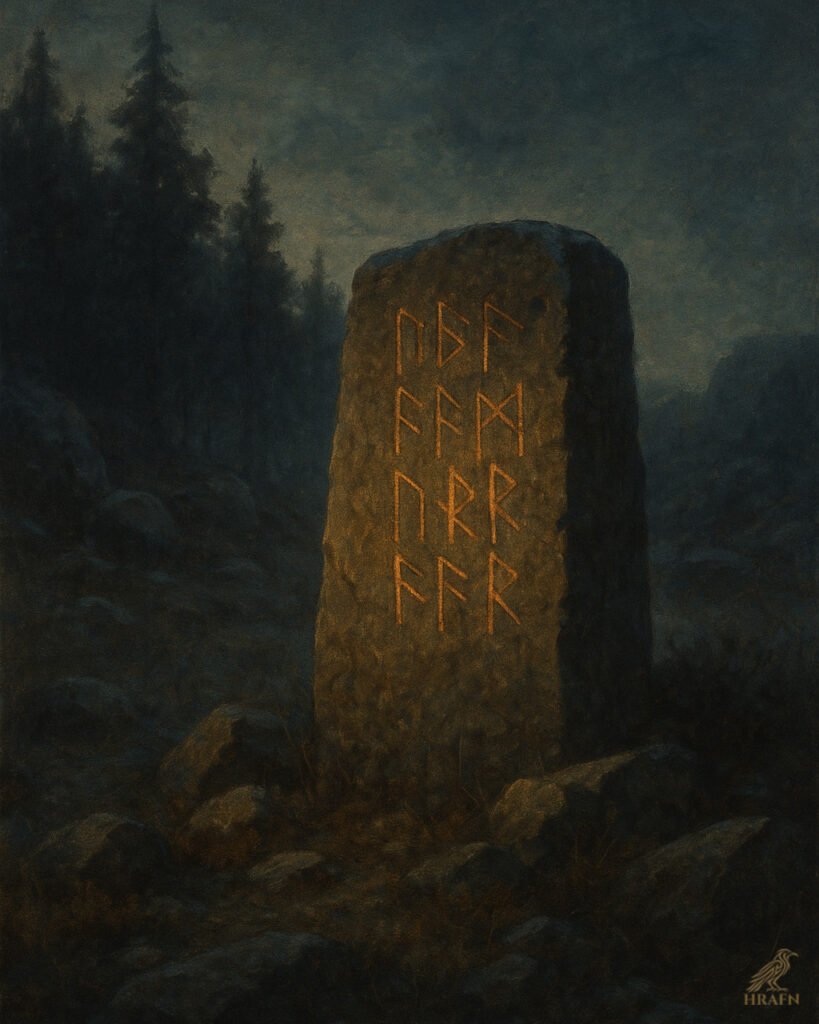
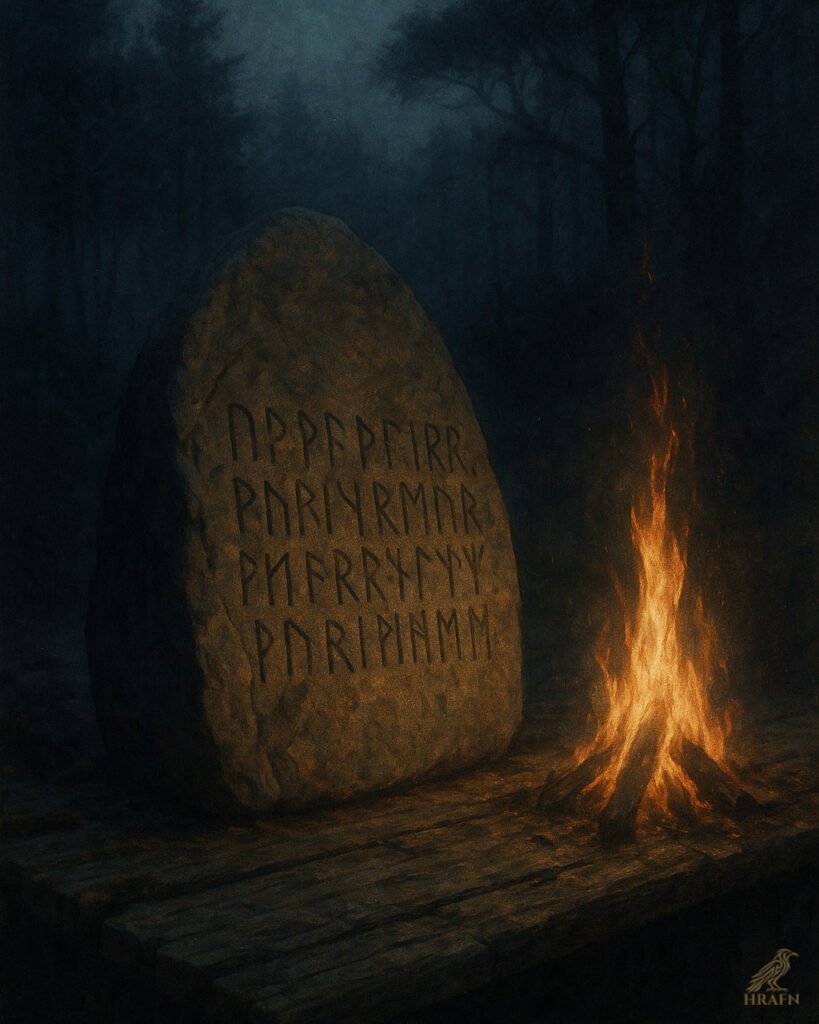
The Kylver Stone from Gotland bears the oldest complete rune row preserved in stone – yet whoever found it did not discover the 24 characters at first. They were carved on the underside of a flat limestone slab that sealed a grave around 400 AD, and were not legible from above. A practice or teaching purpose is presumed; today the stone carries the designation Rundata G 88.
From this find to the notion of “the three rune rows” is a long way – and a misleading one. The threefold division into Elder Futhark, Younger Futhark, and Anglo-Saxon Futhorc is a modern textbook classification, not a self-designation found in the sources. From the Younger Futhark the medieval runes and the Dalecarlian runes later developed. An honest count arrives at at least five rows, not three.
A Name from Six Runes
“Futhark” is an acrophonic name: it derives from the initial characters of the row itself, just as our word “alphabet” derives from alpha and beta. The first six runes are F-U-Þ-A-R-K – reconstructed in Proto-Germanic as Fehu, Uruz, Thurisaz, Ansuz, Raidō, Kaunan. The row is thus named after itself.
The variant names are themselves a piece of language history. In Anglo-Saxon, the sound value of the older A-rune Ansuz shifted to Ōs, and Futhark became Futhorc. The k of Kaunan likewise shifted to c; the Anglo-Saxon form is called cēn, from which the common modern esoteric spelling “Kenaz” arose.
In technical usage, three forms are distinguished: Futhark for the older row, Futhorc for the Anglo-Frisian one, Futhork for the younger, or medieval, one.
Within the Elder Futhark, the 24 characters are often grouped into three groups of eight. The Old Norse term for this is ætt, “kin, group.” Each group is named after its first rune: Fjár ætt, Hagals ætt, Týs ætt. For the first group, the term Freys ætt is also common in the literature.
The Elder Futhark: The First Witnesses
The corpus of the Elder Futhark comprises roughly 350 inscriptions – about 260 of them from Scandinavia, roughly 80 from the continental Germanic region. 133 of these inscriptions alone appear on gold bracteates: a good third of the oldest runic corpus, then, is found not on stones but on pendants.
Three testimonies carry particular weight, because they show the complete row.
The Kylver Stone. As the oldest known witness, it lists all 24 runes of the Elder Futhark, hidden on the underside of a grave slab, around 400 AD.
The Vadstena Bracteate. It likewise bears the complete row, divided by dots into three groups of eight, and is dated to roughly 500 to 550 AD. The threefold division into ættir is thus documented in metal already before the Viking Age.
The piece itself, however, no longer exists: it was stolen from the Statens historiska museum in Stockholm in 1938 and has never resurfaced. All present-day statements rely on images and casts.
The Grumpan Bracteate. The piece (Vg 207, 6th century) confirms the threefold division. A fourth early witness is the Charnay Fibula.
The sequences of these early lists largely agree – with the exception of possible transpositions of p and ï, and of d and o. This is a concrete contradiction among the primary witnesses that cannot be smoothed over.
The oldest dated rune stone of all is provided by the sandstone fragments from the Svingerud burial ground near Hole in Norway. Radiocarbon dates place the context between 50 BC and 275 AD; the fragments apparently belonged to a single, repeatedly inscribed stone and bear, among other things, the first three characters of the row, f, u, th.
The history of this find’s publication has two stages: Kristel Zilmer of the Museum of Cultural History in Oslo presented the initial analysis of the first recovered fragment in 2023; that the fragments added in 2022 belong to the same stone was published on February 3, 2025, in the journal Antiquity, by Zilmer and the archaeologist Steinar Solheim.
Smaller but early-dated individual finds are provided by a bone comb from Vimose in Denmark, archaeologically dated to around 160 AD, and an iron knife from Funen dating to around 150 AD.
The Reduction to Sixteen Characters
From the 9th century onward, after a transitional phase in the 7th and 8th centuries, a reduced row of only 16 characters displaces the Elder Futhark. The timing is bounded by a firm marker: the skull inscription from Ribe, dendrochronologically dated to 725 AD, provides an upper time limit for the emergence of the Younger Futhark.
Paradoxically, the reduction coincides with a sound change that increased the number of spoken sounds. The writing system thus became poorer while the language became richer. Different sounds now had to be written with the same characters.
Several regional variants emerged. Long-branch runes were in use in Denmark. Short-twig, or Rök, runes spread in Sweden and Norway. Staveless runes, also called Hälsinge runes, formed a third, strongly simplified form.
Toward the end of the 10th century, the loss of meaning was compensated for by dotting individual runes. Despite its reduced number of characters, the Younger Futhark forms by far the largest surviving corpus of inscriptions – the figure cited is just under 6,000 surviving rune inscriptions, or, by another count, roughly 6,500 rune monuments, most of them in Sweden. The numbers vary depending on how they are counted.
The Anglo-Saxon Futhorc
From around the 5th century onward, runic writing is attested in Britain and Frisia. Around 800 it disappears in Frisia; in Britain it continues and is expanded in the 9th century into a row with up to 33 character types.
The early Futhorc was nearly identical to the Elder Futhark, apart from one split: the single A-rune became three – āc, æsc, and ōs – bringing the row to 26 characters. The oldest known ōs-rune is found on the Undley Bracteate from the 5th century.
A uniform character set never existed. The Thames scramasax, known as the Seax of Beagnoth, from the 10th century, bears 28 characters, the entire row on the blade, followed by the name Beagnoth. The Vienna Codex likewise shows 28. The Ruthwell Cross inscription comes to 31 characters. Cotton Domitian A.ix, an 11th-century manuscript, finally lists 33.
The Futhorc apparently developed slowly and unevenly, so that the character set differs from find to find.
Compared with the Younger Futhark, the source situation is thin: from at least five centuries of use, roughly 100 objects with Anglo-Frisian runic inscriptions survive – against just under 6,000 in the North.
The Rune Poems – Source of the Names
What individual runes are supposed to mean is not stated on the stones themselves but in later rune poems. Their transmission is itself a lesson in source criticism – each of the three poems has its own catastrophe.
The Old English Rune Poem. The manuscript Cotton Otho B.x burned in 1731 in the fire of the Cotton Library. All present-day editions therefore rely on the facsimile that George Hickes produced in 1705. The poem itself probably originated in the 8th or 9th century and was transmitted in a 10th-century manuscript on folios 165a–165b; another source dates its composition to the 7th century, a third generally to the 8th through 10th centuries – this cannot be decided.
Important for the criticism: Hickes printed the text as prose, subsequently divided it into 29 stanzas, and set the runes as a copper engraving in the margin. The poem thus deals with 29 runes. Four characters of the extended row – cweorð, calc, stan, and gar – do not appear in it at all; they are known only from manuscript rune rows, which is why their sound value and use remain uncertain.
The Icelandic Rune Poem. It is transmitted in the manuscript AM 687d 4to from the 15th century, as well as in later copies.
The Norwegian Rune Poem. It is known only from 17th-century copies that go back to a lost original; this original is usually dated to the 13th century.
The Icelandic and Norwegian poems deal with the 16 runes of the Younger Futhark, while the Old English one deals with 29.
The Abecedarium Nordmannicum. It summarizes the 16 younger runes in a short poem, transmitted in the Codex Sangallensis 878 from the 9th century, page 321, placed there directly after the Hebrew alphabet and next to the Anglo-Saxon Futhorc. The original text was destroyed in the 19th century by preservation chemicals and survives only in a drawing that Wilhelm Grimm made in 1828.
Three of the most important witnesses in this chapter thus survive only as reproductions: Cotton Otho B.x as the 1705 facsimile, the Abecedarium as Grimm’s 1828 drawing – and the Vadstena Bracteate as a cast.
Odin and the Origin of the Runes
The mythological tradition does not explain the rune rows, but the origin of the runes as such. The two should not be confused.
In the Hávamál, the section Rúnatal recounts how Odin obtains the runes. The stanza numbering varies: 138 to 145 is common, other editions count 139 to 146. The discrepancy goes back to an editorial decision – the stanza that Bellows counts as 138 actually belongs at the end of the poem and was placed before the Rúnatal following Karl Müllenhoff. The Ljóðatal follows, with its eighteen spells.
Against a common confusion: the popular shorthand “Odin hangs on Yggdrasil” is a contextual summary. At this point the Hávamál speaks of the “windy tree” and does not explicitly name Yggdrasil. The poem is essentially transmitted in only a single manuscript, the 13th-century Codex Regius.
A second Eddic passage, Sigrdrífumál 6, mentions “victory runes” that one should carve onto the sword, partly onto the hilt, invoking the name of the god Týr twice in the process.
In the sources examined, however, Snorri Sturluson does not appear as the source of a rune row or name list of his own. Such a claim is not adequately substantiated.
Origin and Open Questions in Research
Where Do the Characters Themselves Come From?
Research generally assumes that the runic characters originate from Old Italic scripts, specifically from North Etruscan-Rhaetic alphabets or from the Latin alphabet itself.
The derivation from the Greek alphabet, which today one mainly encounters on popular websites, was once a serious scholarly position – Otto von Friesen advocated it with authority in the early 20th century. It is now regarded as abandoned, not as never having been taken seriously.
Why Eight Characters Disappeared
There are different explanations for the reduction from 24 to 16 characters: practical reasons, since a shorter row was faster to learn and to carve, or religious motives. Why exactly eight characters fell away while the language simultaneously grew more complex phonologically continues to be regarded as unresolved.
Michael Schulte describes the difference between the systems as follows: the Anglo-Frisian Futhorc aims at as precise a one-to-one representation of the sound system as possible, while the Nordic Futhark, from around 500/550 AD onward, tends to follow an etymological notation principle with multiple assignments for individual characters.
A historical error in scholarship is also documented: earlier runologists assumed that the Younger Futhark must have preceded the Elder, because they could not explain why anyone would remove characters from an existing script.
Later Rows and Their Return
From the Younger Futhark, following the introduction of dotted runes at the end of the Viking Age, the medieval runes developed, also called Futhork.
These runes were alive in everyday use. The roughly 670 Bryggen inscriptions from Bergen – letters, notes, sayings on wooden sticks, into the 14th century – attest to an ordinary writing tool that ran alongside the Latin alphabet for centuries.
Something different is the Codex Runicus from around 1300, a 202-page parchment manuscript that renders the oldest surviving Nordic provincial law – the Scanian Law – entirely in runes. Writing an entire law book on parchment in runes, at a time when Latin script had long been in use, is not everyday practice but a deliberate choice.
Accordingly, the majority of scholarship sees in it not a natural continuation of Viking Age book culture, but a nostalgic, antiquarian use of runes. The two findings do not contradict each other: everyday runic writing continued, while runic book production was a revival. The revival of the runes thus already begins in the Middle Ages, not only in modern times.
A much later, purely modern construction is the so-called Armanen Futhark of the esotericist Guido von List (1848–1919). His 18-part row loosely follows the Younger Futhark; List himself claimed it originated in primeval times and had come to him in visions. Through his Ariosophy, the row found its way into the völkisch movement.
The number 18 is no coincidence here: it is modeled on the eighteen spells of the Ljóðatal in the Hávamál. The Armanen Futhark is not historically attested; from a runological perspective, it is a modern construction that reinterprets a mythological number as a supposedly ancient writing system.
Sources
Corpus figures. Elder Futhark: roughly 350 inscriptions, of which about 260 are Scandinavian and roughly 80 continental Germanic; 133 of these on gold bracteates. Anglo-Frisian Futhorc: roughly 100 objects. Younger Futhark: just under 6,000 inscriptions, or, by another count, roughly 6,500 monuments.
Rune stones and metal finds. Oldest complete row: Kylver Stone, Rundata G 88, Gotland, around 400 AD. Threefold division in metal: Vadstena Bracteate, around 500–550 AD (stolen in 1938, transmitted only as an image and a cast), and Grumpan Bracteate, Vg 207, 6th century; also the Charnay Fibula. Oldest dated context: Svingerud fragments, Hole, Norway, radiocarbon dating 50 BC to 275 AD; initial analysis by Kristel Zilmer, 2023, proof that the fragments belong together by Zilmer and Steinar Solheim, Antiquity, February 3, 2025. Early individual finds: bone comb from Vimose, around 160 AD, iron knife from Funen, around 150 AD. Upper limit for the Younger Futhark: skull inscription from Ribe, dendrochronologically dated 725 AD. Futhorc evidence: Undley Bracteate, 5th century; Thames scramasax (Seax of Beagnoth), 10th century; Ruthwell Cross inscription; Cotton Domitian A.ix, 11th century.
Rune poems. Old English Rune Poem: lost in the fire of Cotton Otho B.x, 1731; transmitted only through George Hickes’s facsimile, 1705, originally on fol. 165a–165b of a 10th-century manuscript; 29 stanzas, without cweorð, calc, stan, and gar. Icelandic Rune Poem: AM 687d 4to, 15th century. Norwegian Rune Poem: 17th-century copies of a lost original, usually dated to the 13th century. Abecedarium Nordmannicum: Codex Sangallensis 878, 9th century, p. 321, original destroyed, transmitted in a drawing by Wilhelm Grimm from 1828.
Poetic Edda. Origin of the runes: Hávamál, Rúnatal, stanzas 138–145 by the common count, 139–146 by an alternative count, transmitted in the Codex Regius, 13th century. Eighteen spells: Ljóðatal. Victory runes: Sigrdrífumál 6.
Scholarly literature. On the phonological contrast between Futhorc and Futhark: Michael Schulte, “Älteres und jüngeres Fuþark – Phonologische Aspekte,” p. 427. On the abandoned Greek derivation: Otto von Friesen.
Modern reception. The Armanen Futhark of the esotericist Guido von List, 1848–1919, is not a historically transmitted rune row but a modern, ideologically charged construction, and is explicitly classified here as such, not as another historical rune row alongside the others.