Yggdrasil – The Tree That Bears the Worlds
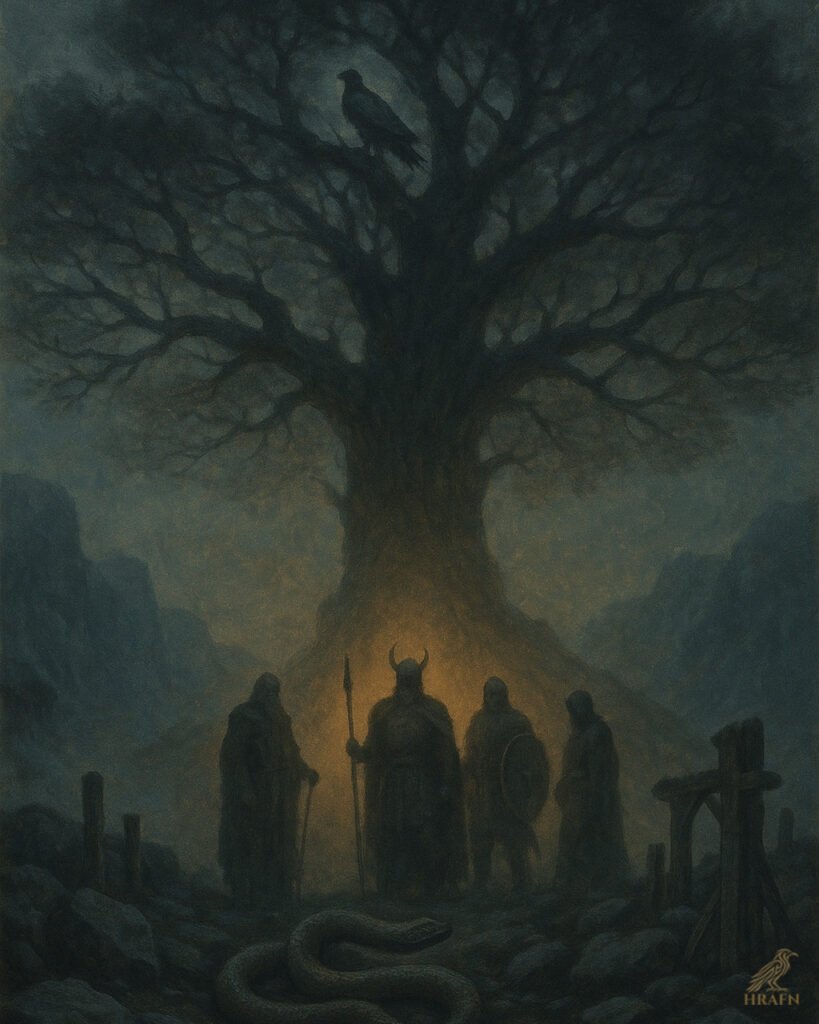
A tree so vast that gods sit in judgment beneath its branches, an eagle keeps watch in its crown, and a serpent gnaws at its roots – this is Yggdrasil.
Where the Name Comes From
Yggdrasil first appears in the Poetic Edda, that collection of Old Norse poems compiled in the 13th century from much older oral tradition – in the poems Völuspá, Hávamál, and Grímnismál. Snorri Sturluson also takes up the tree in his Prose Edda. The name itself poses a riddle. Ygg means “the terrible one” – a byname of Odin. Drasill means “steed.” In skaldic diction, a gallows was called the “horse of the hanged.” Perhaps this image wandered from the gallows to the tree, with which Odin’s self-sacrifice was later associated – “Odin’s horse,” then. This is not certain. The scholar Detter instead reads “tree of terror” or simply “gallows,” while Schröder thinks of a “yew pillar.” Even whether the name refers to the tree itself or merely to the place where it grows remains disputed.
Roots, Wells, and Animals
The Völuspá describes an evergreen ash rising above the well of Urd. Grímnismál expands the image: three roots reach toward Midgard, toward the giants, and into the underworld of Hel. While Völuspá knows only one well, Snorri later speaks of three. A whole ecosystem of fate rages around the tree. An eagle perches in the crown, the hawk Vedrfölnir sits between its eyes. Four stags graze on the branches. The squirrel Ratatoskr darts up and down, carrying insults back and forth between the eagle and Nidhöggr, who gnaws below at a root. Daily the gods ride to the tree to hold thing there – their assembly, where they pronounce judgment. When Ragnarök breaks in at the end of all days, Yggdrasil trembles and groans, so the Völuspá reports – yet no text says that it falls.
Odin’s Nine Nights
In the Hávamál, “The Sayings of the High One,” Odin himself tells of his self-sacrifice: for nine nights he hangs, pierced by a spear, on the tree – giving no one bread, no one drink. He sacrifices himself to obtain the runes, those magical signs that grant knowledge and power. Interestingly, the tree is not named in this poem. Only later readers connected this scene with Yggdrasil – an obvious but not textually certain link.
The Tree of Uppsala
The Bremen chronicler Adam of Bremen describes, in the 1070s, an immense evergreen tree of unknown species standing beside a spring at Uppsala. Some scholars saw in this a real image of Yggdrasil, a cult tree at which the Swedes worshipped their gods. But caution is warranted: the myth scholar Rudolf Simek points out that Adam’s sources vary greatly in their reliability. Archaeologically, no trace of such a tree has been found at Uppsala to this day. The equation with Yggdrasil remains a hypothesis – appealing, but unproven.
Sources
The foundation for everything we know about Yggdrasil consists of the poems of the Edda and Snorri’s prose work – texts that Christian scribes recorded in medieval Iceland from oral tradition. They contradict each other in details: sometimes one well, sometimes three; the tree’s role in Odin’s self-sacrifice remains unspoken. The often-cited notion of nine worlds neatly distributed among the branches and roots appears in no single surviving Old Norse text – it is a modern compilation drawn from various, not always compatible, sources. Adam of Bremen provides a historical account of a real cult tree, but its connection to Yggdrasil is conjecture, not established fact. Whoever speaks today of Yggdrasil as a “web of life” or a symbol of mindfulness moves far from the medieval sources – in the realm of modern interpretation, not transmitted belief.