Ragnarök – The Fate of the Gods
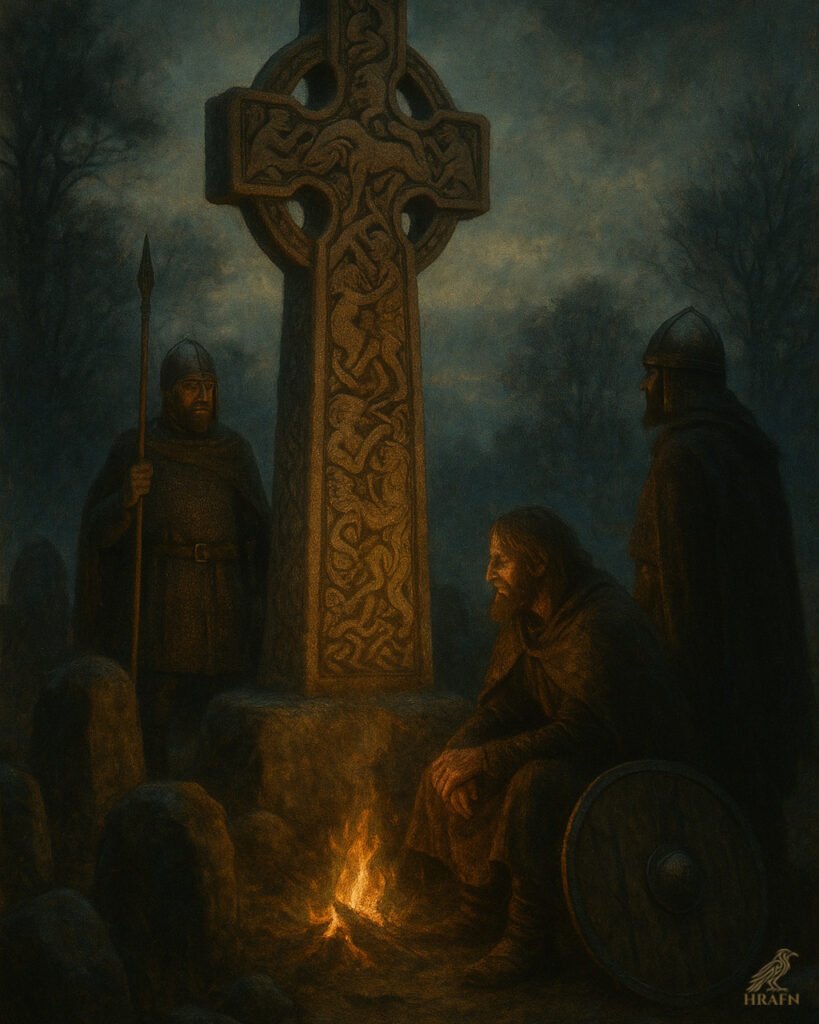
In Cumbria, in the northwest of England, stands a stone cross, four and a half meters tall. It bears the name Gosforth Cross and was created in the first half of the 10th century. Whoever traces the reliefs with their eyes sees a man with a horn, a serpent, a wolf, a bound figure. Scholars read into this Heimdall, Jörmungandr, Fenrir, and the bound Loki – scenes from the destruction of the gods, called Ragnarök. Only one thing is certain: someone carved these images into stone long before any surviving manuscript describes them.
A Name for the End
The word Ragnarök is composed of two Old Norse parts. Ragna is the genitive plural of regin – meaning “powers” or “gods.” Rök means fate or end. Together this yields “fate of the gods.” Some texts instead use Ragnarøkkr – “twilight of the gods.” Some scholars consider this form a later misreading, not an independent old word. The difference is small, the effect great: a sober “end” becomes a poetic “twilight.”
The Path to Battle
The tradition describes the beginning of the destruction as cold. Three winters follow with no summer in between – the Fimbulvetr. Kinsmen turn against one another, a war among brothers breaks out. The wolf Fenrir tears himself free, bound for years. The ship of the dead, Naglfar, breaks loose from the shore. The fire giant Surt advances with a burning sword. All paths lead to a field named Vígríðr. There the order of the gods meets the chaos it could never fully tame.
Odin, Thor, and the Last Battle
On Vígríðr, Odin, leader of the gods, falls. Fenrir devours him. His son Víðarr avenges him at once – with a single shoe, so the tradition tells it, he steps on the wolf’s jaw and tears it open. Thor faces the serpent Jörmungandr, his old adversary. He slays it, then takes nine more steps – and there his path, too, ends. The world the gods once ordered burns.
What Remains After the End
After the fire, the earth rises anew from the sea, green and untouched. The surviving gods find golden game pieces again in the grass – an image from better days. Two humans have hidden themselves: Líf and Lífthrasir, sheltered in the forest of Hoddmímis holt. They survive by drinking morning dew and will populate the new world. Baldr and his brother Höðr also return. Snorri’s Prose Edda depicts this new beginning noticeably warmer and more elaborately than the older Völuspá. Scholars have long asked whether Christian notions of redemption have found their way in here – there is no certain answer.
The Dust-Veil Year 536
Around 536 and again around 540, a dust-veil event darkened the atmosphere over large parts of the Northern Hemisphere. The consequences were crop failures and cold, over several years. In Uppland, Sweden, a decline in documented settlement sites of roughly 75 percent can be demonstrated for the 6th century. Two scholarly works, Gräslund (2007) and Gräslund and Price (2012), see in this event a possible inspiration for the Fimbulvetr and thus for Ragnarök itself. The scholarly community remains cautious: a single catastrophe rarely explains an entire myth, and monocausal interpretations are considered controversial.
Sources
The core of the tradition comes from the Völuspá, probably composed toward the end of the 10th century, and from Snorri’s Prose Edda, written around 1220 in Christian Iceland. Snorri largely follows the Völuspá but adds details and shapes the new beginning more independently. Other Eddic poems such as Vafþrúðnismál, Lokasenna, and Hyndluljóð provide individual names and motifs; the survivors Líf and Lífthrasir are named in the Vafþrúðnismál. The Gosforth Cross and Thorwald’s Cross on the Isle of Man show pictorial scenes that many scholars connect with Ragnarök – yet every such attribution remains interpretation, not proof. No source names a fixed date for the destruction, nor is there a uniform “Viking belief.” The connection to the climate event of 536 is a plausible but unproven hypothesis. Richard Wagner’s “Götterdämmerung” as well as modern adaptations in comics, video games, and series belong to the history of reception, not to the source record itself.