Níðhǫggr: The Curse-Striker Beneath the World Tree
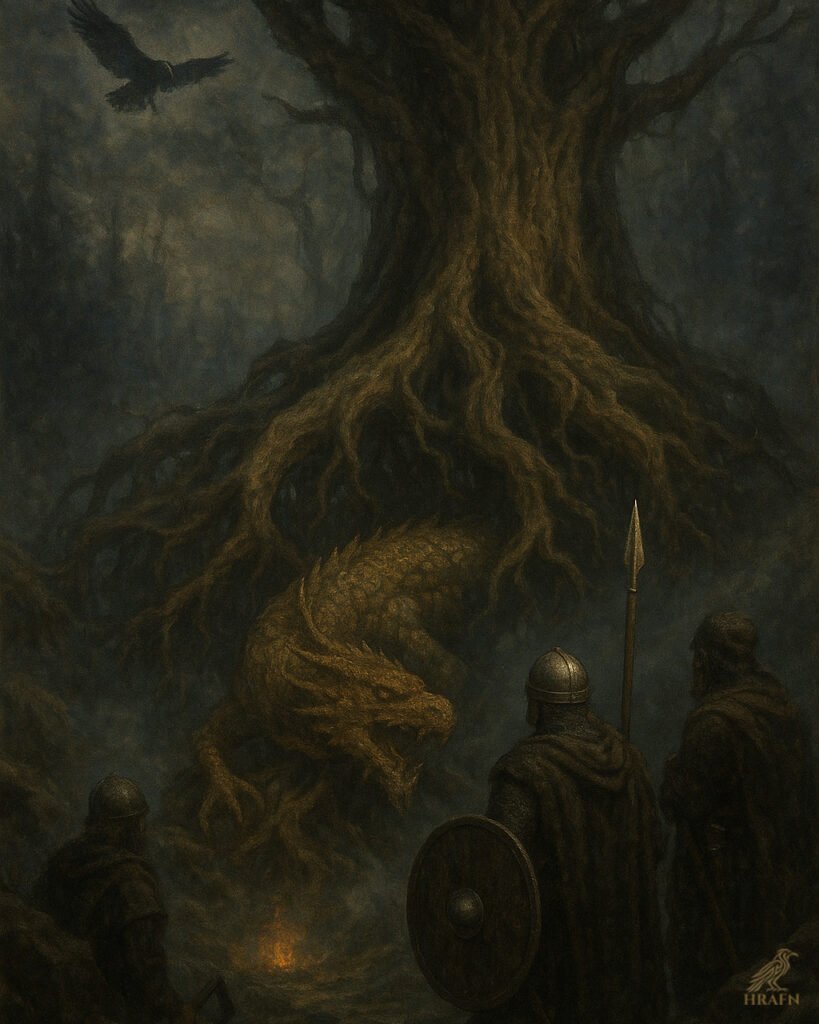
Its name sounds like a verdict. Níðhǫggr is composed of two Old Norse words: níð, meaning shame, malice, and loss of honor, and hǫggr, a word for one who hews or strikes. Together this yields something like “the hate-filled striker” or “curse-striker.” Some scholars read the first part differently, as niðr, “down below” – in which case the name would mean “biter from below.” Which reading is correct cannot be settled with certainty to this day, since the length of the first vowel is not clearly fixed in the surviving manuscripts. Only one thing is certain: whoever was branded with níð in the Viking Age lost their honor before the entire community. A being carrying this word in its name thus bears a stigma from the very start.
The Gnawer at the World Tree’s Root
In the Grímnismál, a poem of the Poetic Edda, Níðhǫggr appears for the first time. There, the world tree Yggdrasil suffers greatly from its inhabitants. From below, the dragon gnaws and tears at its roots. Above, in the crown, sits an eagle. Between the two, the squirrel Ratatoskr runs back and forth, carrying messages and insults from one to the other. The tree thus stands between two enemies who never meet yet fight one another through their messenger. The poem reveals nothing more about the dragon’s role – no battle scene, no description of its form. Only the gnawing itself is recorded.
A Nest Full of Serpents
Snorri Sturluson takes up the brief scene from the Grímnismál in his Prose Edda and expands it. In the Gylfaginning, Níðhǫggr dwells at the spring Hvergelmir in Niflheim, beneath the third root of Yggdrasil, sharing this place with numerous other serpents. In the Skáldskaparmál, the second major part of his work, its name appears again – this time in a list of serpent names alongside Fafnir, Jörmungandr, Góinn, and Móinn. The sources thus list it among the serpents; only the final stanza of the Völuspá calls it a dragon. Snorri’s knowledge of it demonstrably stems from exactly two old poems, the Grímnismál and the Völuspá. He adds little of his own invention, but rather arranges what the older texts already provide. Later, the name even appears in a list of sword names – a sign of how far the sound of the word had drifted from its original meaning.
The Hall on the Shore of Corpses
The most striking scene comes from the Völuspá, the great seeress-poem of the Poetic Edda. Far from the sun, at a place called Náströnd, the shore of corpses, stands a hall. Its walls are woven from serpents’ backs, poison drips down from above. Whoever committed perjury, murdered, or seduced another man’s wife must wade through this hall. There, amid the dead, Níðhǫggr sucks on the corpses. No other text of the Edda depicts the underworld of the dishonored as concretely as these few stanzas.
The Final Flight
The Völuspá ends with an image that still poses riddles today. After Ragnarök, the downfall of the old world of gods, a dark dragon flies up from the depths. In its feathers it carries corpses. No sooner is this line spoken than the seeress falls silent – the poem ends without naming the dragon again. The prevailing interpretation reads this final stanza as a last warning: even after the end of the gods, evil is not finally defeated. Other readings see in it an image of renewal, a kind of macabre phoenix rising from the ruin. Still others suspect the dragon carries the corpses of the righteous upward, to the new hall of Gimlé. None of these interpretations can be conclusively substantiated – the stanza remains open, and that openness is precisely its core.
Sources
Everything known about Níðhǫggr stems from a very narrow textual base: the poems Grímnismál and Völuspá of the Poetic Edda, and Snorri’s Prose Edda, specifically the chapters Gylfaginning and Skáldskaparmál. No other old source mentions the dragon – no saga, no chronicle, no rune stone names it. Snorri himself demonstrably draws from these two poems and adds no independent ancient knowledge, even though he embellishes and arranges the scenes with literary skill. Much of what circulates about the dragon in modern retellings – that it is Hel‘s pet, that it has a certain body size, or that it actively fights in the final battle of Ragnarök – finds no support in the medieval texts. These are later embellishments, not transmitted knowledge. Whoever writes about Níðhǫggr today moves within very few, but clearly identifiable, lines from two manuscript traditions of the 13th century.