Vanaheim: The Realm Known From a Single Stanza
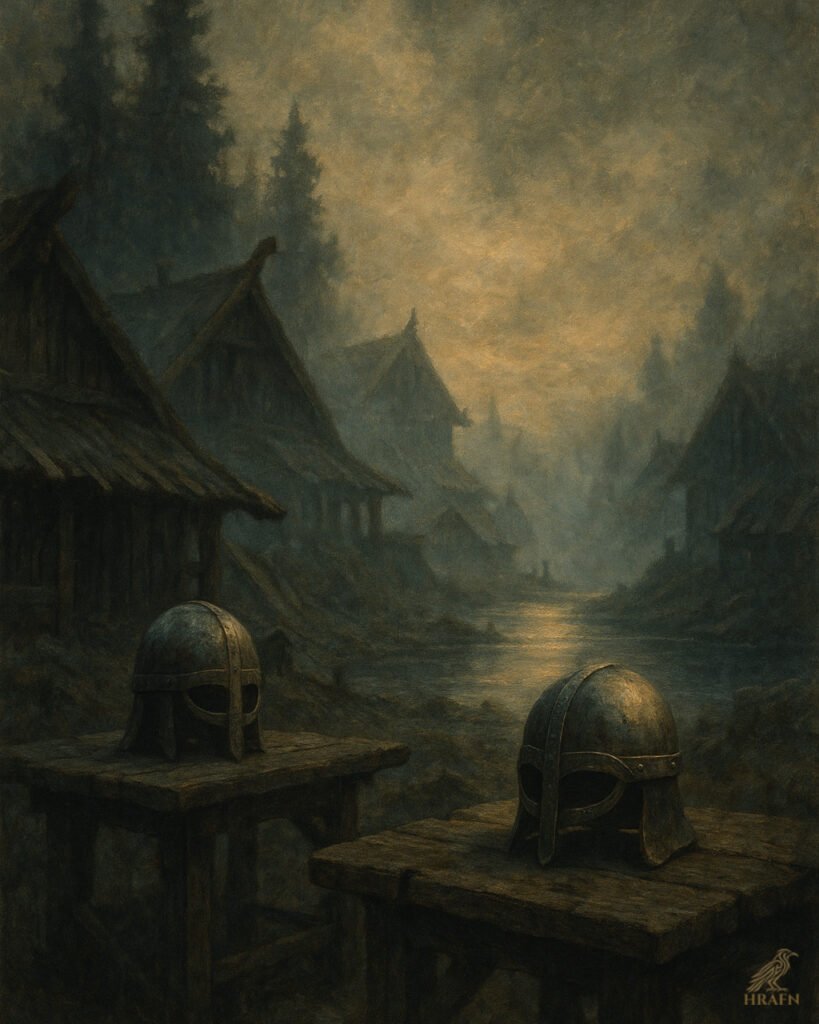
In the 13th-century manuscript Codex Regius stands a word that adds an entire world to Norse mythology – and that appears only once in the whole text: Vanaheimr. In a stanza of the Vafþrúðnismál, Odin, disguised as the wanderer Gagnráðr, asks the giant Vafþrúðnir about the origin of the god Njörðr. There is no more text about Vanaheim anywhere in the Poetic Edda.
One Stanza, One Name
Whoever searches for Vanaheim finds astonishingly little. The name Vanaheimr appears in the Poetic Edda only in that single stanza. The Prose Edda mentions it as well, and so does, in euhemerized form, Snorri Sturluson’s Heimskringla. That is all. No text describes mountains, rivers, or forests of this place. The famous list of the “nine worlds,” which today is printed in almost every book on Norse mythology alongside Vanaheim, Asgard, Midgard, and other realms, appears nowhere in this form in the Völuspá. The Völuspá speaks of nine worlds but does not enumerate them. The common list is a later reconstruction, not a medieval source.
Njörðr, Hostage of the War of the Gods
What we know about Vanaheim depends almost entirely on one figure: Njörðr, the god of the sea and of wealth. In the Vafþrúðnismál, Odin asks the giant where Njörðr actually comes from. The god rules over countless hofs and hörgrs, sacred cult sites, yet he was not raised among the Æsir. The giant’s answer: Njörðr was created in Vanaheimr and given to the Æsir as a hostage to end a war. At Ragnarök, the end of the world, he returns to the “wise Vanir.” Snorri tells the same story in the Gylfaginning: Njörðr grows up in Vanaheim and comes to the Æsir only later, as a hostage. In the sources, then, Vanaheim exists not as a landscape but as the place of origin of a single figure.
Snorri’s Counterpart to Asgard
The myth scholar Rudolf Simek draws a radical conclusion from this. He considers it “beyond doubt” that Snorri Sturluson invented the name Vanaheimr himself – as a linguistic counterpart to Asgard, the home of the Æsir. In 2010, in his essay “The Vanir: An Obituary,” Simek went even further: a distinct family of gods called the Vanir, separate from the Æsir, is largely a systematization by Snorri from the 13th century. What looks like an ancient, clearly structured divine world would then be, above all, the ordering work of a medieval scholar who pressed scattered oral traditions into a scheme.
Underworld or River by the Don?
Where exactly Vanaheim is supposed to lie remains disputed. The historian of religion Hilda Ellis Davidson points out that placing it among the nine worlds is difficult: of all figures, Freyr and Njörðr, the two best-known Vanir, appear in the myths right in the middle of Asgard. Davidson therefore considers a location in the underworld more probable than somewhere at the edge of the world. Snorri himself takes a different path in the Ynglinga saga. There he euhemerizes the myth, turning gods into historical humans, and relocates “Vanenheim” to the Don, specifically to a river branch called Vanakvísl. A mythical homeland thus becomes a piece of real geography in Eastern Europe – evidence of how freely Snorri handled his material.
Vanaheim on Screen and Controller
The lush, forested fantasy world that many today associate with Vanaheim does not come from the Middle Ages but from the 21st century. In “Thor: The Dark World” (2013), Vanaheim is a battlefield; in the video games “God of War” (2018) and “God of War Ragnarök,” it appears as a magical world full of forests and elven sorcery. This “nature-goddess paradise” of dense forest and wild magic is a modern invention of pop culture – entertaining, but without support in the medieval texts.
Sources
Vanaheim is among the most thinly attested places in the whole of Norse mythology. Its only mention in the Poetic Edda stands in a single stanza of the Vafþrúðnismál, preserved in the 13th-century Codex Regius, which itself compiles older, oral traditions. Snorri’s Prose Edda and Heimskringla provide additional, but later and heavily reworked literary versions. For the landscape, inhabitants, or exact location, there is no independent second source – everything beyond the simple formula “home of Njörðr and the Vanir” rests on interpretation, not on text. Modern scholarship remains correspondingly cautious: some scholars suspect that Vanaheim is primarily a literary construct of Snorri’s, others an older, only faintly discernible oral conception. What film and video games make of it belongs to an entirely different category: they tell of a world that the medieval sources never drew in this way.