An eye for a sip of water. Sounds like a terrible trade. Yet Odin, the Allfather, paid exactly this price – without hesitation.
He rules over Asgard, home of the gods. But power alone is not enough for him. Odin wants to know. He wants to understand what has been and what is to come. For this, he goes further than any other god.
Origins and Family
Odin does not spring from nothing. According to the Prose Edda, he is the son of Bor and the giantess Bestla. Together with his brothers Vili and Ve, he slays the primordial giant Ymir and shapes the world from his body – earth from flesh, seas from blood, sky from skull.
As ruler of Asgard, Odin stands at the head of a far-reaching family. With his wife Frigg he fathers Baldr, the most radiant of the gods. With the earth goddess Jord he becomes the father of Thor. Other sons such as Vidar and Vali await their role in the myths at Ragnarok. His faithful steed Sleipnir, however, is not his child – the eight-legged horse descends from Loki, who once mated with the stallion Svadilfari in the shape of a mare.
The Well and the Eye
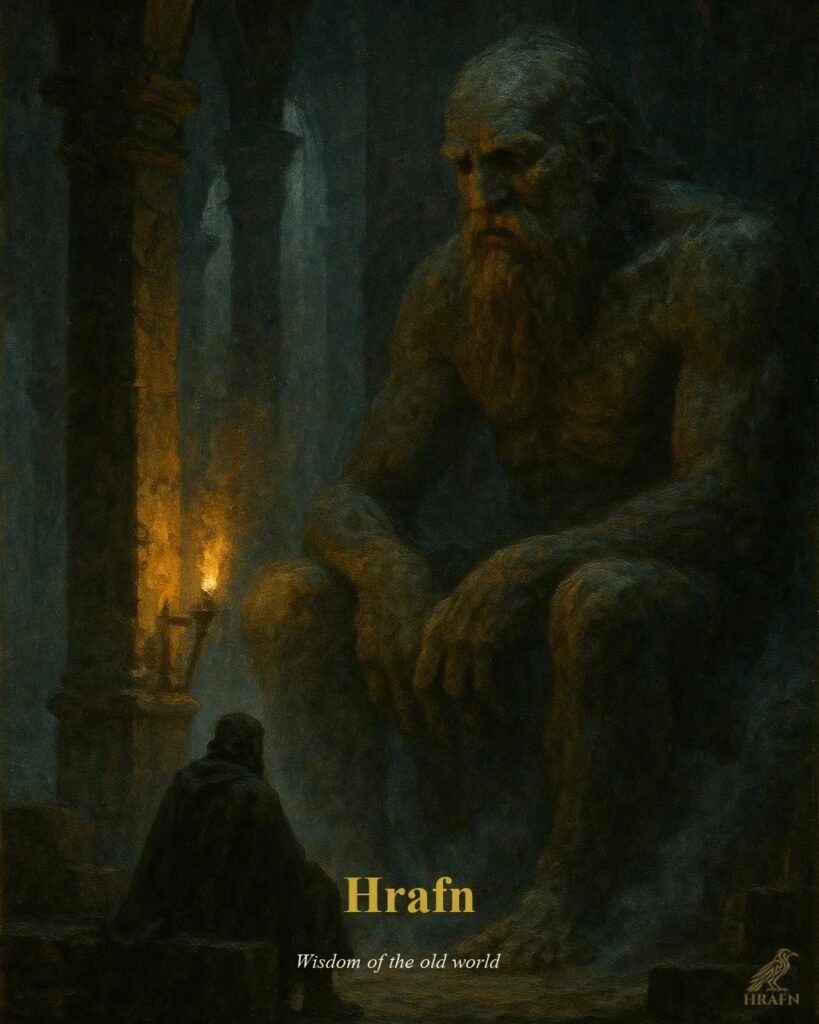
At the foot of the world tree Yggdrasil bubbles a special well. Whoever drinks from it gains wisdom. Its guardian demands a steep price. Odin doesn’t hesitate. He tears out one of his own eyes and casts it into the depths. Ever since, he looks upon the nine worlds with only one eye – and yet sees more than anyone else. Snorri tells this episode in the Gylfaginning; the Völuspá of the Poetic Edda alludes to the well as well.
Nine Nights on the Tree
Even that is not enough for Odin. He wants to understand the runes, the secret symbols of power. So he hangs himself from Yggdrasil. For nine nights. His own spear pierces his body. No food, no water, no help. Only pain and silence. On the ninth day, he grasps the runes – and with them, their power. The Hávamál (stanza 138) of the Poetic Edda describes this self-sacrifice from Odin’s own perspective – nine nights on the wind-battered tree, given to himself.
The Mead of Poetry
Knowledge alone is not enough for Odin – he wants to possess words as well. After the war between the Aesir and the Vanir, both tribes of gods spit into a vessel to seal their truce. From the saliva springs Kvasir, the wisest of all beings. Two dwarves lure him into a trap, kill him, and brew the Mead of Poetry from his blood: whoever drinks it becomes a poet.
The giant Suttung seizes the mead and hides it deep inside a mountain, guarded by his daughter Gunnlod. Odin travels there as a wanderer, seduces Gunnlod, and drains the vessel in three swallows. In eagle form he flees to Asgard and spits the mead out there – ever since, poetry has been his gift to gods and mortals alike. Snorri tells the story in full in the Skáldskaparmál; fragments already appear in the Hávamál.
Two Ravens, a Thousand Eyes
Odin doesn’t rely on his one eye alone. Every morning he sends out his ravens Huginn and Muninn. Their names mean Thought and Memory. They fly across all nine worlds, watching, listening, gathering. By evening they return and whisper to Odin everything they have discovered. So he sits upon his throne, knowing all the same what happens everywhere. In the Grímnismál, Odin confesses his greatest fear: not that Huginn might fail to return – but that Muninn, Memory, might be lost.
The Wanderer of Many Names
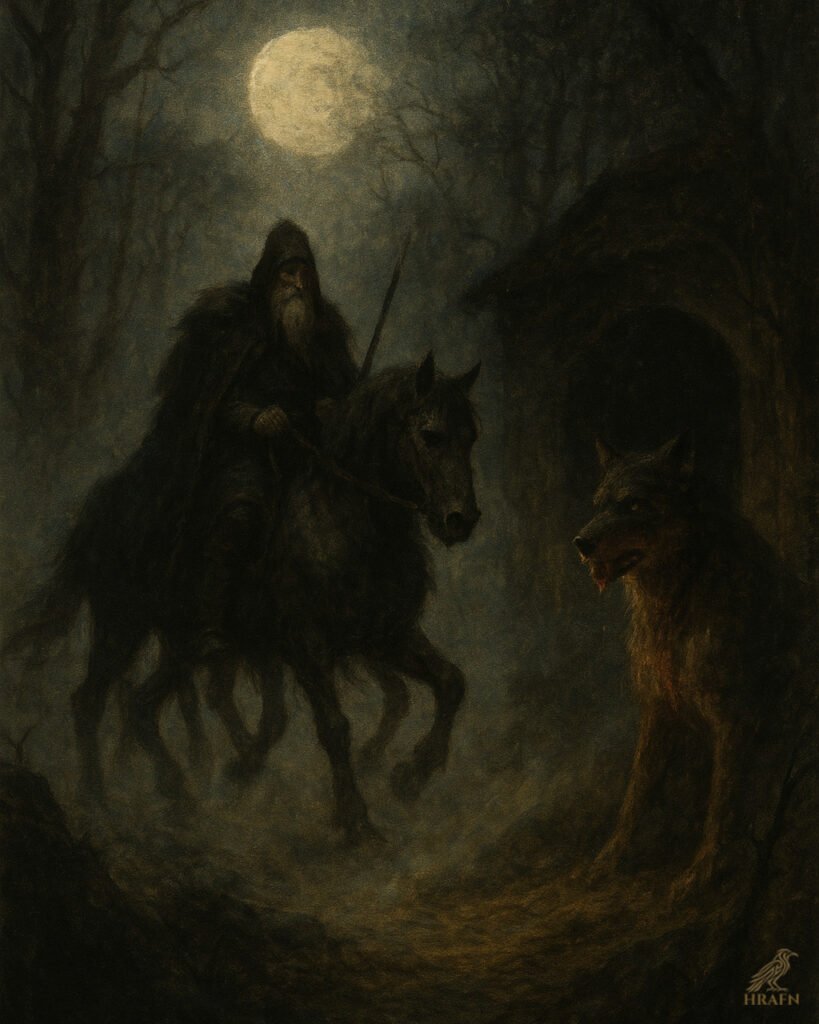
More than 170 bynames survive for Odin. Grímnir, “the Masked One.” Ygg, “the Terrible.” Hár, “the High One.” Each name a different role. Odin rarely appears as himself. Most often he travels in disguise as a grey wanderer, wide cloak, broad-brimmed hat, one eye hidden beneath the brim. He knocks on strange halls, poses riddles, tests kings and giants – and vanishes again before anyone recognizes him. This wandering figure has followed him far beyond the Viking Age: the name of Wednesday, in many Germanic languages, traces back to him – in English from Old English “Wōdnesdæg,” Woden’s day.
The God of the Fallen
War and death belong to Odin as much as wisdom does. In Valhalla, his hall in Asgard, he gathers the bravest of the fallen warriors: the Einherjar. Every day they fight one another, die, and rise again, feasting together each evening – an eternal training for the battle at Ragnarok, at Odin’s side.
Who is admitted among the Einherjar is not decided by the gods themselves, but by the Valkyries, Odin’s “choosers of the slain.” They ride across the battlefields and determine who comes to Valhalla. Odin doesn’t even get first choice: according to the Grímnismál, he shares the fallen with the goddess Freyja, who claims half of them each day for her own hall, Sessrúmnir, in the field of Fólkvangr.
The Battle Already Decided
All this knowledge cannot save him. Odin knows his own fate exactly – which makes his story so hard to bear. At Ragnarok, the battle at the end of the world, he will face the wolf Fenrir. The outcome has been fixed since the beginning of time.
Still, he keeps seeking. Still, he sacrifices his eye. Still, he hangs from the tree and listens to his ravens. Perhaps this is the greatest wisdom of all: knowledge doesn’t make the end easier. But it makes the journey there worthwhile.
In the game: how God of War and Assassin’s Creed Valhalla portray this figure — and where they depart from the sources — is covered in our mythology check and historical check.
Sources
This article draws mainly on two medieval collections: the Poetic Edda (including the poems Hávamál, Völuspá, and Grímnismál) and the Prose Edda of the Icelandic scholar Snorri Sturluson (13th century), especially its Gylfaginning and Skáldskaparmál sections. The self-sacrifice at the world tree and the Mead of Poetry go back to the Hávamál, the creation of the world and the story of Sleipnir to the Gylfaginning, and Odin’s many bynames as well as the division of the fallen between Odin and Freyja to the Grímnismál. This is supplemented by further Old Norse sagas as well as archaeological and runic evidence, for instance on the historical worship of Odin/Woden across Northern and Western Europe. Since this material was only written down centuries after Scandinavia’s Christianization, contradictions and later influences in the sources cannot be ruled out.