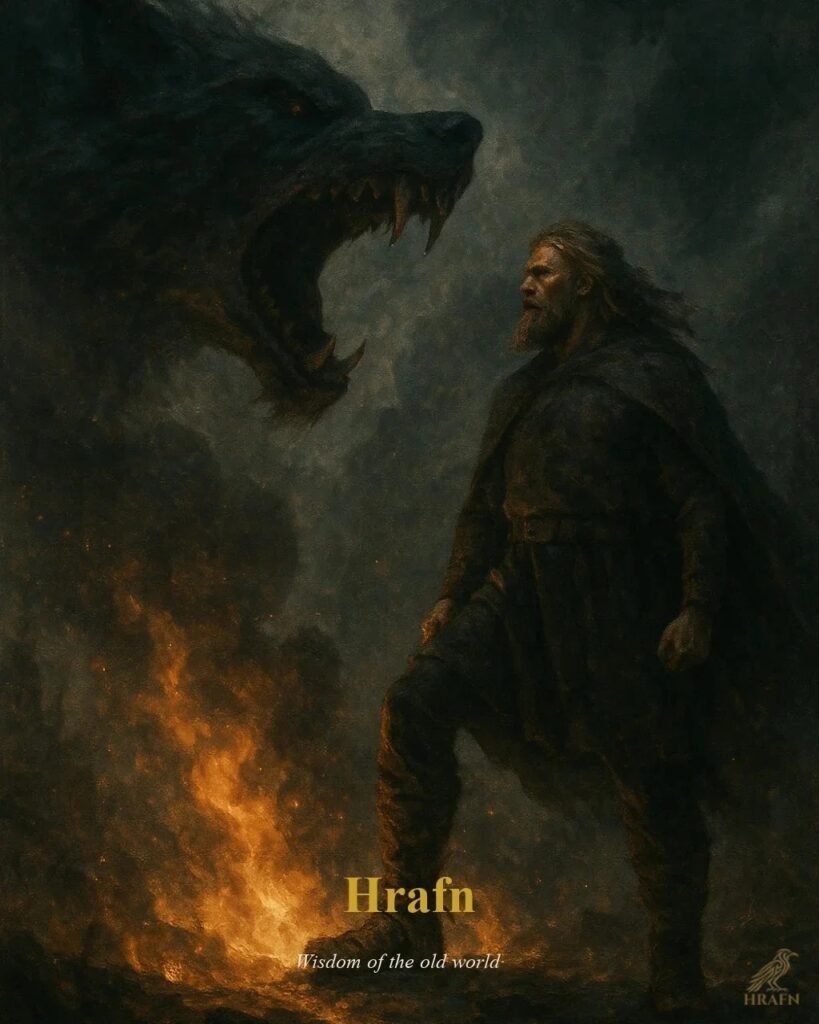
Picture a god no one can kill. No sword cuts him. No fire burns him. No poison touches him. Such was Baldr, the most beautiful and gracious of all the Aesir. His light chased every shadow out of Asgard. Everyone loved him.
But then came the dreams. Night after night, Baldr foresaw his own death. His mother Frigg refused to accept this. She traveled through all nine worlds and made every single thing swear an oath: stone, iron, fire, water, every animal, every plant – none of them would ever harm Baldr. Only one plant she overlooked. The mistletoe. It seemed too young, too small, too harmless to matter.
Family
Baldr was the son of Odin, the All-Father, and Frigg, the queen of the Aesir – making him one of the most nobly born of all the gods. His wife was Nanna, daughter of Nep, and together they had a son, Forseti, who would later become the god of justice and reconciliation. Baldr’s half-brothers included the blind god Hodr, who unknowingly became the instrument of his death, and Hermod, who would later ride to the underworld to try to bring him back. According to the Prose Edda, Baldr’s hall was called Breidablik, “the broadly gleaming,” a place so pure that nothing impure could enter it. (Source: Snorri Sturluson, Prose Edda, Gylfaginning)
The Seeress in the Underworld
When Baldr’s dreams grew darker, the gods gathered in council, troubled by what they might mean. According to the Eddic poem Baldrs draumar (“Baldr’s Dreams”), Odin himself grew so uneasy that he saddled his horse Sleipnir and rode down into Hel, the realm of the dead, to seek answers. There he found the grave of a long-dead völva, a seeress, and woke her with ancient spells. Reluctantly, she told him what was to come: Hodr would kill Baldr, and Baldr’s death would be avenged by Vali, a son Odin had not yet fathered, who would slay Hodr when he was but a single night old, without washing his hands or combing his hair until the deed was done. Only then, unsettled, did Odin ride back to Asgard – no closer to preventing the fate he had glimpsed. (Source: Poetic Edda, Baldrs draumar)
The Gap in the Oath
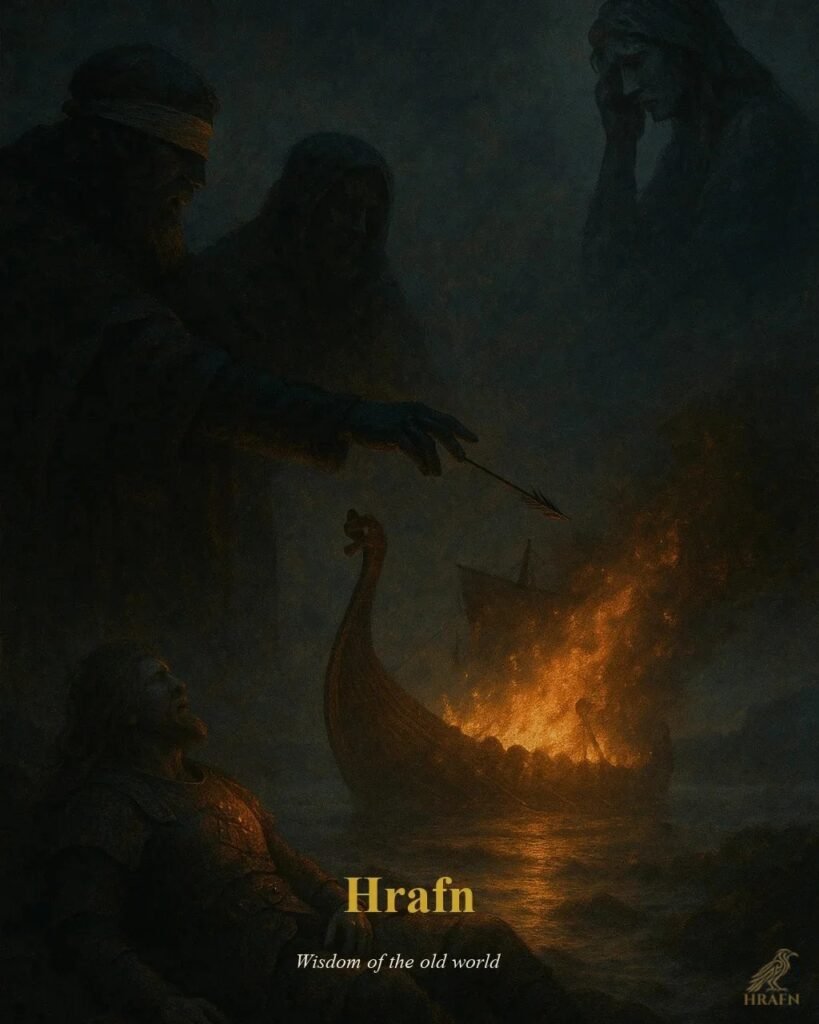
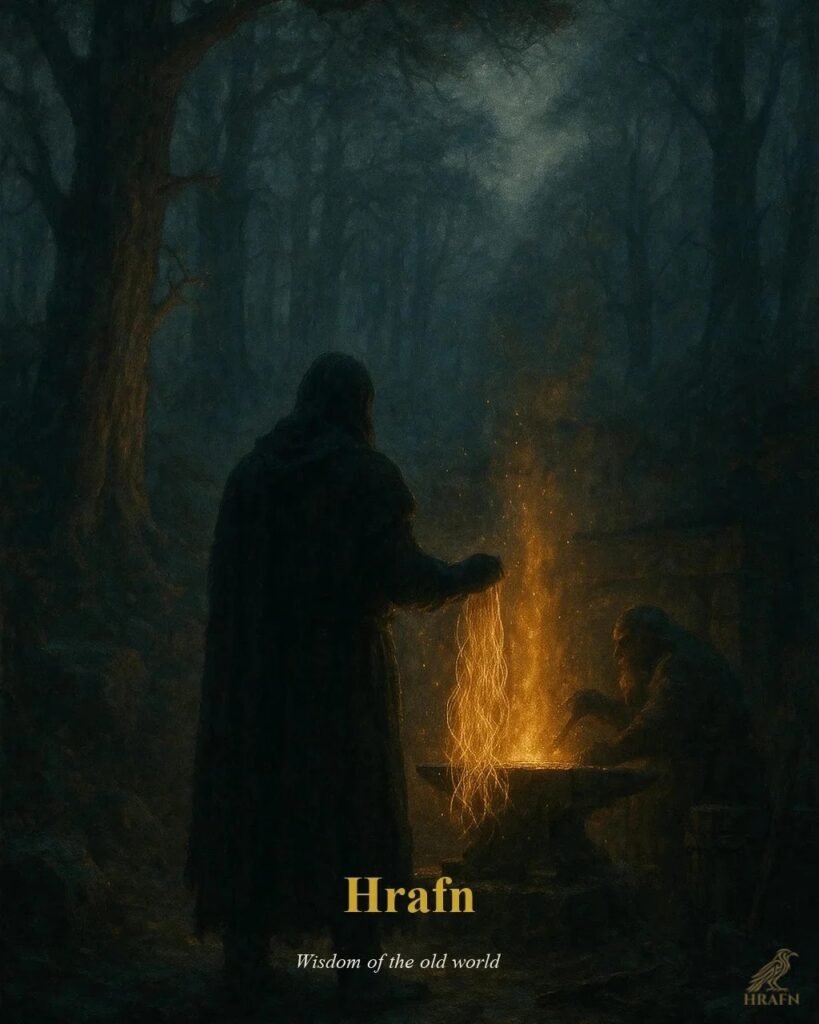
Loki found this gap. He searched for it deliberately. From the overlooked mistletoe, he carved an arrow, sharp and deadly. Then he went to Hodr, Baldr’s blind brother. The other gods were playing a game: throwing anything they could find at Baldr, laughing as it bounced harmlessly off him. Loki placed the mistletoe arrow in Hodr’s hand and guided his aim, telling him he too should join the game and honor his brother.
The arrow struck. Baldr fell. Asgard’s most radiant god was dead – killed by the one thing no one thought could ever be dangerous. (Source: Snorri Sturluson, Prose Edda, Gylfaginning)
Hermod’s Ride to Hel
After Baldr’s death, grief swept through Asgard. Frigg asked if anyone would ride to Hel and offer the goddess of the dead a ransom for Baldr’s return. Hermod, another of Odin’s sons, volunteered, and rode Sleipnir for nine nights through valleys dark and deep until he reached the river Gjöll and crossed the bridge into the underworld. There he found Baldr seated in a place of honor, and pleaded with Hel to release him. Hel agreed – but only on one condition: every single thing in the world, living or dead, had to weep for Baldr. If even one thing refused, he would remain with her. (Source: Snorri Sturluson, Prose Edda, Gylfaginning)
Messengers went out across the nine worlds, and everything wept: stones, trees, metals, animals, and gods alike. But in a cave sat a giantess named Thökk – Loki in disguise, many believe – who refused, declaring she felt nothing for Baldr and that Hel could keep what she had. And so Baldr remained in the underworld. Meanwhile, his body was laid upon his ship Hringhorni and burned on a funeral pyre so vast that the gods had to push the ship out to sea themselves; his wife Nanna, overcome with grief, died on the spot and was laid on the pyre beside him. As the flames rose, Odin is said to have leaned down and whispered something into his dead son’s ear – a secret that, in the old stories, no one else ever learned. (Source: Snorri Sturluson, Prose Edda, Gylfaginning)
A Death With Consequences
His fall shook every world. The gods mourned, but his death was more than just a loss. It was seen as a harbinger of Ragnarok, the downfall of the gods themselves. With Baldr’s death, the light began to fade.
But the old stories don’t end in darkness. After the great world-fire, it is said, a new, green world will rise. And Baldr will return.
Perhaps this is exactly the lesson of this story: even the strongest protection has a gap. And even after the greatest loss, new light can emerge.
In the game: how God of War portrays this figure — and where it departs from the sources — is covered in our mythology check.
Sources
The account of Baldr’s dreams and Odin’s ride to the seeress in the underworld is drawn from the Eddic poem Baldrs draumar (“Baldr’s Dreams”), part of the Poetic Edda. The story of his death, the oath sworn by all things, Hermod’s ride to Hel, and the funeral on Hringhorni are recorded in Snorri Sturluson’s Prose Edda, in the section Gylfaginning (13th century). Since this material was only written down centuries after Scandinavia’s Christianization, contradictions and later influences in the sources cannot be ruled out.