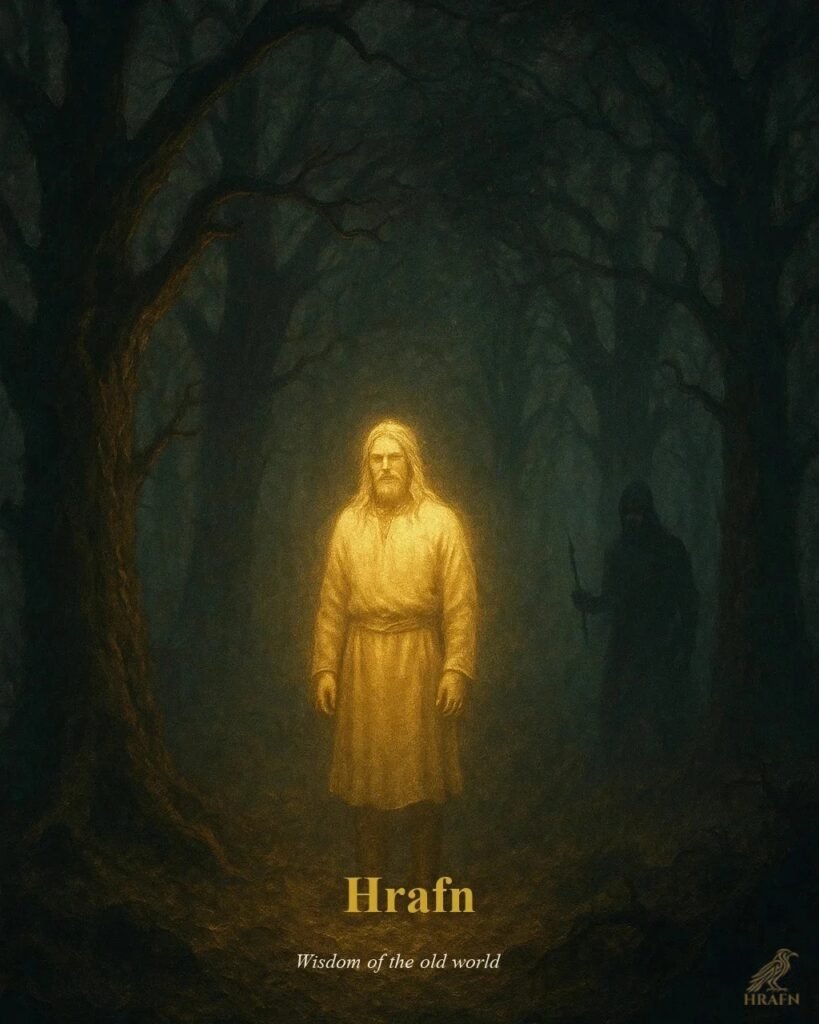
Picture a judge that no one ever leaves the courtroom feeling like a loser. Sounds impossible? In Asgard, there is exactly this judge. His name is Forseti.
Forseti is the son of Baldr and Nanna. He carries no sword, no weapon of vengeance. His weapon is the word. He is the god of justice and reconciliation – and that alone makes him unique among the Norse gods.
Family
Forseti is the son of Baldr and Nanna, making him a grandson of Odin and Frigg. In the surviving sources he is rarely drawn into events the way other gods are – he appears in no battle, he is not mocked in Lokasenna, he has no adventure tales of his own. This restraint suits his nature: a judge who stands above disputes must himself remain outside the dispute. (Source: Snorri Sturluson, Prose Edda, Gylfaginning)
Glitnir – A Hall of Gold and Silver
Forseti dwells in Glitnir. The hall’s pillars gleam with gold, its roof shimmers with silver. The Eddic poem Grímnismál already describes this hall: there, it says, Forseti sits for the longest time and settles every dispute brought before him. Whoever enters this place usually carries something heavy: a dispute, anger, an open wound between two parties.
But Forseti listens. He weighs the matter. He delivers a verdict. And the astonishing part: both sides go home reconciled. No grudge remains. No one leaves Glitnir with anger still burning in their chest. (Source: Poetic Edda, Grímnismál; Snorri Sturluson, Prose Edda, Gylfaginning)
Fosite of Heligoland – A Possible Historical Trace
Interestingly, Forseti is likely not a purely Norse figure. The Anglo-Saxon scholar Alcuin reports in the 8th century, in his “Vita Sancti Willibrordi,” on a Frisian god named Fosite, whose sacred island – probably today’s Heligoland – was called Fositesland. On this island, it is said, there was a holy spring from which water could only be drawn in complete silence; killing animals or working there was considered a sacrilege. The missionary Willibrord deliberately broke this taboo, baptizing three people in the spring and slaughtering cattle, in order to disprove the island’s sanctity. Many scholars regard this Fosite as the same god as the Norse Forseti – a hint that his worship once reached beyond what later became Scandinavia. (Source: Alcuin, Vita Sancti Willibrordi, 8th century)
Why This Is So Remarkable
Conflict is part of life – then as now. People quarrel, but the old Norse imagined a god who could do what people so often cannot: find a balance everyone can live with.
Forseti thus became a model for fair judges and just settlements among people. Even his name hints at this – he stands for the one who presides, who mediates, who creates order where chaos threatens.
A Thought for Today
We too sit constantly in small courtrooms of our own: at the kitchen table, in the office, within the family. Forseti reminds us that a good verdict does not conquer, it connects. Perhaps this is the oldest wisdom of the Vikings: true strength is not shown by defeating another – but by the peace found together.
Sources
The information on Forseti draws mainly on the Eddic poem Grímnismál and Snorri Sturluson’s Prose Edda (Gylfaginning, 13th century). The possible connection to the Frisian god Fosite is documented in Alcuin’s “Vita Sancti Willibrordi” from the 8th century. Since these accounts come from different periods and traditions, and the Edda texts were only written down centuries after Scandinavia’s Christianization, contradictions and later influences in the sources cannot be ruled out.