A wolf grows up that no one can tame. His jaws will one day devour Odin himself, so the prophecy says. The gods must act before it’s too late. But how do you bind a monster that tears apart every chain?
The answer is Gleipnir – a ribbon forged from impossible things: the breath of a fish, the beard of a woman, the roots of a mountain. Thin as a silk thread, stronger than any iron before it. But Fenrir is suspicious. The wolf senses the trap. He agrees to the game only on one condition: one of the gods must place a hand in his mouth as a sign of good faith.
The Aesir fall silent. No one steps forward. No one except Tyr.
Family
Tyr’s origins are inconsistent even within the sources themselves. Snorri Sturluson calls him a son of Odin in the Prose Edda, while the Eddic poem Hymiskvida instead describes him as the son of the giant Hymir – a contradiction that shows how differently the tradition was told in different places and times. Originally, linguists suspect, Tyr was an even older sky god, his name related to the Latin Jupiter and the Greek Zeus – a hint that he once held an even more important position before Odin displaced him as chief god. The sources are almost entirely silent about a wife of Tyr; only in Lokasenna is it mentioned in passing that she is said to have had a son with Loki. (Source: Snorri Sturluson, Prose Edda, Gylfaginning; Poetic Edda, Hymiskvida)
The Courage That Costs Everything
Tyr is the god of law and martial courage. He knows the danger all too well. Still, he stretches out his arm and places his hand between the wolf’s sharp teeth. The other gods bind Fenrir with the ribbon. The wolf struggles, then snaps shut. Tyr loses his hand. A steep price – but the world is saved. The wolf remains bound until the end of the world draws near. (Source: Snorri Sturluson, Prose Edda, Gylfaginning)
The Giant Hymir’s Cauldron
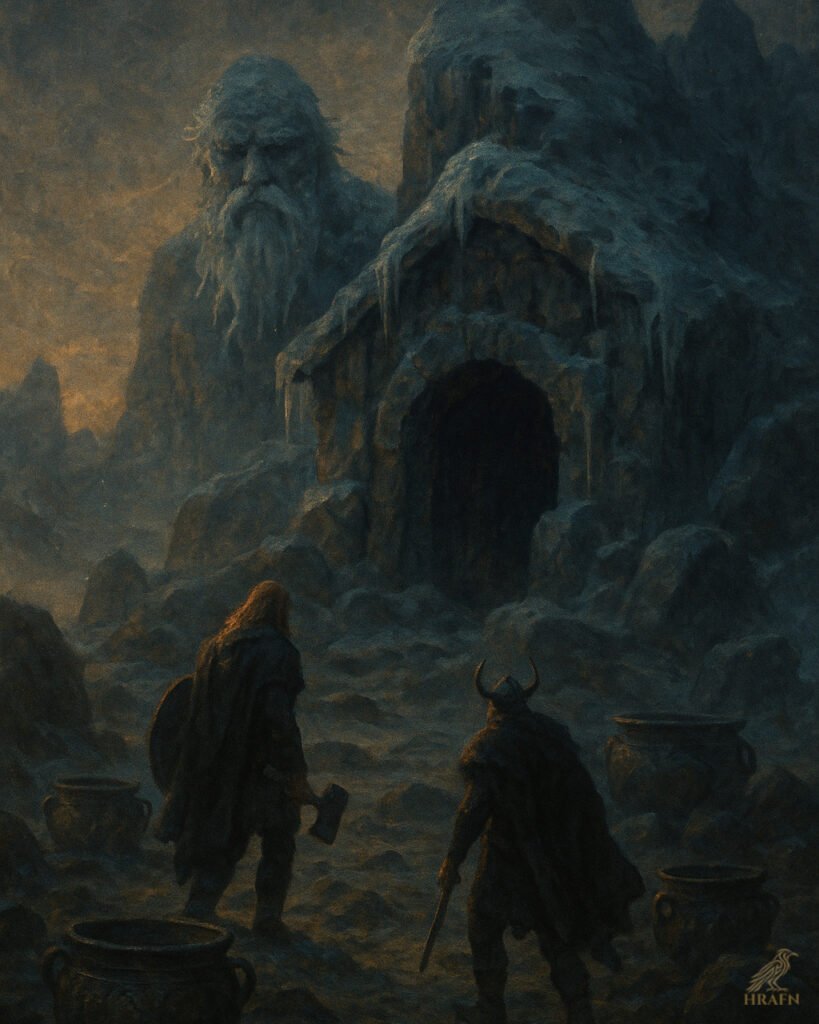
Another story, recorded in the Eddic poem Hymiskvida, shows Tyr in an unfamiliar supporting role: as Thor’s companion. The gods want to hold a great feast, but no cauldron is large enough to brew all the ale needed. Tyr knows where to find one – at the home of his kinsman, the mighty giant Hymir, at the edge of the world. Together with Thor, he travels there. The visit turns dangerous: Hymir shatters several cups in anger, and only when Thor proves his strength does the giant relent. In the end, the two manage to seize the enormous cauldron and carry it back to Asgard. (Source: Poetic Edda, Hymiskvida)
Lokasenna – Mockery Despite a Sacrificed Hand
At the feast described in Lokasenna, Loki spares Tyr no mockery either. He taunts him over his missing hand and claims to have fathered a son with Tyr’s wife – an insult for which Tyr, unlike some other gods, received no compensation. Tyr himself, in the same scene, bravely defends the bound Fenris-wolf against Loki’s scorn, even though it was that very wolf that cost him his hand. It is a brief but telling moment: even in conflict, Tyr stays true to his reputation as the god of justice, refusing to judge out of personal grievance. (Source: Poetic Edda, Lokasenna)
The Final Battle
Tyr’s story doesn’t end with the wolf. At Ragnarok, the downfall of the gods, another enemy awaits him: Garm, the hound of Hel. The two hurl themselves at each other, and neither emerges the victor. Tyr falls in battle – just as he lived: arm outstretched, without hesitation.
To this day, his name stands for what courage truly means: not the absence of fear, but the willingness to sacrifice for others what you will never get back.
In the game: how God of War portrays this figure — and where it departs from the sources — is covered in our mythology check.
Sources
The binding of Fenrir and Tyr’s sacrifice are recorded chiefly in Snorri Sturluson’s Prose Edda (Gylfaginning, 13th century). The journey to the giant Hymir and the quarrel at Lokasenna come from the Eddic poems of the same names in the Poetic Edda. Since these texts were only written down centuries after Scandinavia’s Christianization, contradictions and later influences in the sources cannot be ruled out – as Tyr’s inconsistent parentage itself shows.