Asgard
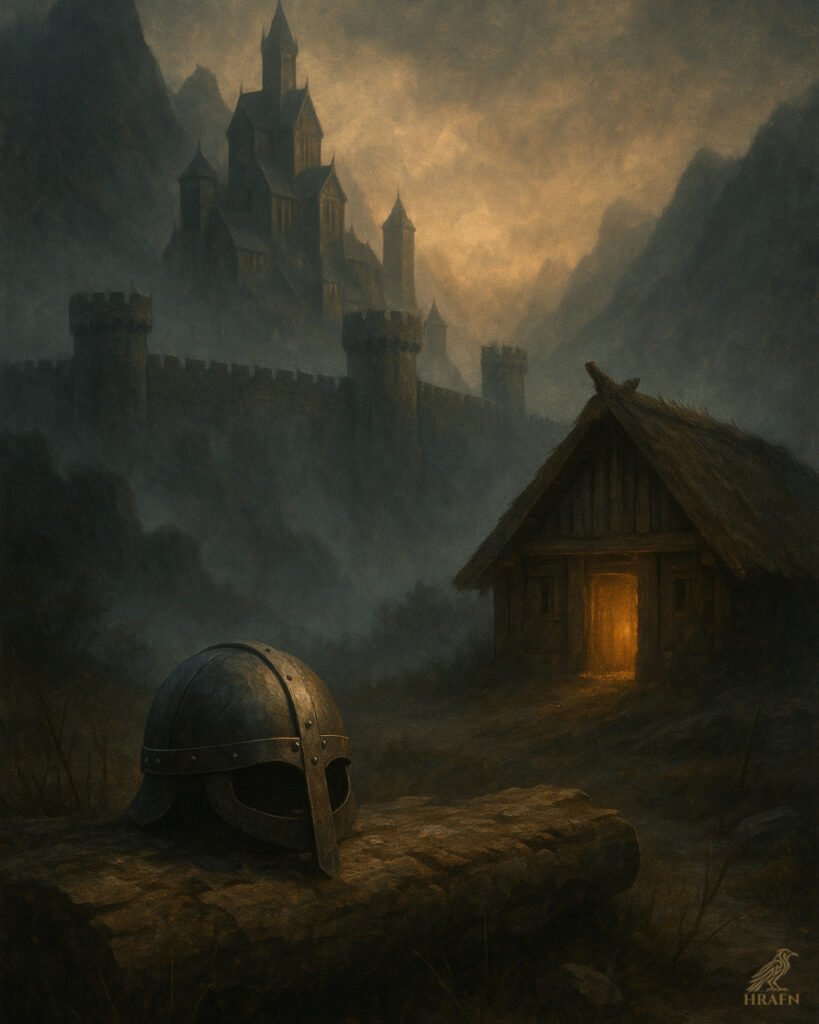
Asgard is named exactly twice in the entire Poetic Edda.
Once in the Hymiskviða, when Thor and Týr set out from there. Once in the Þrymskviða, when Loki argues that without Thor’s hammer the giants would soon be living there. Both times in passing, both times without a single word about what the place looks like.
Everything else — the wall, the location, the halls, the relationship to the other worlds — comes from a single author.
Asgard is the dwelling place of the Æsir. And it is the place where it becomes clearest how much of our picture of the Norse world stems from the 13th century.
What the Name Says
Ásgarðr means “enclosure of the Æsir” — áss for the god, garðr for the enclosure. Not a heaven, not a paradise, but a fortified dwelling.
This is not a linguistic side note. A garðr is something every Icelander knew: a farmstead with a wall around it. The word survives in German “Garten” and English “yard”.
And it is not an isolated case, but the building principle of the entire cosmic order. Miðgarðr — the middle enclosure, the world of humans. Útgarðar — what lies outside, beyond the fence, where the giants live.
Three names, one image: fence, farmstead, outside. The Norse world is not conceived in spheres, but in enclosures. Inside reigns order, outside does not, and the wall makes the difference.
Which leads to the story that is about this very wall.
The Wall and the Builder
A builder offers the gods to erect an impregnable fortification. His price: the sun, the moon, and Freyja.
The Æsir deliberate. It is Loki who advises striking the deal — with a shortened deadline that no one can meet, and on the condition that the builder receives no help. The man agrees and asks only to be allowed to use his horse Svaðilfari. Loki advises that too.
The horse drags stones in a quantity no one expected. The deadline runs, the wall grows, the gods grow nervous. And they know exactly whom to thank for it.
Loki is forced, under threats, to solve the problem. He transforms into a mare and lures the stallion away. Construction comes to a halt, the deadline passes, the builder flies into a giant’s rage and thereby reveals himself. Thor kills him.
And here stands the part that popular retellings gladly leave out: The gods had sworn oaths to the builder. They break them the moment they stand to lose. The fortress of order comes into being through a broken word.
Some time later, Loki gives birth to an eight-legged foal: Sleipnir, Odin’s horse.
What of This Is Older Than Snorri
The tale stands in Snorri’s Gylfaginning. But its core is attested in the Poetic Edda, and more precisely than is usually claimed.
Völuspá 25 asks who gave “Óðr’s maid” — that is, Freyja — over to the race of giants. Völuspá 26 names Thor, who struck alone, and states that oaths, words, and all weighty promises were broken.
Three elements agree with this: Freyja as the price, the broken oaths, Thor’s blow. This is no loose association.
What is missing from the Völuspá: the builder, the horse, the wall, Loki, Sleipnir.
Snorri himself quotes both stanzas in the Gylfaginning. He thus establishes the connection explicitly. Whether he is thereby documenting a known story or claiming an obscure stanza for his own narrative cannot be decided — and that is exactly the normal case when working with him.
The Halls — and a Problem of Assignment
Within the walls lie numerous halls. Odin’s Valhalla and Valaskjálf, Thor’s Bilskirnir, Baldr’s Breidablik, Heimdall’s Himinbjörg. On the field Idavoll the gods gather in council.
So it stands in Snorri. In the Poetic Edda it stands differently.
The Grímnismál lists these dwellings — and does not name Asgard even once. It strings places together without assigning them to any overarching location. That they all lie in Asgard is Snorri’s arrangement.
The same holds for Idavoll: the Völuspá knows the field but not its location. That it lies at the center of Asgard is said only by the Gylfaginning.
Freyja’s hall Sessrúmnir is also often counted among them. According to Grímnismál 14, it stands in Fólkvangr — and where Fólkvangr lies, no source says.
The halls, then, are old. The address is not.
The Special Case of Valhalla
A hall with five hundred and forty doors. A roof of shields, rafters of spear-shafts, benches laid with mail-coats. A wolf hanging before the western door, an eagle above it.
This stands in the Grímnismál, in stanzas 9, 10, and 23 — spoken by a bound man who sits for eight nights between two fires and at the end reveals himself as Odin.
On the number: translations consistently give 540 doors. Old Norse hundrað, however, often denotes the “great hundred” of 120 — in which case it would be 640. The number is thus not certain.
And the most famous feature of all is missing from this poem. The daily battle, in which all fall and in the evening are reconciled and drink together, does not stand in the Grímnismál but in Vafþrúðnismál 41. The eight hundred warriors who step out from every door there march against the Fenris wolf — that is Ragnarök, not everyday life.
Two poems, two different statements. Snorri combined them in the Gylfaginning. Whoever describes Valhalla today almost always describes his version, not that of the poems.
And one more thing: in the Grímnismál, Valhalla stands in Glaðsheimr. Asgard, as noted, does not appear there.
How to Get There
Over the bridge that connects Asgard with Midgard. Even its name is split.
The Poetic Edda calls it Bilröst — Grímnismál 44, Fáfnismál 15. Snorri writes Bifröst. Bif- is usually interpreted as “to tremble, to shimmer,” Bil- as “brief moment.” The common translation “trembling bridge” thus follows Snorri’s form.
That the bridge breaks at Ragnarök already stands in Fáfnismál 15 — this, then, is not Snorri’s addition.
Snorri’s addition is the three colors and Heimdall’s watch duty. In Grímnismál 13, Heimdall lives in Himinbjörg and drinks mead there. Of a bridge guard, nothing is said there.
The Source Problem
Adding it all up yields an unusually clear finding.
The Poetic Edda knows the name Asgard twice, both times in passing, both times without location. It knows halls, but does not assign them. It knows a bridge, but no guard. It knows a broken oath and a slain giant, but no builder.
Asgard as a place — with wall, location, catalogue of halls, and neighboring realms — is, in the surviving tradition, practically entirely Snorri’s construction.
He goes even further. In his prologue, in the concluding section of the Skáldskaparmál, and in the Ynglinga saga, he equates Asgard with Troy and interprets the Æsir as emigrants from Asia Minor. Three passages in two works: not an offhand notion, but a sustained framework. And Christian scholarship of the 13th century, not pagan belief.
This does not mean that Snorri invented Asgard out of nothing. The name is older than he is, and the design of the world as a series of enclosures is embedded in the language itself.
It means this: the orderly picture — the fortress of the gods with named halls in fixed places — is a medieval systematization. Whether the people of the Viking Age imagined it this way, we do not know.
Asgard and the Nine Worlds
The Völuspá speaks of nine worlds. Which nine, it does not say — and no source lists them in full.
The widespread list that appears in every encyclopedia article and every game is a modern compilation drawn from handbooks and popular literature. Not a source text, not a research finding.
Asgard appears in every one of these lists. But even the question of whether it is a world of its own or a place within a world cannot be answered cleanly from the sources. In Snorri, it lies partly in the sky, partly reachable via a bridge from Midgard — which fits together poorly.
Such contradictions are not a deficiency of the tradition. They are the normal case when a body of belief has grown over centuries and across wide regions, and only late does someone attempt to put it in order.
What the Modern Age Has Made of It
Asgard is today probably the best-known place name in Norse mythology — not because of the Edda, but because of Marvel.
The Asgard shown there is an extraterrestrial realm with golden architecture; the Æsir are highly advanced beings whom humans mistook for gods.
This is not a modern invention. It is exactly Snorri’s prologue — beings who were taken for gods though they were not — only with space travel instead of migration. A Christian scholar of the 13th century and a comic-book publisher of the 20th arrived independently at the same solution: one can tell of pagan gods if one declares them to be something else.
God of War and Assassin’s Creed Valhalla also show their own versions. What of this corresponds to the sources, we examine in the Historik-Check.
Sources
Poetic Edda. Asgard by name: Hymiskviða 7, Þrymskviða 18. Halls and dwellings: Grímnismál 4–17, including 9–10 and 23 on Valhalla, 13 on Himinbjörg, 14 on Fólkvangr and Sessrúmnir, 24 on Bilskirnir, 44 on Bilröst. Daily battle of the einherjar: Vafþrúðnismál 41. Idavoll: Völuspá 7 and 60. Freyja as the price, broken oaths, Thor’s blow: Völuspá 25–26. Breaking of the bridge: Fáfnismál 15.
Snorri. Asgard as a place, arrangement of the halls, Bifröst with three colors and Heimdall’s watch: Gylfaginning 9, 13, 41. The builder and Sleipnir’s birth: Gylfaginning 42. Equation with Troy: Prologue, concluding section of the Skáldskaparmál, Ynglinga saga 2.
Editions. Edward Pettit (ed.), The Poetic Edda. A Dual-Language Edition, Open Book Publishers, Cambridge 2023 — freely accessible. Anthony Faulkes (ed.), Snorri Sturluson: Edda, Viking Society for Northern Research, London 1998–2007 — freely accessible. Rudolf Simek, Lexikon der germanischen Mythologie, Kröner, Stuttgart.
Open Questions. Whether Asgard is a world of its own or a place within a world, whether it lies in the sky or on the earth, and which nine worlds the Völuspá means — these questions are not resolved here. There is no certain picture.