Burial Rites of the Viking Age
- Etymology and Technical Terms
- What the Poems Provide – and What Snorri Provides
- The Poetic Edda: The Ritual
- And Immediately the Counter-Evidence
- Snorri: The Myth
- Snorri’s Philosophy of History
- The Hel-Shoes: A Contradiction in the Gísla saga
- Ibn Fadlan: The Only Eyewitness Source
- Archaeology: Diversity Instead of Norm
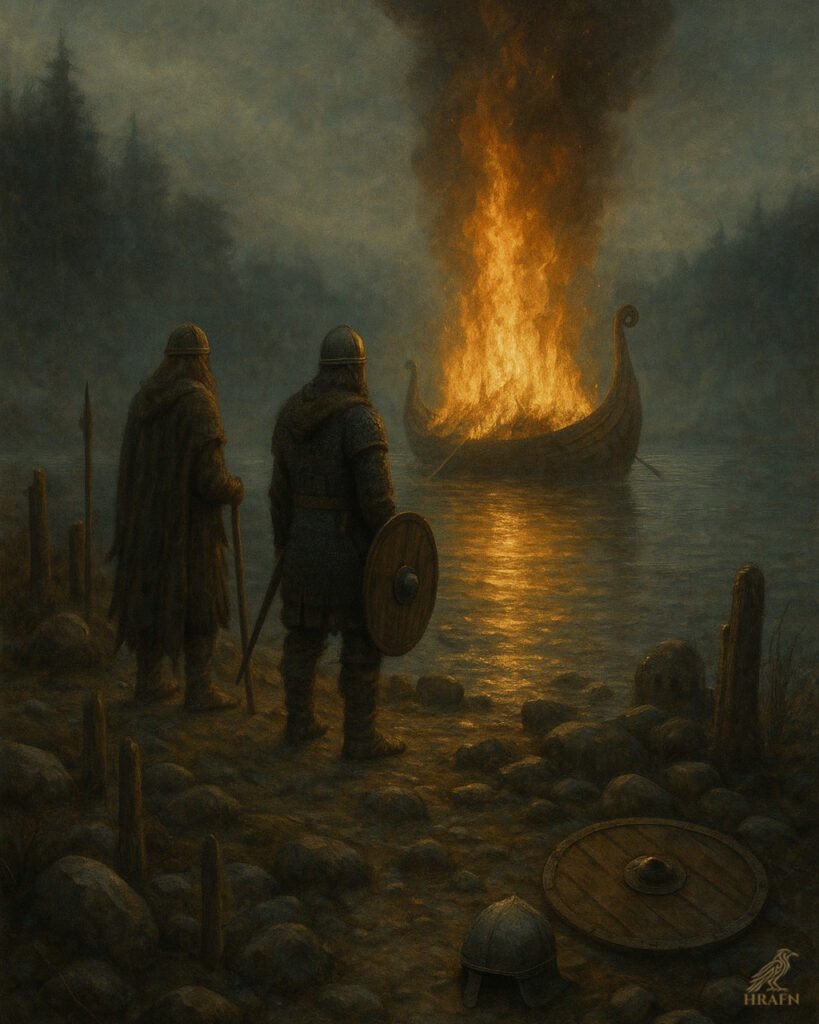
- The Greatest Misconception: The Burning Ship at Sea
- Christianization and the End of the Mounds
- Grave Goods Are Not Identity Cards
- Sources
A single written eyewitness account describes a Viking Age burial firsthand: the travel report of Ahmad ibn Fadlan on a Rus ship cremation on the Volga, written around 922.
Everything else that is popularly regarded as “the Viking burial” comes either from the ground or from texts written down two to three centuries later. The subject is thus almost exclusively accessible through archaeology – and the literary sources are not only late and scarce, they also contradict one another.
Etymology and Technical Terms
Old Norse possesses its own precise vocabulary for death and its rituals. It is worth taking this vocabulary seriously before speaking of “Viking burials” in general.
The mound. Haugr means “burial mound” and is related to the German word for “high” and “hill.” The corresponding verb heygja literally means “to mound someone” – the language itself treats mound-building as an act performed upon a person, not merely as a construction.
Fire and stone. Bál denotes the pyre, bautasteinn the upright memorial stone. Both terms exist side by side because cremation and stone-setting are not mutually exclusive but often belong together.
The funeral feast. Central, and often overlooked in popular accounts, is erfi, the funeral feast. It shares its root with arfr, “inheritance” – the same idea is present in the German word for inheritance.
The funeral feast was thus not a purely mournful act but a legal act of succession: whoever inherited had to affirm this publicly at the feast. Accordingly, the memorial poetry recited on such occasions is called erfidrápa.
Shoes for the dead and names for revenants. Helskór literally means “Hel-shoes.” For the undead who return from the grave, scholarship distinguishes haugbúi, “mound-dweller,” from aptrganga, “one who walks again.” Ármann Jakobsson (2011) points out that the term draugr, common today, appears rarely in medieval Icelandic and is never used at all for some of the best-known ghostly figures. Instead, haugbúi, aptrganga, or reimleikar were the customary terms.
What the Poems Provide – and What Snorri Provides
The common claim is that all burial scenes derive from Snorri Sturluson. That is not correct. The division of labor between the Poetic Edda and the Prose Edda runs differently – and more precisely.
The Poetic Edda: The Ritual
The most detailed burial instruction in the whole of Old Norse literature does not appear in Snorri, but in the Sigurðarkviða in skamma, stanzas 65 to 71. Brynhild dictates it as she dies.
The pyre is to be built wide on the field, large enough for all the slain, and covered with shields and tapestries. Five bondwomen and eight servants are to be burned with Sigurd, two at his feet, two at his head. In addition, a pair of hounds and a pair of falcons. Between Sigurd and Brynhild the sword that once lay between them is to be placed. And the door to the hall in the afterlife is to remain open until his retinue has entered.
This is not a mere allusion. It is a complete program: the construction of the bál, textiles, human sacrifice with precise positioning, animal sacrifice, grave goods, and a conception of the afterlife.
A second eddic passage belongs here as well: in the Helgakviða Hundingsbana II, Helgi returns to his burial mound, and Sigrún spends the night with him in the mound. A revenant motif, in the Poetic Edda, without Snorri.
And Immediately the Counter-Evidence
Anyone now inclined to think the poems are therefore the more reliable source finds the refutation a few pages later in the same codex.
The prose introduction to the Helreið Brynhildar states that two pyres were built for Sigurd and Brynhild. In the Sigurðarkviða, both burn on the same one.
Two texts in the same manuscript, two irreconcilable accounts of one and the same burial. The literary tradition does not first contradict itself between poem and Snorri – it already contradicts itself within itself.
Snorri: The Myth
What Snorri provides is something other than a ritual. It is a scene among the gods.
The most detailed account is Baldr’s burial in Gylfaginning 49. Baldr is carried onto his ship Hringhorni, the largest of all ships. The gods cannot push it into the water until the giantess Hyrrokkin appears riding a wolf with vipers as reins and shoves it so hard that fire springs from the rollers and the earth trembles. Nanna, Baldr’s wife, dies of grief and is laid beside him. Thor consecrates the pyre with his hammer, Odin places the ring Draupnir upon it, and Baldr’s horse, fully harnessed, is led onto the fire.
In this scene, Thor kicks the dwarf Litr into the fire – a minor figure who appears in the Völuspá (stanza 12) only as a bare name in a list of dwarves. In the Skáldskaparmál, Snorri also cites a stanza by the skald Bragi Boddason containing a Thor-kenning that mentions Litr. For the dramatic scene of the kick into the fire, however, no older parallel exists. It is Snorri’s own elaboration.
The division of labor, then, is this: the poems transmit how a burial was supposed to look. Snorri transmits how the gods celebrated one.
Snorri’s Philosophy of History
The famous “Odin’s legislation” in Ynglinga saga 8 is likewise Snorri’s construction. In it, Odin decrees as law that all the dead are to be burned, that their possessions accompany them onto the pyre, and that the ashes are either thrown into the sea or buried in the earth – so that everyone arrives in Valhalla with as much wealth as he had upon him on the fire. For distinguished men a mound should be raised; for other brave warriors, an upright stone.
Immediately afterward comes the sentence that has become a modern commonplace: it was believed that the higher the smoke rose, the higher in the sky the one whose pyre it was would be exalted.
From this, reception history has produced the notion that the smoke “carried the soul.” That is stated nowhere in the text – Snorri describes a correspondence, not a transport. And the very passage from which this image derives is itself part of that legislative scene which Snorri devised in the 13th century. First a late construction, then a popular reinterpretation on top of it.
In the prologue to the Heimskringla, Snorri goes even further and devises a sequence of ages: first an “age of burning” (brunaöld) with cremation and memorial stones, then – after Freyr was laid in a mound at Uppsala and the Danish king Danr inn mikilláti had himself laid in a mound with garment, armor, and horse – an “age of mounds” (haugsöld).
This is 13th-century philosophy of history, not observation. Archaeologically, cremation and inhumation run alongside each other throughout the entire Viking Age.
The Hel-Shoes: A Contradiction in the Gísla saga
The Gísla saga (chapter 14) provides the only clear literary mention of the helskór. Þorgrímr ties these “Hel-shoes” onto the dead Vésteinn, “so that he may walk on them to Valhalla.”
The sentence contradicts itself: tying on Hel-shoes for the journey to Valhalla links two separate conceptions of the afterlife that do not, in fact, belong together.
Older translators therefore interpreted the custom in the opposite sense, namely as a kind of binding meant to prevent the dead from returning as a revenant. Remains of shoes in graves of the 11th and 12th centuries in Lund have been connected with the helskór concept. The evidentiary basis, however, remains thin: a single unambiguous saga passage carries the entire notion.
Ibn Fadlan: The Only Eyewitness Source
Ahmad ibn Fadlan was sent in 921 as secretary of an embassy of the caliph al-Muqtadir to the Volga Bulgars, and in 922 he describes a ship cremation of the Rus, those Scandinavian merchants and warriors who traded along the Russian rivers.
His account survives only as part of a later compilation. A more extensive manuscript, a 13th-century copy, was identified only in the early 20th century – for this reason, the significance and historical reliability of the text are still debated today. The authoritative English translation is by James E. Montgomery.
In content, Ibn Fadlan describes how the ship is drawn ashore. After the cremation, a round mound is raised at the same spot and a large post of birch wood is erected in it, on which the name of the deceased is written.
The famous justification for cremation does not come from Ibn Fadlan himself but is a statement by a Rus that he reports: inhumation leaves the dead to earth and worms, whereas cremation brings him at once into paradise. Regarding the slave woman who was killed and given to accompany the deceased, Ibn Fadlan explicitly notes her own stated willingness to go with him, as well as her singing and drinking in the days before the burial. Whether this reflects genuine willingness or ritual compulsion cannot be decided from the text.
As evidence for “the” Viking burial as such, the account is in any case unsuitable: it describes a Rus group on the Volga, not Scandinavia itself.
Archaeology: Diversity Instead of Norm
The finds show no uniform burial custom, but a broad coexistence of practices. Inhumation graves vary considerably: chamber graves were common, alongside pit graves and boat graves; coffins were sometimes used, sometimes not. According to Anne-Sofie Gräslund and Michael Müller-Wille (1992), the chamber-grave custom may have been adopted from Frisia, Lower Saxony, or Westphalia.
Cremations took place at the intended burial site itself or only a short distance away. Ship symbolism functioned even without an actual ship: stone settings in the shape of ships, so-called ship settings, form their own, widespread type of grave.
Oseberg. In 834 the ship was drawn ashore and used as a burial ship for two wealthy women, one about 50 to 55, the other around 80 years old. The mound has a diameter of roughly 40 meters and was originally about 6 meters high; today it is considerably lower. It consisted of turf sods that formed an airtight seal, which enabled the extraordinary preservation of the wood.
The dating rests dendrochronologically on the year 834; the carvings on the prow are estimated at around 820. The mound was reopened while still in the Viking Age, perhaps by robbers, more likely by descendants. Most of the metal had been removed, and parts of both skeletons were found in the collapsed break-in tunnel.
The widespread identification of the older woman with Queen Åsa fits the dating poorly in terms of chronology.
Gokstad. This ship grave, too, had been broken into, the ship damaged, grave goods destroyed, bones scattered. The skeleton itself is preserved and has been examined: a powerfully built man of about 40 to 50 years, with signs of injury on the legs. What remains open is not what lay there, but who it was – which chieftain.
Salme. In Estonia, even before the actual Viking Age, around 750, 41 individuals were buried in two ships, apparently having died violently, along with richly decorated weapons, tools, gaming pieces, and animal bones. The swords are of Scandinavian workmanship from the Stockholm-Mälaren region; isotope and strontium analyses of the teeth point most likely to Uppland.
It remains unknown who killed the men and who carried out the burial – enemies or allies. Even the number of individuals varies in the literature: Salme II is given as either 34 or 33 individuals, stacked four layers deep; Salme I contained seven men between 18 and 45 years of age.
Tyresta. New scientific methods are also opening up burned remains to fresh analysis: a study of the burial mound at Tyresta in south-central Sweden uses infrared spectroscopy (ATR-FTIR), direct mercury analysis, and analytical color measurement on the burned remains of a person buried together with dogs, a horse, a cat, and other animals.
The Greatest Misconception: The Burning Ship at Sea
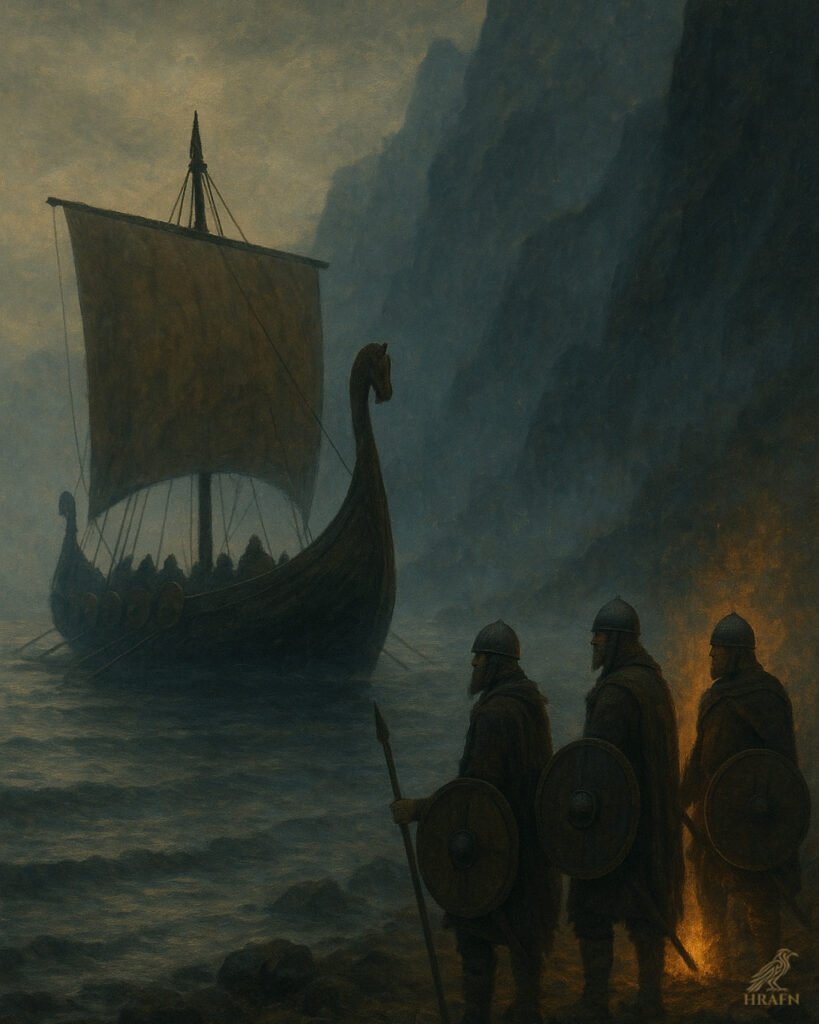
The most popular image of the Viking burial – a burning ship set adrift on the open sea – has no archaeological basis. The Vrak Museum states in its exhibition “Burned Boats of the Viking Age” that there is no evidence for this.
In practice, the scenario hardly works at all: fire behaves unreliably on open water, and the remains would drift back rather than disappear.
Ships do appear in graves, but they were never the norm. Ship burials were exceptions, tied to wealth, power, or status. Even Ibn Fadlan’s ship was drawn ashore and burned there.
The popular image does not come from the ground but from literature: from Snorri’s Baldr scene in Gylfaginning 49, in which the ship Hringhorni is launched onto the water while burning. Modern films thereby reproduce a 13th-century literary solution, not an archaeological finding.
Ibn Fadlan himself became a pop-culture figure: in the film “The 13th Warrior,” Antonio Banderas portrays him as a traveler who witnesses a ship burial.
Christianization and the End of the Mounds
Graves without personal grave goods and a west-east orientation of the deceased are regarded as criteria for Christian influence on burial customs. Haithabu, the Viking Age trading site on the Baltic coast of Schleswig-Holstein, provides a dated case for this.
Increasing Christian influence is discernible there from the 10th century onward. Mound-building ends in the first half of the 10th century, while the majority of graves with grave goods date from the middle of the 9th century into the first half of the 10th century.
Graves from the 11th century can no longer be securely identified as such in Haithabu – an indication that burial practice had changed so much that it can hardly be archaeologically distinguished from Christian graves any longer.
Grave Goods Are Not Identity Cards
Grave Bj 581 in Birka, listed as the grave of a high-ranking male warrior ever since its excavation in 1878, shows how carefully one must handle the interpretation of grave goods. Osteological examinations in 2014 and a DNA analysis in 2017 established that the buried individual was a woman.
The subsequent interpretation of her as a high-ranking professional warrior is disputed in scholarship. The objection is: grave goods alone do not prove a social role. Weapons in a grave do not necessarily prove that the buried person herself fought.
The case thus remains a cautionary example of how quickly a find can become a fixed narrative that is difficult to correct afterward.
Sources
Poetic Edda. Sigurðarkviða in skamma 65–71: Brynhild’s burial instructions with pyre, shields, tapestries, five bondwomen, eight servants, hounds, falcons, and the sword between the dead. Helreið Brynhildar, prose introduction: two pyres, contradicting the above. Helgakviða Hundingsbana II: Helgi in the burial mound. Völuspá 12: Litr in the catalogue of dwarves, without burial context.
Snorri Sturluson. Baldr’s burial with ship, Hyrrokkin, and the kick against Litr: Gylfaginning 49. Bragi’s stanza with the Litr-kenning: Skáldskaparmál. Odin’s legislation and the height of the smoke: Ynglinga saga 8. The age of burning and the age of mounds: prologue to the Heimskringla. Composed around 1220 to 1225.
Saga literature. The Hel-shoes appear in the Gísla saga, chapter 14, written in the 13th century. They are the only literary support for this concept.
Arabic travel literature. Ahmad ibn Fadlan’s Risala, 921/922, describes a Rus burial on the Volga from direct observation. Preserved only in later copies, including a 13th-century manuscript that was identified only in the early 20th century. Authoritative English translation: James E. Montgomery.
Commentary literature. Klaus von See et al., Kommentar zu den Liedern der Edda, vol. 6: Heldenlieder, Winter, Heidelberg 2009 – on the Sigurðarkviða in skamma.
Archaeology. Oseberg and Gokstad in Norway, Salme in Estonia, the burial mound of Tyresta in Sweden, grave Bj 581 in Birka, the burial ground of Haithabu. On chamber graves: Anne-Sofie Gräslund and Michael Müller-Wille (1992). These finds form the backbone of the subject, because the literary sources are so late and so few.
Open scholarly debate. The reading of the runic inscription on the Tune Stone, dalidun arbija, as evidence for a funeral feast is disputed; see Thórhallur Eythórsson, Futhark 3 (2012). Also not certain are the exact numbers of horses sacrificed at Oseberg and Gokstad, as well as the attribution “the only ship grave in Denmark” for Ladby. The chapter reference for the Bragi stanza in the Skáldskaparmál could not be verified against the primary text for this article; chapter numbering varies between editions.