Sleipnir: Odin’s Eight-Legged Steed
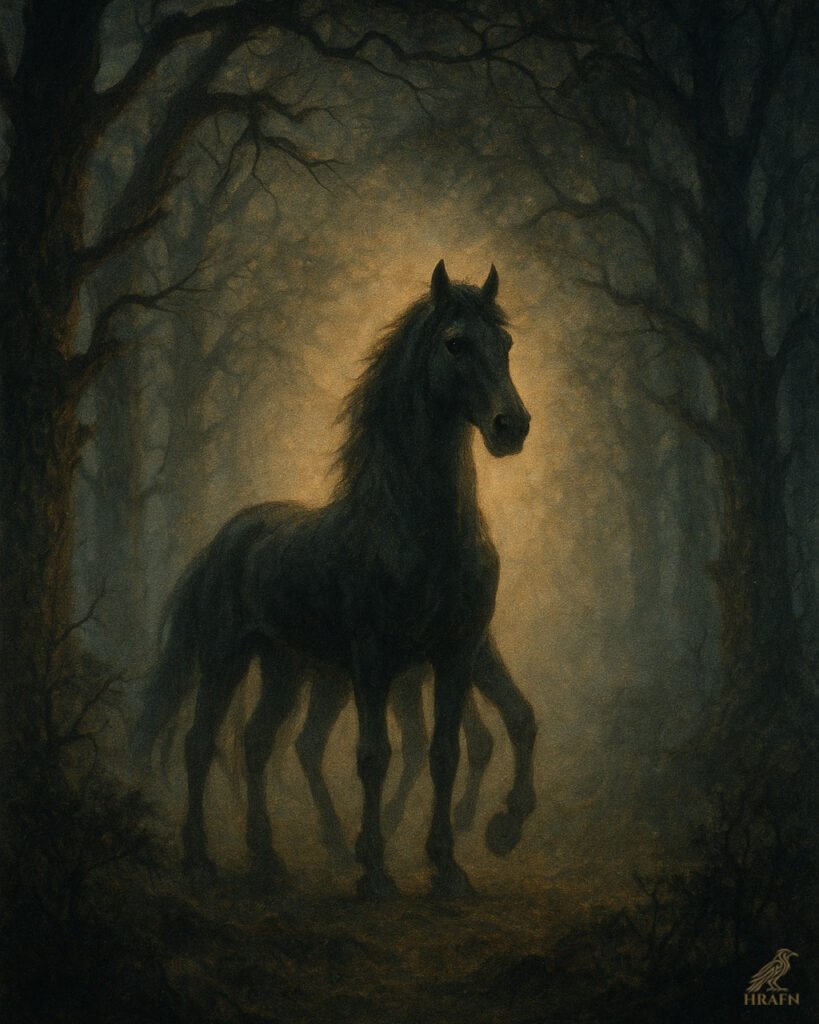
On the Gotlandic picture stone from Tjängvide, carved in the 8th century, a man rides a horse with eight clearly visible legs. There is no inscription. Only centuries later, in the Poetic Edda and in Snorri’s Prose Edda of the 13th century, does the animal get a name: Sleipnir, Odin’s steed.
Origin: a foal born of trickery
Sleipnir’s story begins with a wall. An unnamed builder offers the gods to raise the fortifications of Asgard in a single winter. His price is Freyja, along with the sun and the moon. The gods agree, because they consider the deadline impossible.
But the builder has a stallion named Svaðilfari, whose name means something like “the one who makes the unlucky journey,” and the animal accomplishes an extraordinary amount of work in very little time. As the wall nears completion, Loki turns himself into a mare and lures Svaðilfari away. The builder misses his deadline — and some time later Loki gives birth to a gray, eight-legged foal. It becomes, so the sources say, the best horse among gods and men.
The best of all horses
The Grímnismál names Sleipnir explicitly as the best of all horses, just as Odin is the best of the gods and Bifröst the best of bridges. The Sigrdrífumál turns practical: whoever wants to work rune magic, the valkyrie Sigrdrífa advises, should carve runes into Sleipnir’s teeth. The horse is therefore more than a mount. It carries power that can be drawn upon.
The ride into the underworld
The most striking scene comes from the Baldrs draumar. After ominous dreams about his son Baldr, Odin saddles Sleipnir and rides down into Hel, the realm of the dead, to question a seeress.
Later Hermóðr, another of Odin’s sons, takes the horse for a second ride: he rides nine nights through valleys so dark that he can barely see his own hand, until he reaches the bridge Gjallarbrú over the river Gjöll. At the end of the journey Sleipnir leaps over the gate of the dead, the Helgrind, without its having to open for him. No other horse in Norse tradition moves so easily between the worlds.
Two stones from Gotland
Besides Tjängvide, the picture stone Ardre VIII also shows an eight-legged horse with a rider. Tjängvide is dated to the 8th century, Ardre VIII to the 8th or 9th — both, then, to a time when the written sources are still centuries away.
The common reading sees Odin on Sleipnir in the scene. This is not certain: a widely held alternative reads the same rider not as a god but as a dead man on his way to the realm of the dead — on the Tjängvide stone a female figure receives him with a drinking vessel.
The images are older than any surviving text about Sleipnir. They establish that the idea of an extraordinary, many-legged horse existed long before the Eddas were written down — but they provide no reliable caption.
From a canyon to a spider: traces and interpretations
Icelandic folklore credits Sleipnir with the creation of Ásbyrgi, a horseshoe-shaped canyon in the north of the island, roughly 1.1 kilometers wide and 3.5 kilometers long — supposedly the print of one of his eight hooves. There is no evidence for this in the older sources; it belongs to later popular tradition.
Scholarship has offered interpretations as well. Some connect Sleipnir with shamanic practices in Norse paganism, with the idea of a soul traveling between the worlds. That remains a hypothesis.
Older explanations are now regarded as obsolete — among them the attempt to derive Loki’s name from a Scandinavian word for spider and to construct from it a connection to the eight legs. Equally unsubstantiated is the popular notion that the eight legs stand for four pallbearers.
Sources
What is known about Sleipnir comes almost entirely from the Poetic Edda and from Snorri’s Prose Edda, both of the 13th century, both drawing on older oral material. The references are scattered across several poems and chapters, from Grímnismál and Sigrdrífumál to Gylfaginning and Skáldskaparmál. These are literary works with their own narrative logic, not historical chronicles.
The picture stones from Tjängvide and Ardre VIII provide archaeologically solid evidence that the idea of an eight-legged horse already existed in the 8th century, but their precise interpretation remains open.
Everything beyond that — Ásbyrgi, shamanic backgrounds — belongs clearly to folklore or to modern interpretation and cannot be presented as established knowledge.