Alfheim
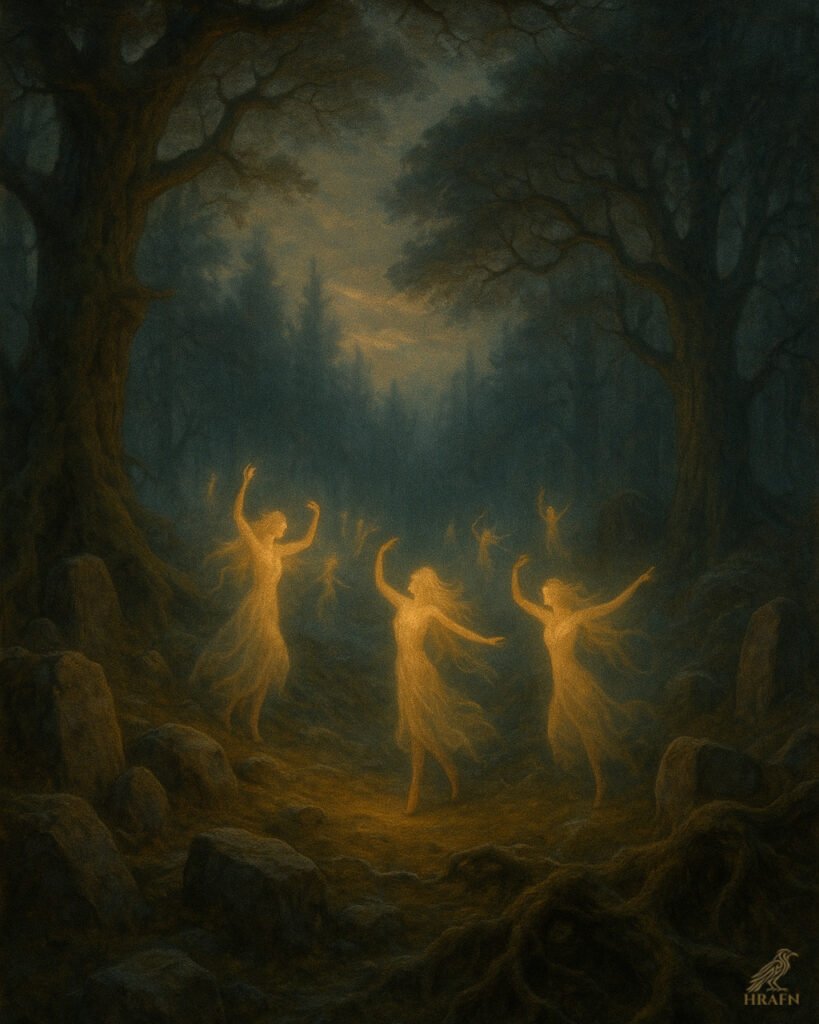
A baby cuts his first tooth, and the gods hand him an entire world. That is how the Poetic Edda opens the story of Alfheim: the gods gave Álfheim to Freyr as a “tooth-gift”, the present given to a child at the first tooth.
A Realm of Light Elves
After that, silence. Álfheim is one of the thinnest-sketched worlds in the whole Norse cosmos. Around 1220, Snorri Sturluson finally paints it: the light elves live there, fairer to look upon than the sun, while the dark elves dwell underground, blacker than pitch. Two sentences, a whole cosmology – and a puzzle, because no surviving myth actually links Freyr to the elves in action.
The elves get far more real where they touch daily life. Each autumn, Scandinavian farms made offerings to the álfar. The álfablót was no grand public feast but a household rite, usually led by the woman of the house and wrapped in secrecy; strangers stayed outside. The poet Sigvatr learned that the hard way around 1018: the door stayed shut, the people told him the place was holy, and he walked on.
A Second Alfheim
There is also an Alfheim of soil rather than light. It named the land between the Glomma and the Göta älv, roughly modern Bohuslän – a name already old-fashioned by the 13th century.
So what remains? Perhaps this: even the famous “nine worlds” are never actually listed in any old source. The North left gaps. Whoever fills them mostly tells us about themselves – like the farmers who bolted the door, because some things are simply nobody’s business.
Sources
The description of Alfheim is based mainly on the Poetic Edda – particularly the Völuspá and Grímnismál – as well as on Snorri Sturluson’s Prose Edda, which first systematically compiled the oral tradition in the 13th century. As this is a mythological realm rather than a historical place, details vary between sources.