Bifröst
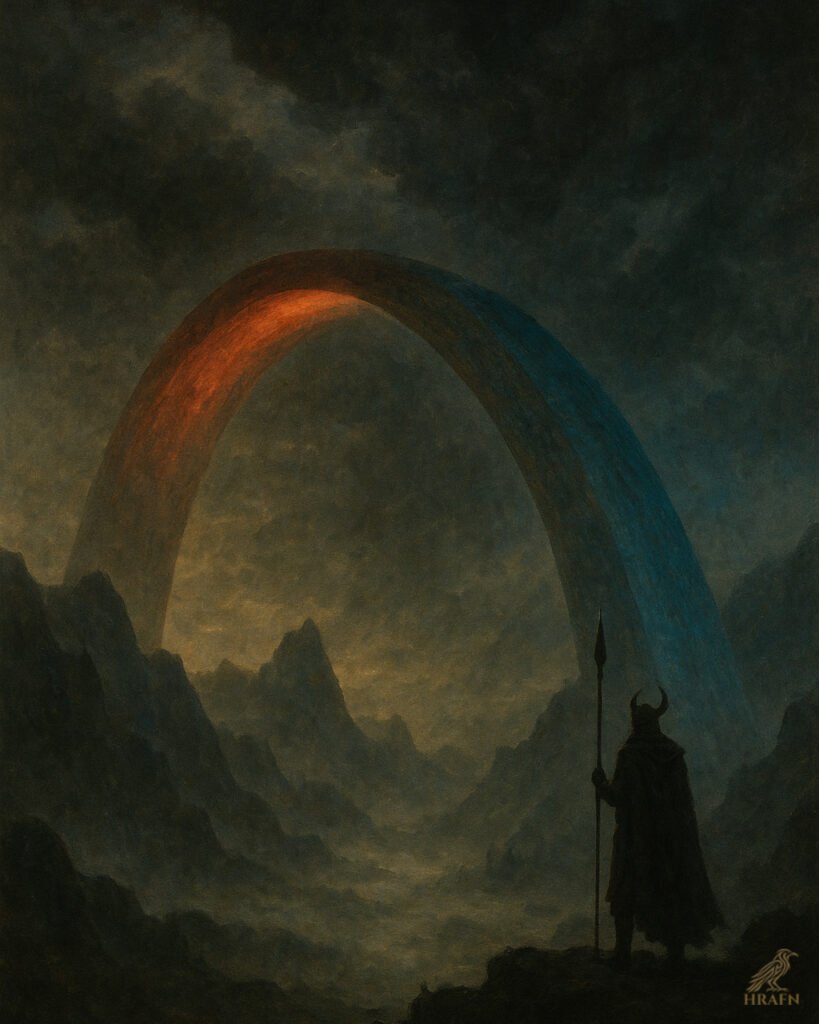
Red, green, blue – the rainbow we see today is more than a weather phenomenon in Norse mythology. It is Bifröst, the “trembling” or “swaying” bridge, connecting Midgard, the world of humans, with Asgard, the realm of the gods.
Structure and Guardian
The Prose Edda describes it as built from three colors – some readings interpret these as fire, water, and air. The red band, it says, burns so that mountain giants and other uninvited guests cannot climb it. Heimdall stands guard, the god with the sharpest hearing and sharpest sight among all the Æsir. His horn, Gjallarhorn, lies ready to warn the gods the moment danger approaches.
That watch is no accident. On the day of Ragnarök, the end of the world, it is the sons of Muspell, led by the fire giant Surtr, who ride across Bifröst against Asgard – and the bridge collapses under the weight of their horses. Even a bridge built by the gods doesn’t survive the end times.
A Motif Across Cultures
Scholars place Bifröst within a widespread idea: many Indo-European mythologies feature a bridge or path linking heaven and earth. What sets Bifröst apart is its fragility – unlike in some other traditions, the Norse gods’ bridge is designed, from the start, with its own end already built in.
Sources
The description of Bifröst is based mainly on the Poetic Edda – particularly the Völuspá and Grímnismál – as well as on Snorri Sturluson’s Prose Edda, which first systematically compiled the oral tradition in the 13th century. As this is a mythological realm rather than a historical place, details vary between sources.