Uppsala
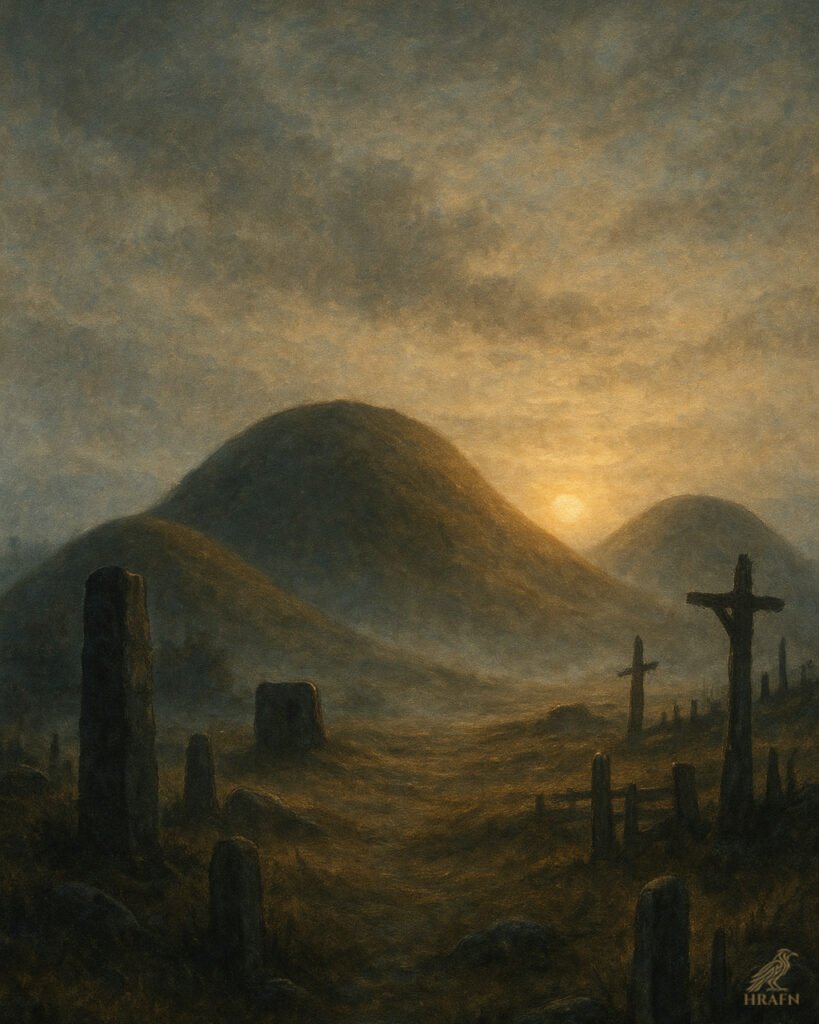
Three massive burial mounds still rise from the plain north of the Swedish city of Uppsala. They are said to be the graves of legendary kings of the Yngling dynasty – the royal line that Snorri Sturluson traces, in his Ynglinga saga, all the way back to the gods Freyr and Odin.
A Center of Power and Cult
Gamla Uppsala, as the site is known today, was far more than a cemetery. It was both a religious and political center: seat of a thing, the popular assembly, and – according to the Bremen chronicler Adam of Bremen around 1075 – home to a massive temple. Statues of Thor, Odin, and Freyr were said to be worshipped there, surrounded by a golden chain, with sacrificial festivals held every nine years.
Between Legend and Evidence
How much of this is true is debated. Adam of Bremen never visited the site himself; he relied on secondhand reports – and his description may also have served to paint pagan Sweden as especially dark. The German bishop Thietmar of Merseburg describes a strikingly similar sacrificial festival in Danish Lejre about 70 years earlier, which shows how much such accounts followed a literary pattern.
What is archaeologically confirmed: Gamla Uppsala was, for centuries, one of the most important sites in Scandinavia, with richly furnished burial mounds dating back to the 6th century and continuous use well into the Viking Age. Whether people were truly sacrificed there, or whether the bloodiest details are literary embellishment, remains one of the open questions of Norse history.
Related siteLike Uppsala, Hedeby is an excavation site where written tradition can be measured against archaeological evidence – there for trade and urban life, here for cult and kingship.
Sources
The information on Uppsala is based on archaeological excavations as well as on contemporary written sources, including Rimbert’s Vita Ansgarii and Adam of Bremen’s Gesta Hammaburgensis Ecclesiae Pontificum. More recent research findings may revise earlier assumptions in detail.