Fenrir – The Wolf the Gods Chained
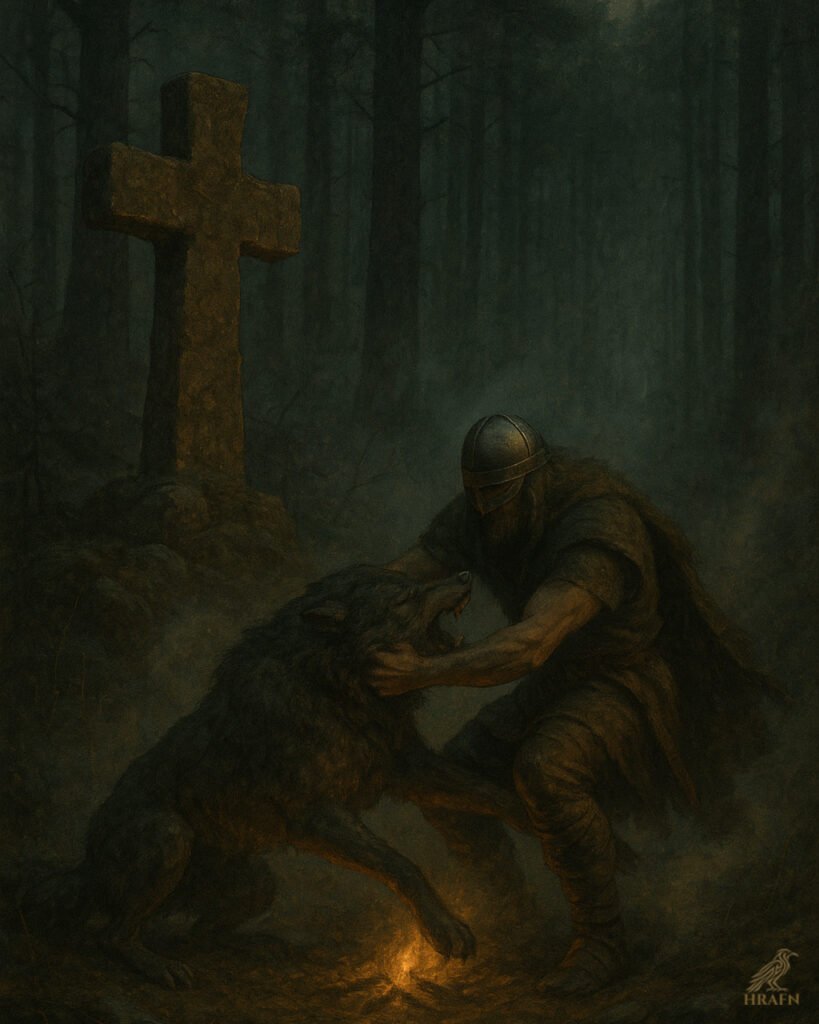
At the church of Gosforth in Cumbria stands a stone cross, 4.4 meters tall, carved between 920 and 950. On one of its panels a man forces open the jaws of a wolf — his foot on the lower jaw, both arms on the upper. Scholars read the scene as Víðarr killing the wolf Fenrir.
On the Isle of Man, Thorvald’s Cross at Kirk Andreas shows the other half of the same story: a man with a spear and a bird on his shoulder, a wolf feeding at his foot. He is read as Odin being devoured. Directly beside him stands a figure interpreted as Christ triumphing over the Devil — pagan and Christian imagery on the same stone.
What is certain in all of this is only this: few beings in Norse mythology leave as many open questions as this wolf.
Son of Loki, brother of the Midgard Serpent
Fenrir is born to Loki and the giantess Angrboða. Two siblings grow up alongside him: the Midgard Serpent Jörmungandr and Hel, goddess of the dead.
The gods separate the three at once. Jörmungandr they cast into the sea, where the serpent grows until Ragnarök. Hel they send to Niflheim, the realm of the dead. Only Fenrir they keep in Asgard, under their own eyes. The wolf grows faster than any animal should — day by day he visibly gains strength, until no god dares bring him food. Only Týr, god of law and of war, continues to feed him.
A name with many faces
The name Fenrir most likely means “fen-dweller” in Old Norse — an origin as dark as the marsh itself. The sources also call him Fenrisúlfr, “Fenris-wolf,” with the epithet Hróðvitnir, “fame-wolf.” A third name, Vánagandr, “monster of the river Ván,” points to the river that will later form from his own drool.
From Læðingr to Gleipnir
The gods fear a prophecy: Fenrir will one day be their undoing. So they plan to bind him — although he has harmed no one yet.
Two chains fail. Læðingr he tears apart with a single jerk, Drómi likewise, even though the smiths made it twice as strong. The gods send messengers to the dwarves, who forge Gleipnir: a band as thin as a silk ribbon and yet unbreakable. Six impossible things go into it — the sound of a cat’s step, the beard of a woman, the roots of a mountain, the sinews of a bear, the breath of a fish, the spittle of a bird. Things that do not exist make a band that no one can tear.
The hand of Týr
On the island Lyngvi, in the lake Ámsvartnir, the gods challenge Fenrir to a trial of strength. He is to let himself be bound and prove that he can break this band as well. The wolf suspects deceit and sets a condition: one of the gods must lay a hand in his mouth as a token of good faith.
They all draw back. Only Týr holds out his right hand. When Fenrir realizes the band is holding, he bites down — and Týr loses the hand.
The gods fasten the cord Gelgja through the rock Gjöll and anchor it to the stone Thviti deep in the earth. A sword is wedged into his jaws as a gag. His drool runs without end and forms the river called Ván.
Ragnarök: the wolf set free
On the day the world ends, Fenrir breaks loose. His jaws gape so wide that the upper touches the sky and the lower the earth. He devours Odin, father of the gods.
It is Vídar, Odin’s son, who avenges him. In one version he drives a sword into the wolf’s heart; in another he sets an armored shoe on the lower jaw and tears the upper one open. Both versions end the same way: the wolf that no bond could hold dies at the hands of a single god.
Sources
Fenrir appears in few but weighty stanzas: in the Völuspá, the Vafþrúðnismál and the Lokasenna. These eddic poems draw in part on older oral tradition but were only written down in the 13th century — centuries lie between composition and manuscript.
The fullest account comes from Snorri Sturluson in the Gylfaginning, written in Christian Iceland in the 13th century. Snorri orders and interprets older material, but he also adds narrative logic of his own — his version is literature, not a direct witness to pagan belief.
The stone crosses of Gosforth and Kirk Andreas, both from the 10th century, show scenes that can be related to Ragnarök. Their interpretation remains disputed: the same stones also carry Christian motifs, and the two visual worlds stand immediately side by side. No cult of Fenrir is attested archaeologically.
What appears in modern films, comics and video games as a symbol of wild, suppressed force is late popular culture — not evidence from the tradition itself.