Huginn and Muninn: Odin’s Ravens Between Thought and Desire
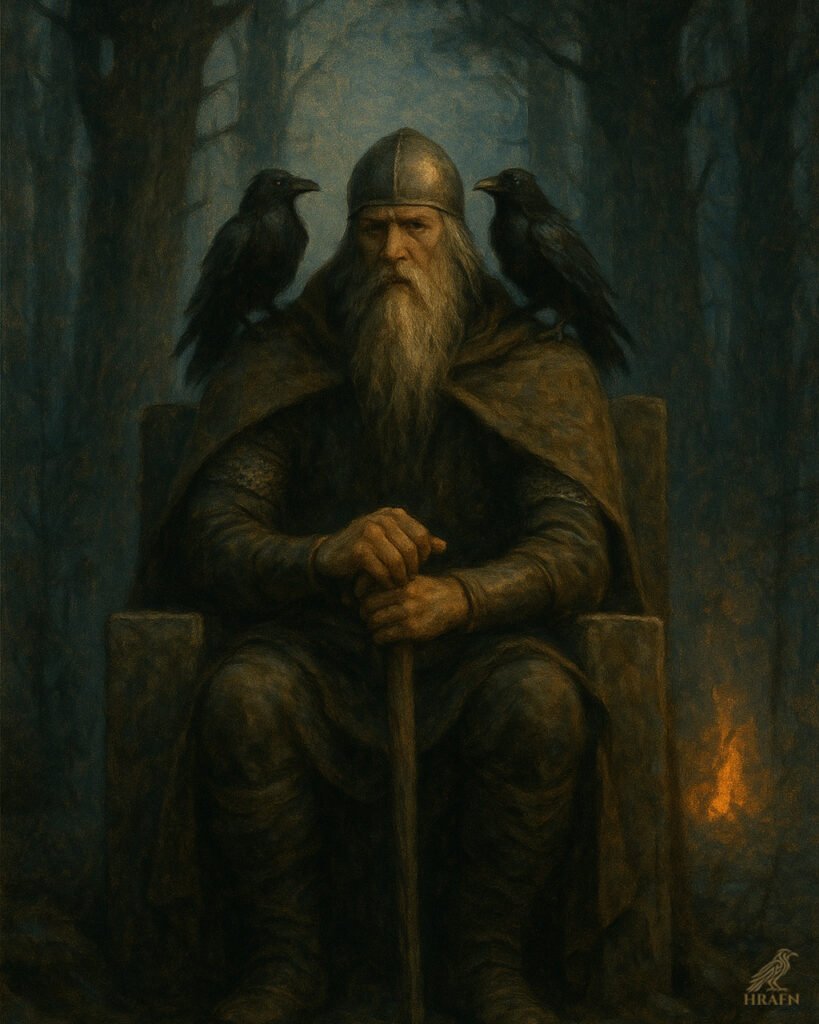
On helmet plates and jewelry from the 6th and 7th centuries, long before the Viking Age proper, a man sits with one or two birds on his shoulders. Scholars have long recognized this as the image of the raven god Odin – centuries before the Edda texts are written down. Two names accompany this image throughout the entire Old Norse tradition: Huginn and Muninn, the ravens who fly through the world for the god.
Two Names, One Thought
Huginn comes from Old Norse hugr, “thought.” Muninn derives from munr, a word that encompasses “thought,” “desire,” and “feeling” – the common translation “the one who remembers” does not quite hit the mark. In the sources themselves, the two ravens carry no distinct personality. They always act as a pair, never singly, and no saga fixes thinking to one and remembering to the other. This clear division of roles is a later attribution, not a statement of the original texts.
Messengers in the Sky
Snorri Sturluson describes in the Gylfaginning, chapter 38: two ravens sit on Odin’s shoulders and tell him everything they see and hear. Every morning he sends them out. They fly over the whole world and return at mealtime. This is why Odin bears the byname hrafnaguð, raven god. The Ynglinga saga adds: Odin gave the ravens speech. They brought him news from distant lands and thereby made him very wise.
The Worry Over Hugin
Grímnismál, stanza 20, from the Poetic Edda, records perhaps the most important line about the two ravens: “Huginn ok Muninn fljúga hverjan dag jǫrmungrund yfir; óumk ek of Hugin, at hann aptr né komit, þó sjámk meirr um Munin.” Translated: every day the two fly across the vast world, and Odin fears that Hugin will not return – yet he worries even more about Munin. Even the father of the gods is not certain of his messengers. Knowledge has its price, even for him. This stanza is the key passage for both names, and it shapes every further interpretation to this day.
An Image Older Than the Viking Age
The motif, then, is older than any manuscript that tells of it. The names are not: Huginn and Muninn arose, on current scholarly reckoning, hardly before the 9th or 10th century. The god with the birds on his shoulders was already there long before the two ravens carried names at all.
Trance, Guardian Spirit, or Hunting Partnership?
One line of scholarship reads the ravens’ daily flights as a shamanic journey: Odin’s spirit leaves his body, wanders through the world, and returns with knowledge. Others dispute this interpretation: the personification of Odin’s thought and feeling as two distinct beings can only be derived from the names themselves, and these names probably do not arise until the 9th or 10th century – considerably later than the archaeological pictorial motif. Further interpretations link the ravens to the fylgja or hamingja, guardian and luck spirits that accompany a person. Still others see in them an echo of the real hunting partnership of raven, wolf, and human: ravens lead wolves and hunters to carcasses, an observation that could have been known in the Viking Age. Not substantiated, on the other hand, are later additions such as “nine worlds” instead of Midgard, the interpretation of a raven banner on the Bayeux Tapestry, or fixed role divisions between the two names. Nor do present-day logos, series, and games serve as sources for the myth – they tell us something about our own time, not about the Viking Age.
Sources
The hard core of the tradition stands on solid ground: Huginn and Muninn appear in the Poetic Edda, in Snorri’s Prose Edda and Heimskringla, in the Third Grammatical Treatise of Óláfr Þórðarson, and in skaldic poetry – broad, mutually independent testimony spanning centuries. The Grímnismál stanza is regarded as especially old and probably goes back to oral tradition predating its written form. Snorri’s prose account in the Gylfaginning, by contrast, is a later, literary elaboration – vivid and rich in detail, but written with the distance of a 13th-century Christian scholar from the pagan material. Archaeological finds do confirm the basic motif of Odin-with-raven already before the Viking Age, but say nothing about names or characters. Modern interpretations such as trance, guardian spirit, or hunting symbiosis are interpretations, not evidence – they help us understand the myth but do not replace the original texts.