Dwarves: The Smiths of the Norse Pantheon
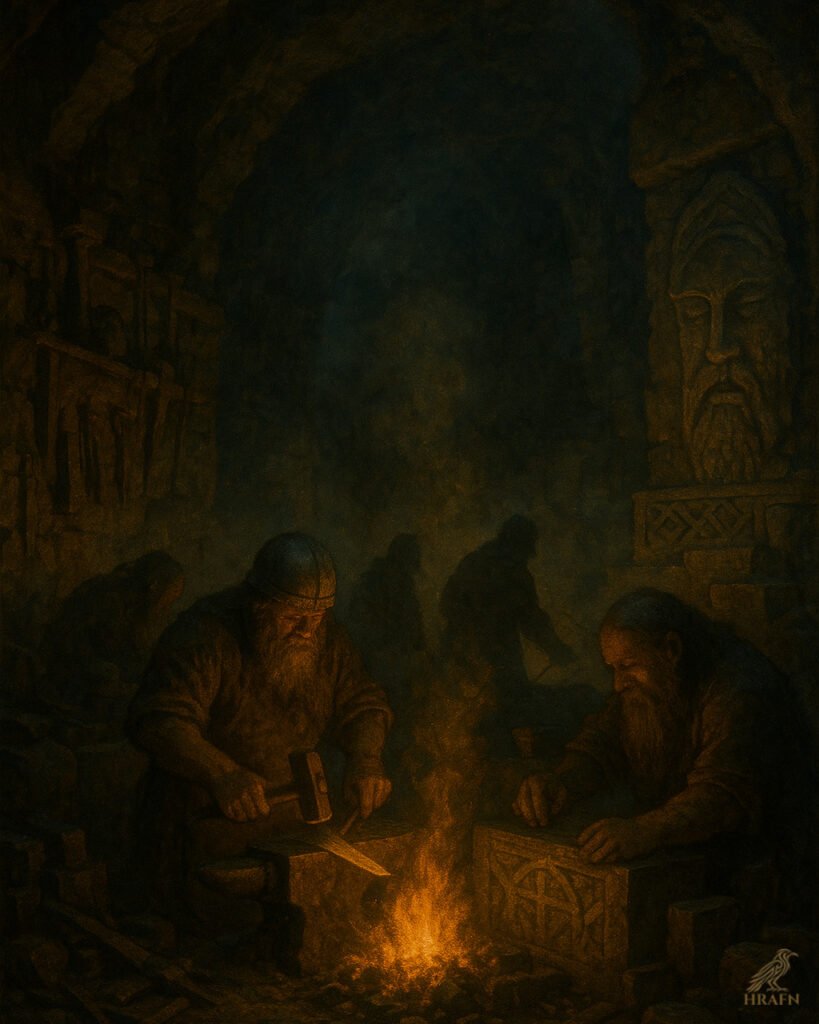
- There Is No Such Thing as “the Dwarves”
- Origin: From the Body of the Primordial Giant
- What the Texts Show — and What They Don’t
- And Where Does the Word Come From?
- A Finding That Is Often Misreported
- The Wager for Loki’s Head
- Kvasir’s Death and the Mead of Poetry
- Alvíss and the Daylight
- Echoes in Popular Culture
- Sources
The Poetic Edda strings together more than sixty names in just a few stanzas. Völuspá 9 leads into the creation of the dwarves, and from there until stanza 16 almost nothing follows but a catalog of names — the so-called Dvergatal. The exact number varies, because the manuscripts list different counts.
Many editors regard this list as a later insertion into the poem. If that is true, then of all things, a later addition became the most consequential list of names in world literature.
Because almost all the names of the dwarf company in Tolkien’s Hobbit come from it. Thorin, Dvalin, Fíli, Kíli, Bombur, Durin. And Gandalf.
There Is No Such Thing as “the Dwarves”
A caveat that belongs before everything else.
Modern fantasy has turned the dwarf into a species: roughly 1.30 meters tall, bearded, ax-wielding, mountain-dwelling, a three-hundred-year lifespan, its own language. A race with a stat sheet.
The sources know nothing of the kind. They offer no definition, no consistent description, and no system. What they offer is a field of beings repeatedly linked to the same things: the underground and stone, craftsmanship, special knowledge, extraordinary objects — and an unclear relationship to the elves.
Whether all texts understood the same thing by dvergr, we do not know. Probably not.
Everything that follows is therefore a composite: drawn from individual poems, from Snorri’s attempt at systematization, from later interpretation. Anyone who builds a coherent picture from it does exactly what the sources do not do.
Origin: From the Body of the Primordial Giant
The tradition knows two accounts of their origin.
The Völuspá says the gods shaped the dwarves from the blood of Brimir and the bones of Bláinn. Snorri Sturluson relates in the Gylfaginning that the dwarves arose as maggots in the flesh of the primordial giant Ymir; only afterward did the gods give them understanding and human form.
Brimir and Bláinn are often understood as bynames for Ymir himself. This interpretation is not entirely uncontroversial. If one follows it, both versions trace the dwarves back to the same material — the dismembered body of the primordial giant, from which the world itself was built.
The remaining difference is more interesting than a contradiction. In Snorri, the dwarves arise on their own, as vermin, and are only afterward shaped into proper form. In the Völuspá, the gods create them deliberately. Made or grown — that remains open.
Móðsognir is regarded as the mightiest among them, with Durinn second. Snorri then associates them with a life in earth and stone.
What the Texts Show — and What They Don’t
Let us begin with what stands in the texts, not with the word.
Dwarves forge. That is their role in practically every story in which they appear: they make what the gods possess but cannot make themselves. Weapons, jewelry, ships, the mead of poetry. Without dwarves, Thor would have no hammer and Odin no spear.
The eddic texts, however, give no indication of body size. They do not define dwarves by short stature — they provide no consistent physical description at all. In these stories, the dwarf is defined by what he can do.
At least some individual dwarves also appear in other shapes. Andvari, explicitly called a dwarf, lives í geddu líki — in the form of a pike — in the water, until Loki catches him and forces from him the gold ring that sets the entire Nibelung legend in motion. Whether this held true for dwarves in general, no source says.
Snorri additionally classifies them: he calls the inhabitants of Svartálfaheimr svartálfar, black elves, and elsewhere distinguishes light elves from dark elves. This systematic division appears in this form only in his work and cannot be reconstructed from older sources. Whether he invented it or took it from lost tradition cannot be decided. The place-name Niðavellir, by contrast, comes from the Völuspá: there, in the north, stands a golden hall of “Sindri’s kin,” the lineage of Sindri.
And Where Does the Word Come From?
As far back as Proto-Germanic, the matter is clear. Old Norse dvergr, Old English dweorg, and Old High German twerg all go back to a common form *dwergaz.
What lies before that is regarded as strongly contested. The older derivation posits a Proto-Indo-European *dhwergwhos, “something tiny.” Riccardo Ginevra put forward a counter-thesis in 2020: an origin from a root *twerḱ-, “to cut, to shape,” with comparisons to the Vedic Tváṣṭar, the divine craftsman. Anatoly Liberman, in turn, sees a connection to sickness and confusion.
The second thesis fits best with what dwarves do in the sources. That is an argument in its favor — and at the same time a reason for caution. An etymology does not become correct simply because it supports one’s own argument. The question remains open.
It is fortunate that the craftsmanship needs no proof from etymology. It stands in the texts themselves.
A Finding That Is Often Misreported
It is widely claimed that the small stature of dwarves is a modern invention. That is not quite right.
Old English glosses from the 7th to 9th centuries translate dweorg with the Latin nanus, pygmaeus, and pumilio — consistently “small-statured person.” That is older than the Codex Regius and older than Snorri.
The finding, then, is not: dwarves were not small. It is this: in the West Germanic language area, the word early on denoted a small human being, entirely without mythological connotation — while the Norse mythological texts define the same beings by craftsmanship and knowledge and stay silent on size.
Two traditions, one word. They were merged only later.
The Wager for Loki’s Head
The Skáldskaparmál tells the most famous dwarf story.
Loki has cut off Sif’s hair and must make good the damage. He has the sons of Ívaldi forge three treasures: golden hair for Sif, the ship Skíðblaðnir, and the spear Gungnir.
Then he wagers — his own head — that the dwarf Eitri cannot make anything better. Brokkr, Eitri’s brother, takes the bet.
Eitri forges, Brokkr works the bellows and must not let go. Loki turns into a fly and stings three times: in the hand, in the neck, and finally in the eyelid. At the third sting, blood runs into Brokkr’s eye, he wipes it away for a moment — and the handle of the hammer taking shape comes out too short.
Even so, the brothers win. Their three works are the boar Gullinbursti, the ring Draupnir, and the hammer Mjölnir. The gods declare the hammer the finest piece, short handle or not.
Loki escapes with a legal trick: his head belongs to Brokkr, he says, but not his neck — and the head cannot be taken without injuring the neck. Brokkr then sews his lips shut.
A story about craftsmanship that ends as a legal dispute. It hardly gets more Icelandic than that.
Kvasir’s Death and the Mead of Poetry
The mead of poetry, too, goes back to two dwarves.
Fjalarr and Galarr invite the wise Kvasir to visit them, kill him, and brew from his blood, mixed with honey, a drink that grants the art of poetry to anyone who drinks it.
Thus the dwarves stand not only at the origin of the gods’ weapons but also at the origin of poetry itself. For a textbook for skalds — and that is what the Prose Edda is — this can almost be read as the founding narrative of its own craft.
The mead does not stay with them. The two go on killing, lose it to the giant Suttungr, and in the end Odin steals it. That is why Snorri, in the Skáldskaparmál, lists kennings such as “Odin’s find” and “Odin’s booty” for poetry.
Alvíss and the Daylight
The third great dwarf story involves no forge at all — and it appears in the Poetic Edda, so it does not depend on Snorri.
The dwarf Alvíss, “All-Wise,” appears before the gods and demands Thor’s daughter as his bride; she was promised to him, he says. Thor does not refuse. He asks questions.
What is the earth called among men, among the Æsir, among the giants, among the elves, among the dwarves? And the sky, the moon, the sun, the clouds, the wind, the calm, the sea, the fire, the forest, the night, the grain, the beer? Thirteen questions, each with a long answer. Alvíss answers them all correctly.
Then Thor tells him what he has been doing the whole time: stalling him. The sun rises. Alvíss turns to stone.
The Alvíssmál thus explicitly links this dwarf to a petrifying effect of daylight. Whether this was meant as a trait of all dwarves cannot be derived from the tradition — it is one poem, one case. Later reception turned it into a general rule.
One further caveat: the Alvíssmál is among the poems whose dating is disputed. Some scholars place it as late as the 13th century — that is, Snorri’s own time.
Echoes in Popular Culture
Hardly any figure from Norse mythology reaches so directly into the present as the dwarf.
Tolkien took the names of his dwarves almost entirely from the Dvergatal. Thorin, Dvalin, Fíli, Kíli, Dori, Nori, Ori, Bifur, Bofur, Bombur, Durin — all of them appear in Völuspá 9 through 16.
So does Gandalf. Old Norse Gandálfr, composed of gandr — among other things “staff, wand” — and álfr, “elf.” In the list it is a dwarf’s name; in Tolkien it becomes a wizard with a staff, which is closer to the word’s meaning than to its source.
What Tolkien did not invent is often told incorrectly. Bearded dwarves, mountains, stone, and smithcraft belong to European narrative and pictorial tradition long before him — and the connection to the underground already stands in the Edda. Tolkien’s achievement lies elsewhere: he built, from the transmitted names, an elaborate culture with history, kingdoms, social order, and its own language. The names came from the Edda; the culture came from him.
In the video game series God of War, the brother smiths are named Brok and Sindri. Brok goes directly back to Snorri’s Brokkr. The second name is more complicated: Snorri names the smith Eitri, while Sindri appears in Völuspá 37 as a lineage name. This conflation is not new — popular handbooks of the 19th century already list Sindri as Brokkr’s brother. The game thus draws on genuine Old Norse names, and on an old mix-up along with them; the characters and plot are freely invented.
What in it corresponds to the sources, we examine in the Historik-Check.
Sources
Poetic Edda. Dvergatal: Völuspá 9–16. Niðavellir and Sindri’s lineage: Völuspá 37. Alvíss: Alvíssmál. Andvari as a dwarf in the shape of a pike: prose introduction to the Reginsmál.
Snorri. Origin as maggots in Ymir’s flesh: Gylfaginning 14. Light elves and dark elves: Gylfaginning 17. Dwarves in Svartálfaheimr: Gylfaginning 34. The wager, the treasures, and the sewn-shut lips: Skáldskaparmál 35. Kvasir, Fjalarr, and Galarr, as well as the kennings for poetry: Skáldskaparmál 57.
Further dwarf material occurs especially in the legendary sagas — in the Völsunga saga and in the Hervarar saga, where Dvalinn and Durinn forge the sword Tyrfingr.
On the etymology. Riccardo Ginevra (2020) on the *twerḱ- thesis; counterpositions in Vladimir Orel, A Handbook of Germanic Etymology, Brill, and in Anatoly Liberman. On the Old English glosses: the relevant dictionaries of Old English, under dweorg.
Reference work. Rudolf Simek, Lexikon der germanischen Mythologie, Kröner — entries Zwerge, Dvergatal, Brimir, Bláinn.
Open questions. The origin of the word, the age of the Dvergatal, the question of whether its names come from older oral tradition or arose at the time of the insertion — and whether the texts even understood the same kind of being by dvergr.