Women in the Viking Age
- Terms and Their Meaning
- The Time Gap – Sources and Retrospective Projection
- Law, Marriage, and Divorce
- The Prohibition That Holds Everything Together
- The Birka Grave – Bj 581
- Officer or Merely Weapons as Grave Goods?
- Oseberg, Fyrkat, and the Staff-Bearers
- Rune Stones as Endowments
- Names with History
- Two Portraits of the Same Woman
- The Shield-Maiden in Reception
- Sources
Not a single manuscript from the Viking Age was written by a woman. Everything that sagas, Snorri Sturluson, and Saxo Grammaticus report about women was composed 200 to 400 years after the events described, in Christian-influenced scriptoria run by men.
Only three things are contemporary: rune stones, archaeological findings, and a few foreign accounts – such as that of the Andalusian-Jewish merchant Ibrahim ibn Ya’qub at-Turtushi, who visited Haithabu around 950 to 965.
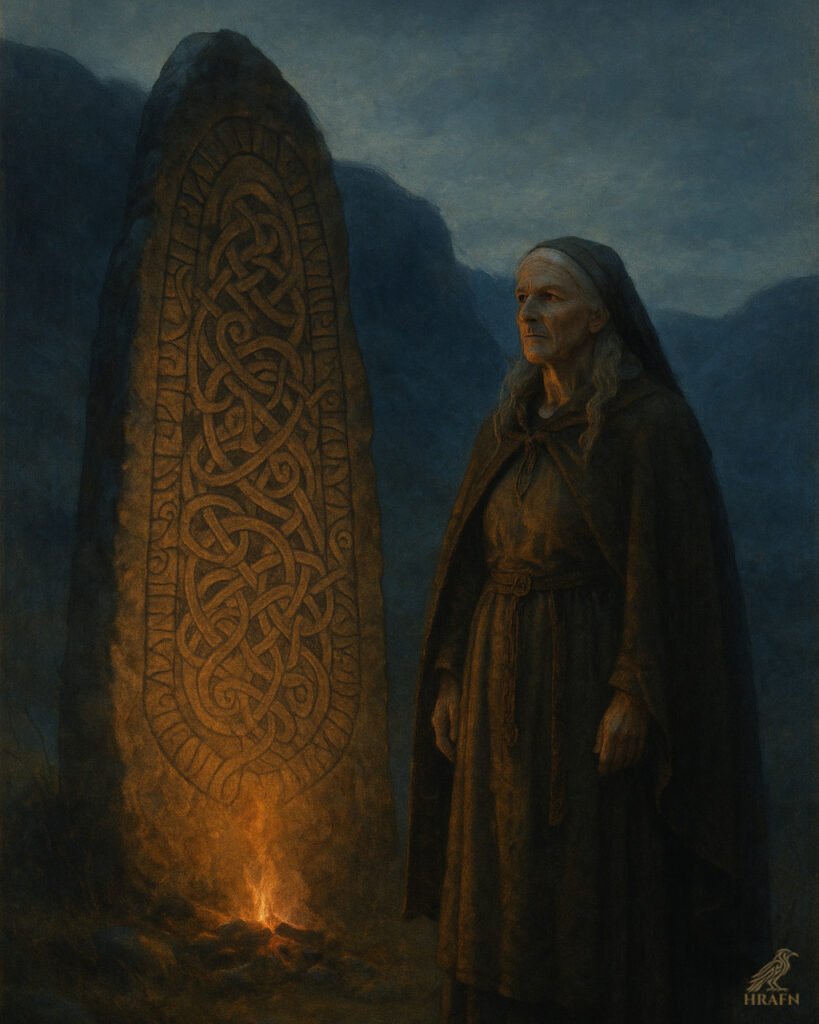
There is exactly one exception, and it stands in stone. The rune stone Hs 21 from Jättendal states that Gunnborga the Good made this stone. She is the only rune master of the North attested by name – and thus the only woman of the Viking Age from whom we possess a sentence in her own hand.
Every other statement about “the Viking woman” otherwise rests on late narrative texts and even later law codes. A retrospective projection, not a firsthand observation.
Terms and Their Meaning
Húsfreyja. The word combines hús (house) and freyja (mistress) – the same word stem found in the name of the goddess Freyja, “the mistress.” Related is the Old High German frouwa, from which the modern German “Frau” developed. Húsfreyja is an official title, not a term of endearment: managing the farm, búsýsla, was considered her domain, with an authority within the house that corresponded to the man’s authority outside it.
Vǫlva. The plural vǫlur probably derives from Old Norse vǫlr, “staff.” A vǫlva is accordingly, literally, a staff-bearer – a title referring to an implement, not to a supernatural quality.
Skjaldmær. Formed from skjǫldr (shield) and mær (girl, unmarried young woman), the term in Old Norse literature designates a woman who takes up arms. The second element is decisive: mær requires unmarried status. According to Carol Clover’s analysis, the archetypal shield-maiden must be unmarried and must dress and arm herself like a man. Saxo and other medieval sources consistently end the warrior role at marriage.
Ambátt. This is the term for the unfree woman, the female slave. She probably formed the numerically largest group of women in the Viking Age – and is almost entirely silent in the sources.
Almost. The one detailed contemporary description we have of the life of an enslaved woman in the North appears in Ibn Fadlan’s account of the burial of a Rus leader on the Volga in the year 922. It describes how an enslaved woman was prepared for her killing over several days and finally strangled and stabbed.
Of the numerically largest group, we thus know almost nothing firsthand – except how one of them died.
The Time Gap – Sources and Retrospective Projection
The often-cited, comparatively free legal standing of women does not come from Viking-Age texts but from law codes that were only fixed in writing afterward. The Icelandic Grágás survives only in manuscripts from the 13th century, the Konungsbók and the Staðarhólsbók. The Norwegian Frostating and Gulating laws likewise belong to this post-Viking-Age layer.
This does not mean these texts are wrong. It means that every statement of the form “the Viking woman was allowed to …” actually reads: “A 13th-century Icelandic law code allowed …” – a retrospective projection onto a time that lay two to three centuries in the past.
The same distance applies to the sagas. They were composed starting around 1200, often in Iceland, under the influence of Christian narrative traditions and literary patterns. What they report about women is literature with a historical core, not a record.
Law, Marriage, and Divorce
Two payments shaped a marriage: mundr, the bridegroom’s bride-price, and heimanfylgja, the bride’s dowry. Both remained the woman’s property, even in the event of divorce – an independent property status that was not a given.
Against this stands a hard limit. Women could hold no public office, could not speak at the thing, could not serve as legal witnesses, and could not bring a lawsuit without a male guardian. Whoever quotes only the first paragraph distorts the picture; both sides belong together.
Regarding divorce, the Norwegian Gulathing law is more explicit than the Grágás. If a man struck his wife in front of witnesses, she could demand the same compensation that a man would have received for the same blow – and after the third blow, additionally the divorce.
The Grágás proceeds differently: it names specific grounds for divorce, including serious injury, and declares a divorce outside these grounds invalid.
The execution was a public act. The woman gathered witnesses and announced the dissolution of the marriage twice: once at the front door, once before the marriage bed.
At-Turtushi, in the 10th century, expressed surprise at Haithabu that women possessed a right to divorce at all – his account, however, has come down to us only indirectly, in quotations by later Arab authors. How frequent divorces actually were remains unclear. Divorce and inheritance law, however, show an independent legal status.
The Prohibition That Holds Everything Together
The same law code provides the counter-test, and it has three parts, not two.
The Grágás forbids a woman to dress in men’s clothing, to cut her hair short – or to carry weapons. The penalty is lesser outlawry: three years of banishment. The procedure is also specified: a matter for summons, five neighbors as jurors.
Auðr fails against this prohibition in the Laxdœla saga, chapters 34 and 35. She wears men’s trousers, is mocked as “Bróka-Auðr” for it, the divorce follows – and she takes armed revenge in her ex-husband’s bed. The episode is literary, not historically attested, but it shows how closely clothing, gender, and status were bound together.
The third part of the prohibition leads directly to the archaeology below. A law code explicitly forbids women to bear weapons – and in the graves, fewer than one percent of women are found with a weapon.
Whether the law describes an existing state of affairs or suppresses an older practice cannot be decided. And the objection is obvious: the Grágás is two hundred years younger than the Birka grave, Icelandic rather than Swedish, and a grave good is not everyday practice. It is not an answer. It is a juxtaposition – and the most interesting one the material offers.
The Birka Grave – Bj 581
Of more than 3,000 known graves at Birka, roughly 1,100 have been excavated. The chamber grave Bj 581, uncovered in 1878, was from the start regarded as a model example of a high-ranking warrior grave: sword, axe, spear, arrows, a fighting knife, two shields, two horses, and gaming pieces along with a game board, suggesting tactical knowledge. A quarter-dirham of the Samanid Nasr ibn Ahmad, minted between 913 and 933, dates the grave to the 10th century.
aDNA analyses showed that the person buried carried two X chromosomes and no Y chromosome – biologically female. The team around Charlotte Hedenstierna-Jonson argued that the distribution of the grave goods, their clear connection to the deceased, and the complete absence of typically female grave objects spoke against family ownership or a “missing” male occupant.
Officer or Merely Weapons as Grave Goods?
The criticism, among others from Judith Jesch and Fedir Androshchuk, points to the excavation documentation of 1878, a possible mixing with neighboring graves, and the objection that weapons as grave goods indicate status, not actual occupation. The research team responded in 2019 in the journal Antiquity.
The dispute is not resolved – and does not need to be. The biological sex of the deceased is regarded as certain; the interpretation “officer” remains an interpretation. Saying both at once is not an evasion but the current state of affairs.
Oseberg, Fyrkat, and the Staff-Bearers
Dendrochronology of the burial chamber timbers dates the Oseberg ship burial to the autumn of the year 834. The burial mound measures roughly 40.5 meters in diameter and is 6.4 meters high – one of the most elaborate burials of the entire Viking Age.
Two women lie within it, their ages disputed: one estimate gives about 80 years and severe arthritis, a differing examination gives 60 to 70 and around 50 respectively.
Their identities also remain open. Queen Åsa of the Yngling dynasty has been proposed, but this attribution is disputed. Other scholars suspect a vǫlva – one argument for this is a wooden staff that was among the grave goods. The mtDNA haplogroup U7 of the younger woman, published by Per Holck, could not be confirmed in three follow-up studies, probably due to contamination or DNA loss.
At Fyrkat, grave 4, dated to around 980, is the richest grave in the entire cemetery: a burial in a wagon, with henbane seeds as a grave good, a plant with hallucinogenic effects. Iron staffs like this one mostly come from the graves of wealthy women, which places the vǫlur closer to the upper class than to a broad segment of the population. At Köpingsvik on Öland, an 82-centimeter-long iron staff with bronze ornamentation was found. Neil Price cataloged such staff graves in The Viking Way; the count is in the range of roughly forty.
Leszek Gardeła analyzed 28 female burials with weapons from the period between roughly 750 and 1100 in Women and Weapons in the Viking World (2021). Such graves make up less than one percent of all known female graves. His conclusion: shield-maidens probably existed, but in very small numbers.
Among these is the double grave of Gerdrup near Roskilde, excavated in 1981 and dated to the 9th century – a woman beside a man who had apparently been killed beforehand. The elongated iron object found with the woman is interpreted as a spear, by others as a staff. This attribution decides whether the grave belongs among the weapon graves or the staff graves.
Rune Stones as Endowments
The province of Uppland alone counts over 1,300 rune stones. According to Birgit Sawyer’s analysis, women appear as sponsors in about seven percent of the inscriptions, usually together with men.
Sawyer interprets the cases in which women sponsor alone as an indication that they could inherit and sponsor when male relatives were lacking – and that an endowment was at the same time a strategy for securing future inheritance claims. In this reading, a stone is not a memorial but a title deed.
Concrete examples confirm this. On the rune stone N 68 in Dynna, Norway, created around 1040 to 1050, Gunnvǫr, daughter of Þrýðríkr, had a bridge built in memory of her daughter Ástríðr; the pictorial side is regarded as one of the earliest Christian pictorial works in Norway. On U 489, Gullaug had a bridge built for her daughter Gillaug. The stone Vg 59 in Norra Härene praises Ása, who acted as no other wife would for her husband.
And then Hs 21 from Jättendal, with which this article began: Gunnborga the Good, the only attested rune master.
Not every alleged rune master withstands scrutiny. The supposed “Frögärd i Ösby” rests on a misreading of the stone U 203 by Erik Brate – a reading that Elias Wessén disproved in 1943. The case shows how easily a reading error turns into a fixed claim that then propagates itself.
Names with History
Auðr djúpúðga, “the Deep-Minded.” The main source is the Landnámabók in the Sturlubók version; the Laxdœla saga names her differently, as Unnr. She also appears in Íslendingabók, Eyrbyggja saga, Eiríks saga rauða, Orkneyinga saga, and Færeyinga saga.
According to Laxdœla, she secretly had a knörr built in the forest, a merchant ship, loaded it with great wealth, and took all surviving relatives with her – hardly any other woman is said to have escaped a time of war with so much property and so large a following. She married her daughters to important landowners and eventually settled at Hvammur in Iceland. As a Christian, she had crosses erected on hills, the Krosshólar.
Even her death is told contradictorily: the Landnámabók and the Laxdœla saga describe the burial differently, once as a mound grave, once as a burial at the tideline under a stone.
Two Portraits of the Same Woman
Freydís Eiríksdóttir. The Grœnlendinga saga, in chapter 8, makes her the instigator of a massacre. The Eiríks saga rauða, in chapter 11, makes her a heroine who drives off the Skrælingar – the indigenous population of North America. Two 13th-century texts, two irreconcilable portraits of the same figure; neither can be identified as the “true” one.
Þorbjǫrg, the seeress. The Eiríks saga rauða describes her appearance in Greenland in chapter 4 down to the last detail: a high seat with a cushion of hen feathers, a cloak trimmed with cat fur, a brass-fitted staff, chants, a trance. The scene is the most detailed literary description of a vǫlva ritual that has survived – and thus also the source for almost everything written about it today.
Lagertha. She appears exclusively in book 9 of Saxo Grammaticus’s Gesta Danorum, composed around 1200. Judith Jesch regards Saxo’s tales of shield-maidens as largely fiction.
The Shield-Maiden in Reception
The figure of the shield-maiden resonates far beyond the Middle Ages, from Richard Wagner’s Brünnhilde to the television series “Vikings.” What is interesting here is not so much the repetition as an observation: modern popular culture almost always chooses the same solution as medieval literature. The warrior woman is the exception, noble, unmarried, and a narrative engine.
Saxo himself provides an exception to the exception. In book 8 of the Gesta Danorum, in the account of the legendary Battle of Brávellir, three women – Hetha, Visna, and Webiorg – each lead their own units. This is the only mass scene of this kind – and recognizably a literary elaboration of a legendary battle, not a report.
The archaeological record rather supports the exceptional status than confirms the serial imagery: under one percent of known female graves contain weapons, and even this figure is disputed in its interpretation.
Bj 581 is nevertheless regularly reduced in popular texts to proof of “real Viking warrior women” – a simplification that takes into account neither the findings nor the scholarly debate about the excavation documentation. Conversely, however, the same holds: whoever dismisses the grave must explain why precisely here the weapon equipment is complete, while the female grave-good equipment is completely absent.
Sources
Law codes, fixed after the Viking Age. Grágás, preserved in the Konungsbók and the Staðarhólsbók, both 13th century – inheritance law, guardianship, grounds for divorce, and the prohibition of men’s clothing, short hair, and weapons for women, penalty lesser outlawry. Norwegian Gulathing law – compensation for blows and right to divorce after the third blow; also the Frostating law.
Sagas and literary texts, from around 1200. Auðr/Unnr: Landnámabók (Sturlubók), differing in Laxdœla saga; also Íslendingabók, Eyrbyggja saga, Eiríks saga rauða, Orkneyinga saga, Færeyinga saga. Bróka-Auðr: Laxdœla saga 34–35. Freydís: Grœnlendinga saga 8 versus Eiríks saga rauða 11. Þorbjǫrg: Eiríks saga rauða 4. Saxo Grammaticus, Gesta Danorum: Lagertha in book 9, Brávellir in book 8.
Archaeology. Birka Bj 581: excavated 1878, aDNA evidence of two X chromosomes (Hedenstierna-Jonson et al. 2017), dating via a Samanid dirham (913–933), criticism from Judith Jesch and Fedir Androshchuk, response by the team in 2019 in Antiquity. Oseberg: dendrochronology autumn 834, mound 40.5 m in diameter and 6.4 m in height, mtDNA finding by Per Holck not reproduced in three follow-up studies. Fyrkat grave 4: around 980, wagon burial with henbane seeds. Gerdrup: 1981, 9th century, interpretation of the iron object disputed. Köpingsvik: iron staff, 82 cm. Catalog of staff graves: Neil Price, The Viking Way, 2nd ed. 2019. Statistics on weapon graves: Leszek Gardeła, Women and Weapons in the Viking World, Oxbow 2021.
Rune stones. Analysis according to Birgit Sawyer, The Viking-Age Rune-Stones, Oxford 2000. Attestations: N 68 Dynna, U 489 Morby, Vg 59 Norra Härene, Hs 21 Jättendal (Gunnborga). On source criticism: the disproven reading of U 203 by Erik Brate, corrected by Elias Wessén in 1943.
Foreign accounts. Ibrahim ibn Ya’qub at-Turtushi on Haithabu, around 950/965 – preserved only in quotations by later Arab authors. Ibn Fadlan, Risala, 921/922 – on the burial of the Rus leader and the killing of the enslaved woman.
Open questions. Whether the weapons prohibition in the Grágás describes an existing state of affairs or suppresses a practice, how frequent divorces actually were, and how the weapon graves are to be interpreted cannot be decided.