Helheim
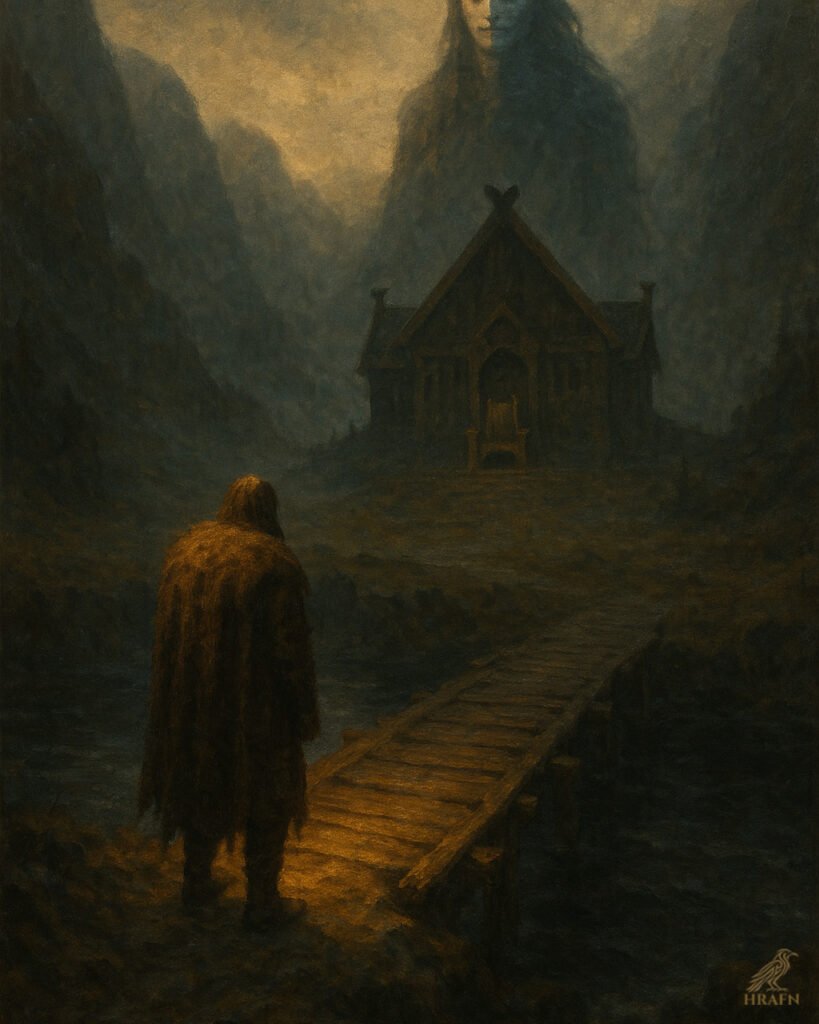
Nine nights a god rides through valleys so dark he sees nothing. No light, no sound. Then gold gleams ahead: a bridge across the river Gjöll. Its guardian steps out and says one thing that gives him away – the bridge thunders louder under him alone than under five troops of the dead the day before. Because he is still alive.
Hermóðr has come to bring his brother Baldr home. He finds him in the hall of the dead, seated in the high seat, honoured, not tormented. And he meets the ruler of that realm: Hel, daughter of Loki, half flesh-coloured, half corpse-blue. She does not refuse. She does not agree. She names a price: if every single thing in the world weeps for Baldr, he walks free. If one refuses, he stays. One refuses. Baldr stays.
No Fire, No Torment
That moment shows what her realm actually is. No fire. No torturers. The name itself means “the hidden” – what lies covered beneath the earth. The old texts never state clearly that bad deeds sent you there. Those who died of age or sickness took that road. Not a verdict. Just the other exit.
Even the popular word “Helheim” misleads. It barely appears in the old Norse texts themselves; it thrives in later books written about them. And the famous furniture of the death hall – a plate called Hunger, a bed called Illness – comes from Snorri Sturluson’s pen in the Christian thirteenth century. Many scholars read it as his own decoration.
The Coldest Lesson
What remains is the coldest lesson in Norse myth: not even all the gods together can buy a dead man back. They can beg. Weep. Bargain. Then they have to bear it. Perhaps that is the real courage this story asks for.
Sources
The description of Helheim is based mainly on the Poetic Edda – particularly the Völuspá and Grímnismál – as well as on Snorri Sturluson’s Prose Edda, which first systematically compiled the oral tradition in the 13th century. As this is a mythological realm rather than a historical place, details vary between sources.