Jörmungandr: The Midgard Serpent That Encircles the Earth
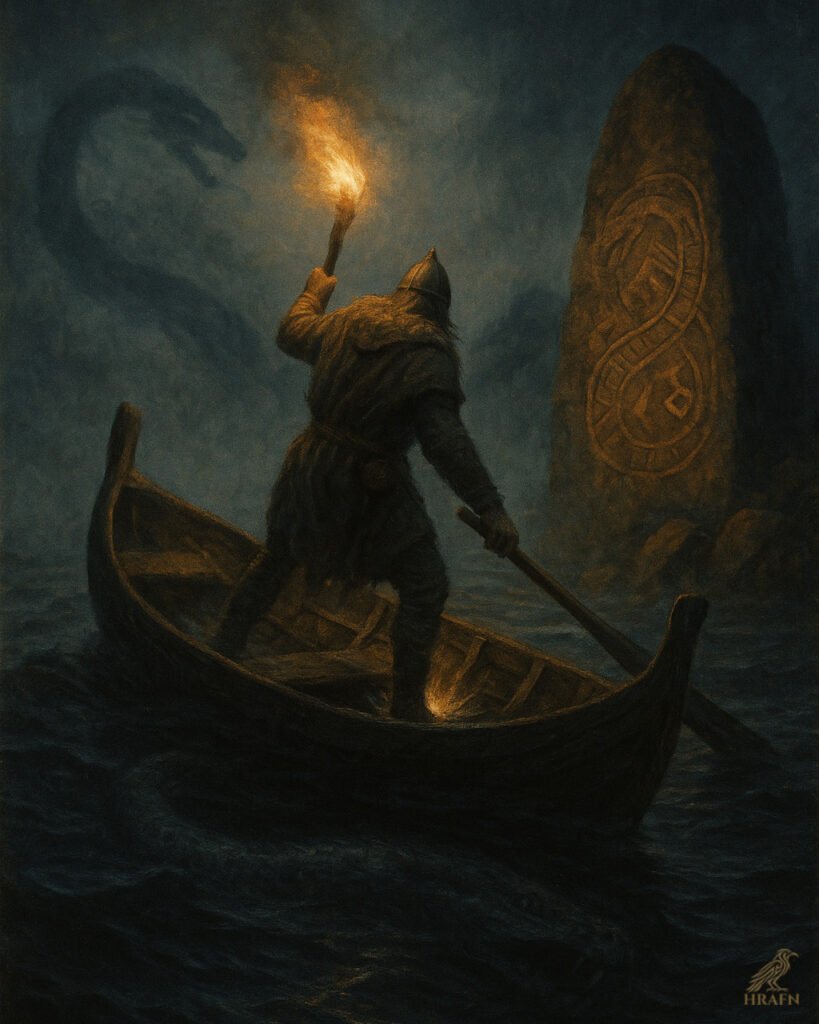
On a runestone from Altuna in Uppland, 1.95 meters tall and found in 1918 in the wall of a chapel, a single man stands in a boat. His foot breaks through the hull, his hand holds a fishing line. The stone, carved in the 11th century, shows Thor on his fishing trip — alone, without a companion, locked in a struggle with Jörmungandr, the Midgard Serpent.
That craftsmen cut this scene into stone two centuries before Snorri wrote it down shows how deeply the story of Thor and the world serpent was rooted in Norse tradition.
Origin: a child of Loki
Jörmungandr is born to Loki and the giantess Angrboða. The siblings are the wolf Fenrir and Hel, goddess of the dead — a brood the gods fear from the outset.
The name combines “Jörmun-” and “gandr”: “Jörmun-” means “the immense,” while “gandr” can be read as “monster” or as “magic staff.” Scholars therefore interpret the name either as “immense monster” or as “earth-staff.” In the older texts the serpent is also called simply Ormr (“serpent”) or Naðr (“adder”).
Odin’s throw into the world sea
Odin sees a danger to the world of the gods in Loki’s children. He casts the young serpent into the sea that surrounds Midgard, the world of men. There Jörmungandr grows without pause until its body encircles all lands and it bites its own tail. In that form, holding the whole world in its grip, it lies — until the end of the world.
The gray cat at Útgarða-Loki’s hall
The first of the three recorded encounters with Thor is hidden behind a trick. Visiting the hall of the giant Útgarða-Loki, Thor is asked to lift a gray cat off the floor — an apparently simple task that turns into a trial of strength. He manages to raise a single paw.
Only later does he learn that the cat was in truth Jörmungandr, transformed and diminished by the giant’s magic. Even in that disguise its real size was enough to push the strongest of the gods to his limits.
The fishing trip with Hymir
The second encounter takes Thor out to open sea. Together with the giant Hymir he rows out to fish, baiting his hook with the head of an ox. Jörmungandr takes it, and a bitter struggle between god and serpent begins.
Here the sources diverge. Snorri’s Prose Edda has the terrified Hymir cut the line before Thor can strike the killing blow — the serpent escapes back into the depths. The Hymiskviða of the Poetic Edda leaves open whether it breaks free or is cut loose. Skaldic verse, such as the Ragnarsdrápa, suggests instead that Thor kills it in this very encounter.
The picture stones give a telling picture of their own. The Hørdum stone in Denmark shows Hymir with a tool in hand, apparently about to cut the line — which matches Snorri’s version. On the Altuna stone Hymir is absent altogether, and from this it has been concluded that Thor prevails. That is not certain: the stone is narrow, and the omission may simply be a matter of format.
Ragnarök: the last encounter
The third and final encounter falls at the end of the world. The Völuspá describes how Thor at last kills the Midgard Serpent — but the victory costs him his life. He walks nine paces from its body, then succumbs to the venom it has spat over him.
Snorri takes the scene into his Gylfaginning almost word for word. With that the long enmity between the thunder god and the serpent he could never quite defeat ends in the death of both.
Sources
What we know about Jörmungandr comes from two very different kinds of evidence.
The written sources — Snorri’s Prose Edda of around 1220, the eddic poems Völuspá and Hymiskviða, and scattered skaldic stanzas such as the Ragnarsdrápa — were recorded centuries after the myths took oral shape, and they already carry the hand of Christian scribes who ordered and interpreted pagan material. That their versions of the fishing trip contradict one another shows how living and uneven these stories remained in oral form before they were fixed in manuscript.
Archaeological finds — the Altuna stone, the Hørdum stone in Denmark, the Ardre picture stones on Gotland and a stone slab at Gosforth — establish independently of any text that the scene of Thor’s fishing trip was a fixed part of the visual repertoire long before Snorri.
Modern readings that treat Jörmungandr as an ouroboros holding the world together, its released tail triggering Ragnarök, find no literal support in the surviving texts — they are interpretation, not tradition. The serpent’s role as an ally in modern video games such as God of War likewise belongs to popular culture, not to the myth.