Valkyries – Choosers of the Slain
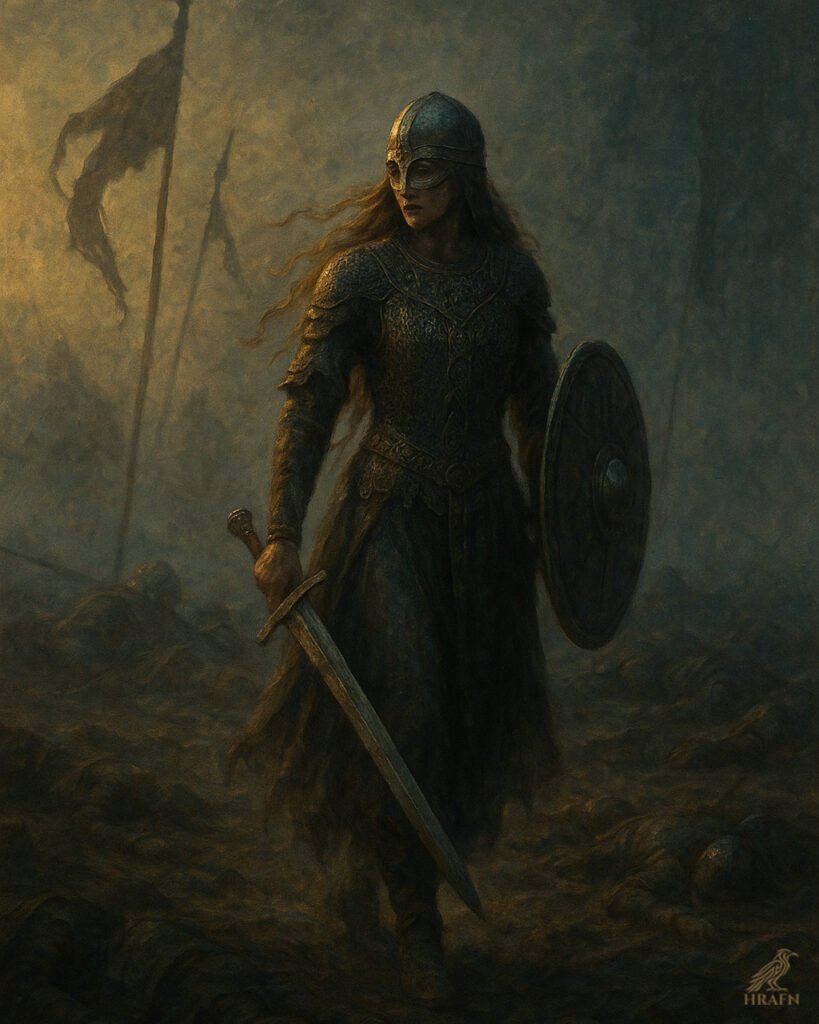
In 2012, a hobby archaeologist finds a tiny silver figure on the Danish island of Funen. It measures only 3.4 centimeters, gilded, adorned with fine niello inlays. It shows a woman, a sword in one hand, a shield in the other. The National Museum of Denmark in Copenhagen dates the find to around 800 AD. Scholars call it the Hårby valkyrie – the first known three-dimensional depiction of this kind. Whether the figure truly shows a valkyrie, no one knows for certain. What is certain is only this: hardly any other being of Norse mythology raises as many questions as these women who decide over life and death.
The Origin of the Name
The Old Norse word valkyrja is composed of two parts. Valr denotes the fallen, the corpses on the battlefield. The second part goes back to the verb kjósa or kyrja, “to choose.” Together, this yields: the chooser of the slain. The root reaches back to Proto-Germanic *walakuzjǭ. Old English also has a related word, wælcyrġe. The German term “Walküre,” by contrast, is young. It arises only in the 18th and 19th centuries as a learned loanword formation from Old Norse – long after the Viking Age had ended.
Messengers in Odin’s Hall
In the mythology of the Edda, valkyries serve a single lord: Odin. They choose who is to die in battle and bring the chosen ones to Valhöll, Odin’s hall of the fallen. There, the dead become einherjar, warriors awaiting the last great battle. The valkyries serve them – they pour mead and beer. In the poem Grímnismál, stanza 36, Odin himself lists their names. He names Hrist, the Shaker, and Mist, then eleven more: Skeggjöld, Skögul, Hildr, Þrúðr, Hlökk, Herfjötur, Göll, Geirahöð, Randgríðr, Ráðgríðr, and Reginleif. Thirteen names, thirteen faces of a single office.
The Loom of Clontarf
A second image of the valkyries shows them not as servants but as mistresses of fate. The poem Darraðarljóð, preserved in the Njáls saga, chapter 157, tells in eleven stanzas of a man named Dörruð. He sees twelve valkyries sitting at a loom. They weave not with wool but with human entrails. Swords serve as treadles, an arrow as a weaving sword, severed heads as weights. What they weave is the outcome of the Battle of Clontarf in 1014. Every thread decides who falls and who survives. The image is cruel and precise at once – here the valkyries appear as weavers of death itself.
Between Death and Healing
Valkyries are not a uniform group. Some kill warriors without regard. Others protect life – they keep ships from sinking and stand by heroes instead of destroying them. The sagas call such figures heroic valkyries. Sigrdrífa from the Sigrdrífumál belongs to this second group: she is linked not only to the battlefield but also to healing. This dual role makes the valkyrie a contradictory figure – messenger of death and protector in one.
Norns, Dísir, and a Find Without Proof
Scholars have long discussed how closely valkyries are related to other female beings of fate, such as the norns or the dísir, the ancestral and protective spirits of a kin group. Many of the names from Grímnismál were probably never independent figures with their own history, but rather poetic circumscriptions of a single function. This same imprecision shows up in the Hårby find as well: the small silver figure carries weapons, but no epithet, no inscription reveals whom it represents. The interpretation as a valkyrie remains just that – an interpretation. In popular culture, however, the figure has long been fixed, at the latest since Richard Wagner’s “Ride of the Valkyries,” the prelude to the third act of his opera Die Walküre, premiered on June 26, 1870, in Munich. To this day, the valkyrie in film marks above all one thing: the moment of male heroic deeds.
Sources
The foundation for the image of the valkyries consists chiefly of poetry and narrative literature. Grímnismál and Sigrdrífumál belong to the Poetic Edda, a collection of mythological and heroic poems that was only fixed in writing in the 13th century, though with an older oral core. The Darraðarljóð within the Njáls saga is family saga literature, which processes historical events such as the Battle of Clontarf in literary form, not as a record. Both groups of sources allow insights into contemporary worldviews but are not historical reports. Archaeologically secured is only the Hårby find as an object and its dating to around 800 – its interpretation as a valkyrie remains a matter of interpretation. Not substantiated, however, is the widespread equation of valkyries with real female warriors or shield-maidens of the Viking Age; none of the sources named provide sufficient evidence for this.