Freyr’s Wooing of Gerðr
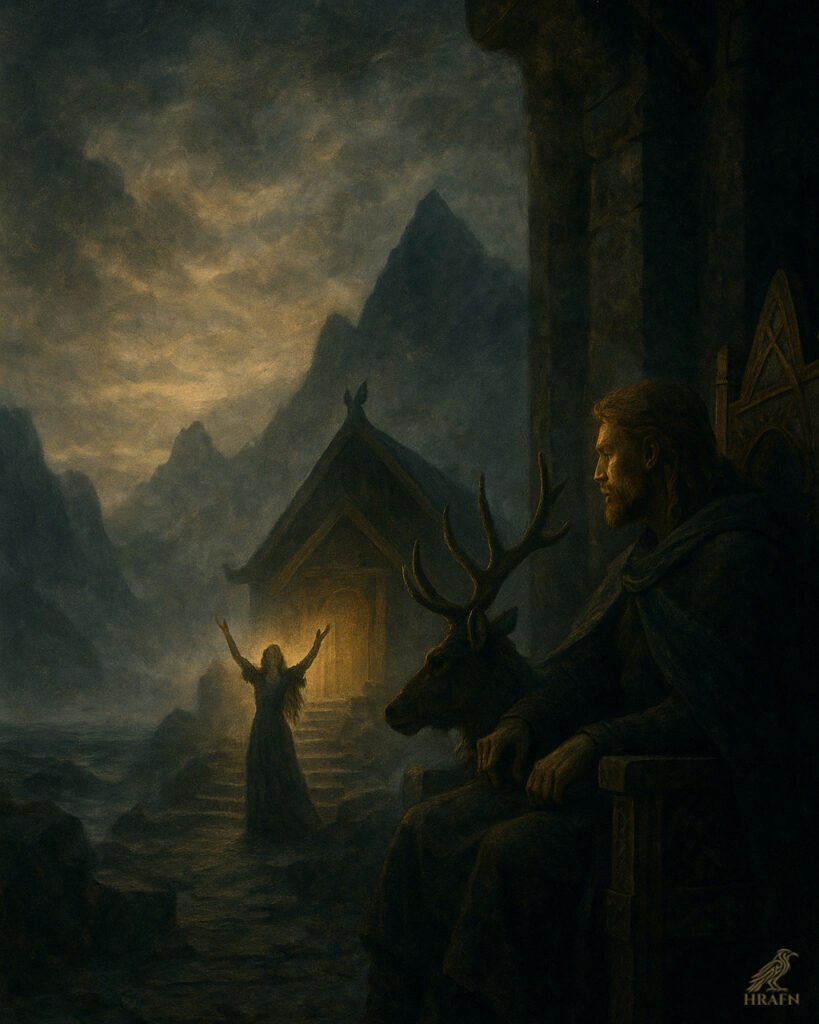
A god sits down on a throne that isn’t his. Freyr climbs onto Hliðskjálf, Odin’s high seat. From there, one can see all nine worlds. Freyr looks north, toward Jötunheim, the land of giants. A woman steps out of her father Gymir’s hall. She raises her arms. Light spills over sky and sea. Her name: Gerðr, a giant’s daughter. From that moment on, Freyr eats nothing more. He does not speak. He does not sleep.
A Servant, a Sword, a Ride into the Giants’ World
So begins the Skírnismál–the fifth poem of the Poetic Edda, passed down orally and first written down in the 13th century. Freyr’s father Njörðr sends the servant Skírnir to woo on his son’s behalf. The price is steep: Freyr surrenders his sword, one that fights giants entirely on its own. Along with it, a horse that carries its rider through flame.
What happens next is no love story. It’s a negotiation that turns into extortion. Skírnir offers Gerðr eleven golden apples. She refuses. He offers the ring Draupnir, which multiplies itself every ninth night. She refuses again–nothing is lacking in her father’s house.
Then Skírnir changes his tone. He draws the blade. He speaks a curse. He swings the magic wand. He paints for Gerðr what awaits her: loneliness, disgust, longing that is never satisfied. Only now does she yield. She names a place–the grove of Barri–and a deadline: nine nights. Freyr, left behind waiting, laments: a single night feels longer to him than an entire month.
The True Price Reveals Itself Only Later
Freyr gets his bride. But he pays for the sword twice over. First he slays the giant Beli unarmed, with nothing but a stag’s antler–it barely goes well. Then comes Ragnarök, the end of the world. The fire giant Surtr advances from the south. Freyr stands against him–without the blade that stayed behind for a single night of desire.
The names in the poem are no accident. Gerðr means, roughly, “the enclosed one”–the fenced field. Skírnir means “the shining one.” Some scholars read an old fertility myth in it, a sacred marriage between god and land. Others see an ideology of rule, still others simply poetry of violence. Scholarship agrees on no single point–but the reckoning within the poem itself stays clear: desire now, weapon gone, ruin later.
Sources
This tale has been passed down mainly through the Poetic Edda and Snorri Sturluson’s Prose Edda. As with all orally transmitted myths, the material was only written down centuries after it originated, so later influences and differing versions cannot be ruled out.