Muspelheim
A Forgotten Word Returns
In a ninth-century Bavarian manuscript, one word appears exactly once: muspilli. A scribe squeezed the poem into the margins of a Latin book. It speaks of the world ending in fire. Then the word vanishes from German entirely.
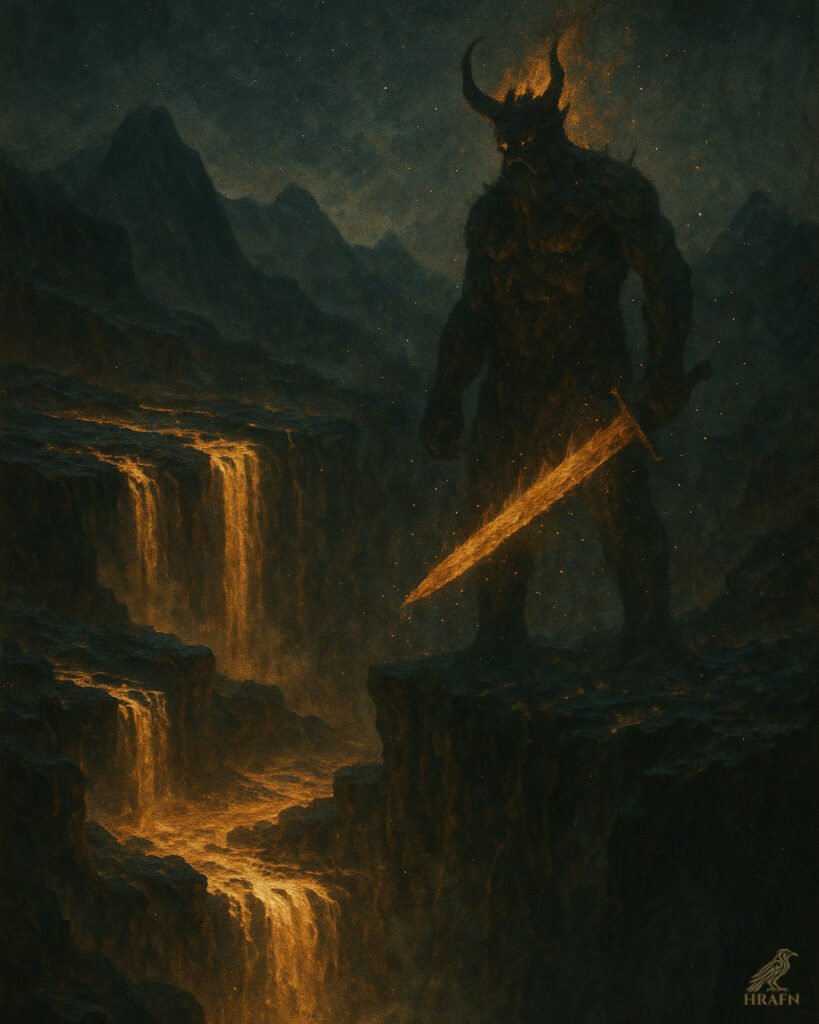
In the North it survives. Some 350 years later, the Icelander Snorri Sturluson takes that old sound and turns it into a landscape: Múspellsheimr, the world of Múspell. In the south, he writes, lies a land of light and heat that flames and burns. Outsiders cannot endure it. At its border stands Surtr, a giant with a sword of fire.
A Fire That Also Creates
Here comes the surprise. This fire does not only destroy – it builds. Sparks fly from Muspelheim into the vast emptiness of Ginnungagap. From the north the ice creeps closer. Where heat meets frost, the rime drips, and from the drops grows Ymir, the first giant. The gods shape the world from his body. Then they gather the loose sparks and fix them in the sky as sun, moon and stars. Every point of starlight is a fragment of Muspelheim.
Between Ragnarök and Doubt
At the end, the circle closes. At Ragnarök the sky tears open, the sons of Múspell ride through, Surtr in front. The rainbow bridge Bifröst breaks under their hooves. Everything burns – and a new earth rises from the ashes.
Whether the old poems ever knew Muspelheim as a place is still debated. Perhaps Múspell began not as a country but as an event: the fire itself. That is the heart of it. The same force that devours everything also lit the first light. In Norse thinking, fire is no enemy. It is a beginning that already knows its end.
Sources
The description of Muspelheim is based mainly on the Poetic Edda – particularly the Völuspá and Grímnismál – as well as on Snorri Sturluson’s Prose Edda, which first systematically compiled the oral tradition in the 13th century. As this is a mythological realm rather than a historical place, details vary between sources.