Thor’s Duel with Hrungnir
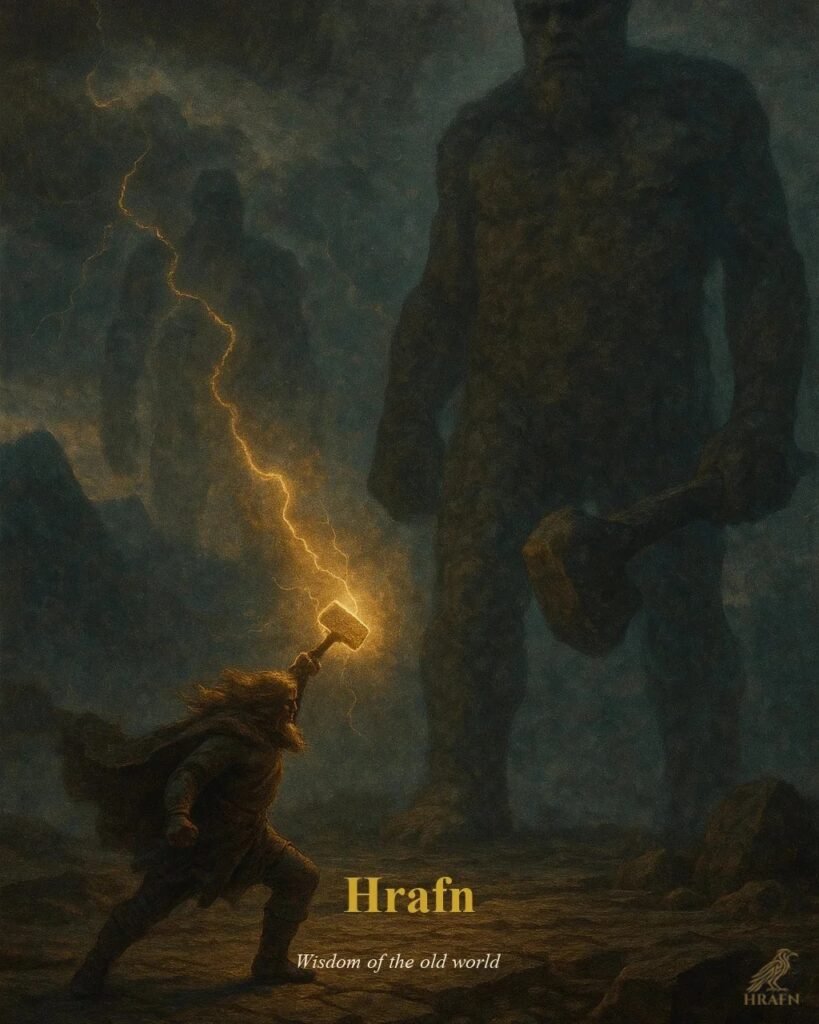
A horse race decides between life and death. Odin rides his eight-legged stallion Sleipnir to Jotunheim, the land of the giants. There he meets Hrungnir, seated on Gullfaxi, a proud steed. The two argue: whose horse is faster? Odin wagers his own head on it. Brave – or reckless.
The ride leads straight to the gates of Asgard. There the gods are celebrating in their hall, mead flowing freely. Hrungnir drinks too much and boasts: he will slay all the Aesir. Only two will he spare – and he’ll take Freyja and Sif with him.
Thor Comes Home
Then Thor enters the hall. The thunder god hears the boasting and wants to strike at once. But Hrungnir carries no weapon. Killing him would be dishonorable, the giant says. Instead, he challenges Thor to a duel – a holmgang, as the old warriors called it. Meeting point: the border at Grjotunagardar.
Thor accepts. For the first time in his life, someone offers him a genuine man-to-man fight.
A Giant Made of Clay
Hrungnir prepares. He fashions himself a companion out of clay: Mokkurkalfi, nine miles tall, but with the heart of a mare. When Thor appears, the clay giant loses his nerve – he urinates in fear.
Hrungnir himself is made of stone, his heart as well. A formidable opponent. But Thor doesn’t win through sheer strength alone. His servant Thjalfi whispers a lie to Hrungnir: the attack will come from below, from the earth. The giant believes him and stands on his own shield – a fatal mistake.
Mjolnir, Thor’s hammer, strikes the stone skull and shatters it. Hrungnir crashes to the ground. But as he falls, his foot lands across Thor’s neck. Meanwhile, Thjalfi deals with the trembling clay giant and kills him.
A Three-Day-Old Child Saves the Thunder God
Thor lies pinned beneath the dead giant. No god can lift the heavy foot. Only Magni comes to help – Thor’s own son, just three nights old, child of the giantess Jarnsaxa. Effortlessly, he rolls the foot aside and frees his father.
As a reward, Magni receives the horse Gullfaxi. Odin is anything but pleased – after all, he himself had raced for that very horse.
A Wound That Remains
The battle leaves its mark. A splinter of the shattered whetstone lodges in Thor’s head. The sorceress Groa tries to work it loose with a spell. She nearly succeeds – but then Thor tells her joyful news, and Groa, overcome with happiness, forgets the rest of the incantation. The splinter remains.
Snorri tells this story in the 13th century. It is attested even earlier, in the 10th-century poem Haustlong. Some interpret “Hrungnir’s heart” as the interlocking symbol we now call the Valknut – a knot of three triangles. This is not certain. Like so much from that era, this riddle too remains hidden in the mist of the centuries.
Sources
This tale has been passed down mainly through the Poetic Edda and Snorri Sturluson’s Prose Edda. As with all orally transmitted myths, the material was only written down centuries after it originated, so later influences and differing versions cannot be ruled out.