Hermóðr’s Ride to Hel
A god dies. The other gods fall silent. No sword helps here, no cunning. Baldr, the Radiant, lies dead – and suddenly even the mightiest of the Aesir do not know what to do.
Only after this silence does Frigg find her voice again. She asks a question that changes everything: who will ride to Hel and offer the mistress of the dead a ransom for Baldr? Whoever dares this wins “all her love and favor.” Hermod rises. He saddles Sleipnir, Odin’s eight-legged horse, and rides out.
Nine Nights Into Darkness
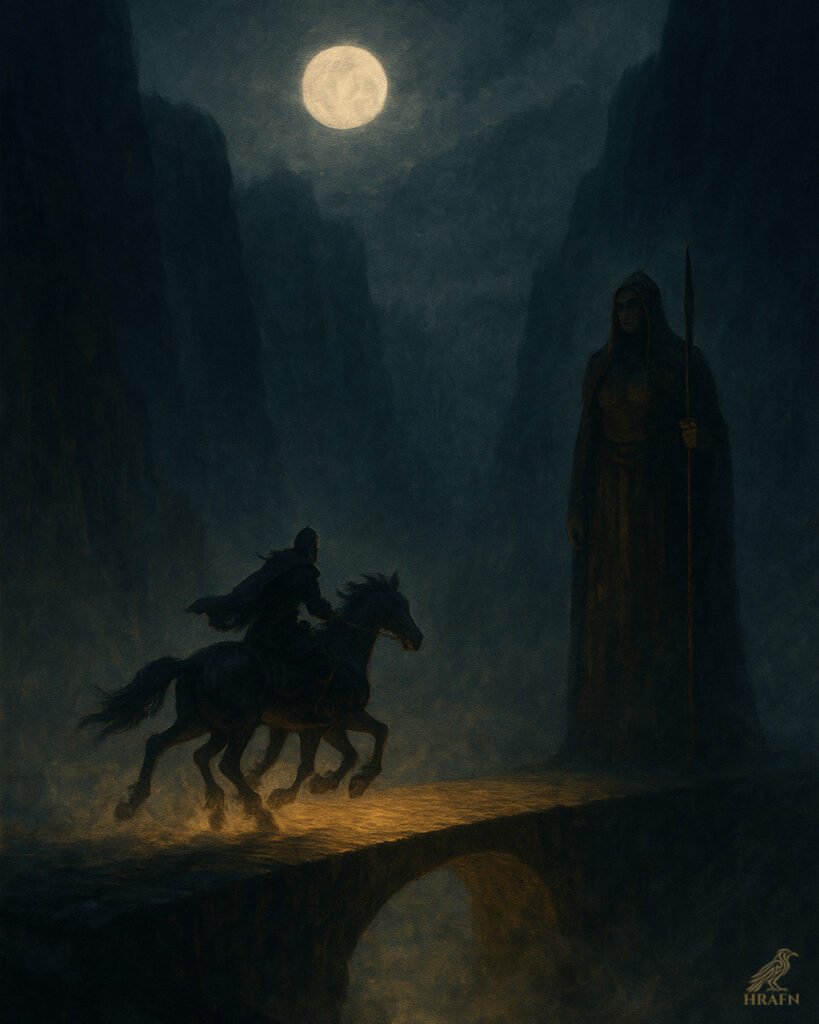
For nine nights, Hermod rides through valleys. The source describes them as “so deep and dark that he saw nothing.” No light, no path, only the hoofbeats of Sleipnir in the void. Then he hears a roar: the river Gjoll. Before him lies a bridge, roofed with shimmering gold. Its name: Gjallarbru.
A guardian watches over it: Modgud. She sees through Hermod at once. The bridge thunders under his hooves louder than under five whole hosts of the dead. And his color – that is not the color of someone deceased. Modgud knows: a living man rides here. She points him the way. It leads downward. And northward, deeper into the realm of the dead.
The Leap Over the Gate
Hermod reaches the gate that encloses Hel’s realm. He dismounts, tightens the saddle girth, mounts again – and Sleipnir leaps. A jump clean over the entire gate, straight into the hall of the dead.
There sits Baldr. On the seat of honor, among the dead. Hermod finds him and names Hel’s price: Baldr may return, if truly everything that lives and everything that is dead weeps for him. Not a single being may remain dry-eyed.
Baldr sends gifts back with Hermod. The ring Draupnir for Odin. His wife Nanna sends a linen gown for Frigg and a finger ring for Fulla.
One Tear Is Missing
The message travels through every world. And indeed: everything weeps. Stones weep, trees weep, every animal weeps. Only one giantess does not. Her name: Thokk. Many believe her to be Loki, disguised one last time. Thokk refuses to weep. And because a single tear is missing, Baldr remains with Hel. Forever.
This story comes from Snorri Sturluson, from the Gylfaginning, chapter 49, written in the 13th century. Whether Hermod was truly a god or merely a hero of legend remains disputed. The scholar Rudolf Simek says: he is a god “only in Snorri’s version.”
Perhaps this is exactly the lesson of this saga. Sometimes all the courage in the world is not enough. Sometimes, in the end, a single tear is missing – and fate remains as it is.
Sources
This tale has been passed down mainly through the Poetic Edda and Snorri Sturluson’s Prose Edda. As with all orally transmitted myths, the material was only written down centuries after it originated, so later influences and differing versions cannot be ruled out.