Odin’s Ride to the Seeress
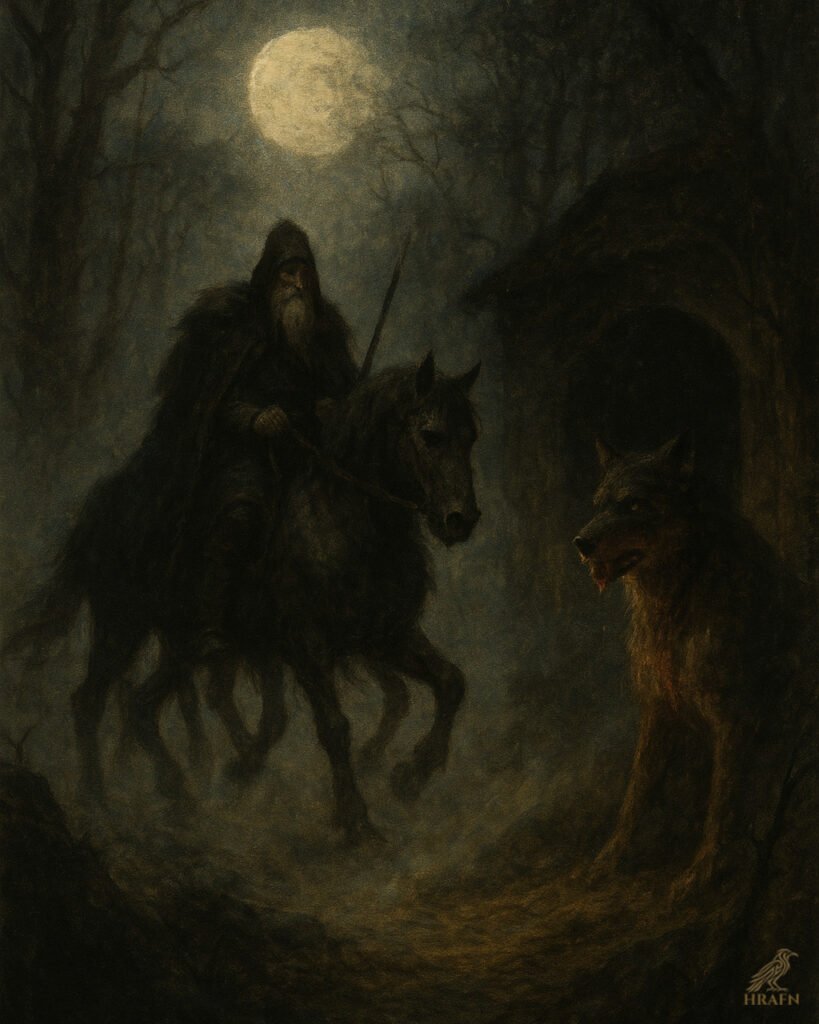
Baldr dreams. And his dreams startle him awake. In Asgard, the gods gather and struggle to interpret them. None of them can. So Odin mounts his horse.
Sleipnir has eight legs. He carries Odin through the night, downward, ever northward, into the underworld. At the gate waits a hound. Blood clings to its fur. The earth itself seems to tremble beneath the hooves – so loudly do they echo through the realm of the dead. Before Odin rises Hel’s house, tall and heavy.
A Grave at the East Gate
Odin knows this grave. He turns north, toward the dead woman, and begins to sing. Powerful runes lie within his words. It is a compulsion, not a plea. The dead woman must rise. Her voice sounds as only the voices of the dead can sound.
Odin does not give his own name. He calls himself Vegtam, son of a Valtam. A trick, thin as spring ice.
The Answer No One Wants to Hear
The seeress speaks reluctantly – but she speaks. Baldr will fall, she says. The blind Hodr will kill him, with a shaft of mistletoe. And an avenger will come: Vali, Odin’s son with Rind, born for this purpose alone.
Then she sees through the disguise. “You are not Vegtam,” she says. “You are Odin.” She sends him away. Ride home, she says. No living being will ever wake her again – not until Loki breaks his bonds and Ragnarok falls upon the world.
That is the price Odin pays. He rides down into death to buy knowledge. And the knowledge tells him only one thing: he can change nothing. Not even the mightiest of the gods escapes what must come.
What Remains of This Ride
The poem itself barely survived. A single manuscript preserves it: AM 748 I a 4to, written between 1300 and 1325. Fourteen stanzas, terse and hard, in the old fornyrdislag meter.
And the seeress herself? She was no mere invention of the poets. At Fyrkat, an ancient Viking settlement, archaeologists found the grave of a woman – with an iron staff at her side. Such women are called volvas. The word means: she who carries the staff. Perhaps one of them really did sit by the fire and sing what no one wanted to hear. Just like the dead woman at the East Gate, whom Odin forced to speak the truth.
Sources
This tale has been passed down mainly through the Poetic Edda and Snorri Sturluson’s Prose Edda. As with all orally transmitted myths, the material was only written down centuries after it originated, so later influences and differing versions cannot be ruled out.