Midgard
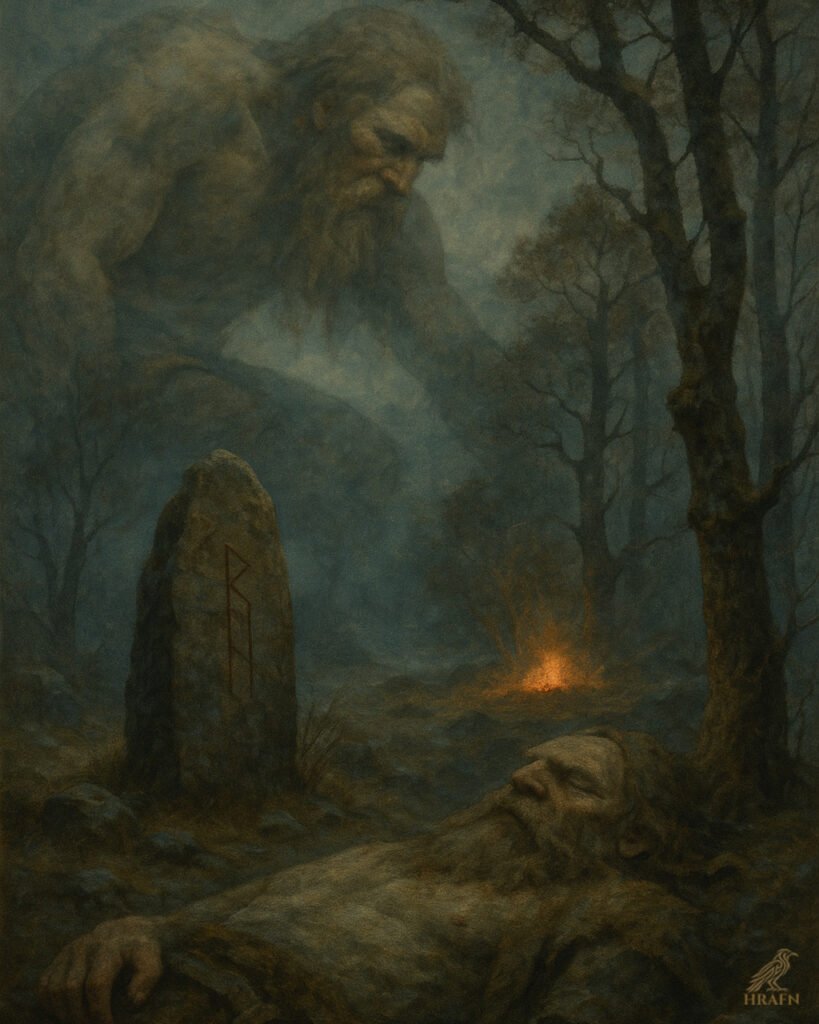
A rune stone in Fyrby, Södermanland, carries a short, almost casual inscription: “a : miþkarþi” – “á Miðgarði,” “in Midgard.” Two sons had the stone raised to boast: they claimed to be the most rune-skilled men “in Midgard.” No gods, no world serpent, no doomsday – just two sons bragging about their knowledge. The word for the world of humans was apparently so ordinary that it was carved in stone for posterity.
A Word Travels Through the Languages
Midgard, Old Norse Miðgarðr, is made up of two parts: mið means “middle,” garðr means “enclosure” or “yard.” Together they yield something like “the fenced-in space in the middle.” The word does not stand alone. In Gothic, midjungards appears, used by the Gospel of Luke to translate the Greek oikouménē, the inhabited earth. The Old Saxon Heliand knows middilgard, the Old High German poem Muspilli speaks of mittilagart, and in Old English middangeard turns up – no fewer than six times in the epic Beowulf. All these forms mean the same thing: the world in which humans live, set apart from what lies outside it.
From the Body of a Giant
The Völuspá, the great prophetic poem of the Edda, tells how Midgard comes into being. Borr’s sons Odin, Vili, and Vé slay the primordial being Ymir and shape the world from his body. The fourth stanza reports on the raising of the lands and the creation of Midgard. The poem Grímnismál becomes more specific: from Ymir’s flesh the earth is made, from his blood and sweat the sea, from his bones the mountains, from his hair the trees, from his skull the sky. And from his eyebrows the gods build Midgard, the dwelling place of the sons of men. The world of humans is thus literally made from a dead giant – not an empty space, but a structure built of flesh and bone.
Between Asgard and Jötunheim
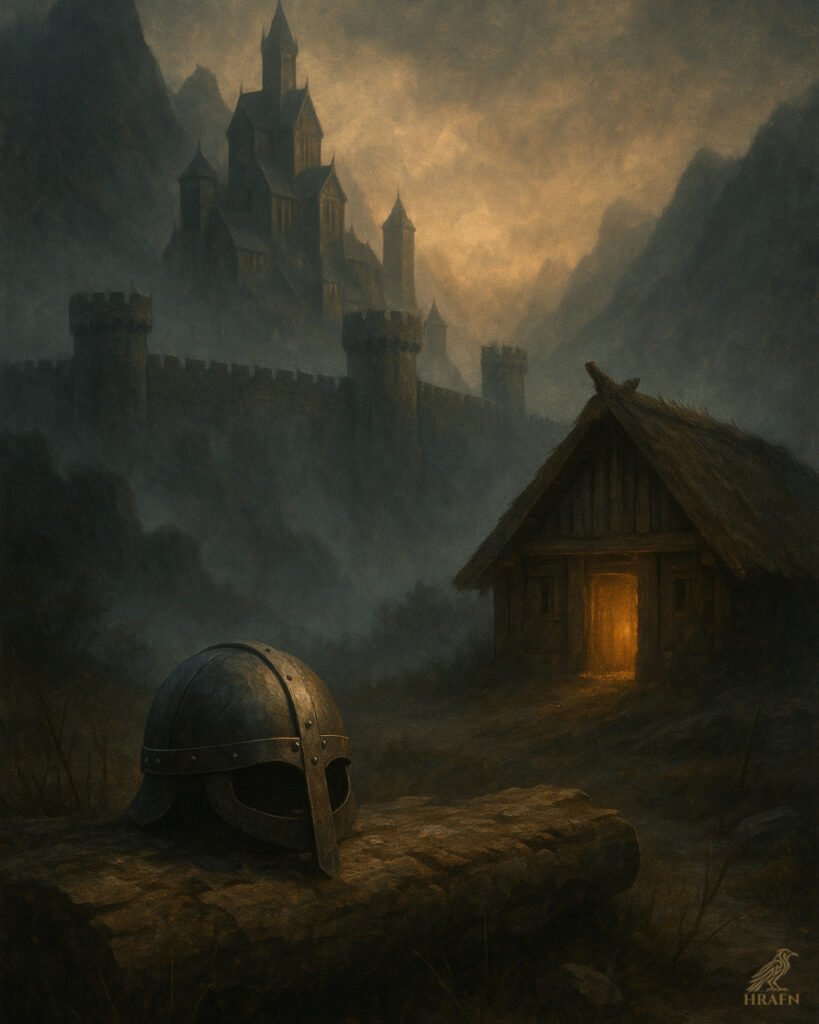
Snorri Sturluson’s Gylfaginning describes the world as round, surrounded by a deep sea. The Jötnar, the giants, receive the land along the shore. Further inward, the gods build a fortification against them from Ymir’s eyelashes – Midgard, more a border structure than a mere continent. Midgard is connected to Asgard, the seat of the gods, by the bridge Bifröst; on the outside, it borders Jötunheim, the land of the giants. All of it is held up by the world tree Yggdrasil. Out in the ocean that encircles Midgard lies Jörmungandr, the Midgard Serpent. It is so long that it wraps around the entire earth and bites its own tail – a belt of living venom around the world of humans.
The Downfall That Is a Beginning
At the end of mythic time, at Ragnarök, Jörmungandr rises from the sea and poisons land and water. After the great battle on the field of Vígríðr, Midgard sinks beneath the waves. But this is not a final end: the world resurfaces, green and new. The myth, then, does not conceive of Midgard as eternal, but as something that can perish and return – built, destroyed, reborn.
From Beowulf to Middle-earth
The Old English word middangeard lived on long past the Viking Age, for instance in the epic Beowulf. J. R. R. Tolkien took up this very term and shaped it into “Middle-earth,” the setting of his novels. This is a modern literary adaptation, not part of the original myth. Films, comics, and video games have since discovered Midgard as a setting as well – pure pop culture, sharing with the Eddic conception of Midgard nothing but the name.
Sources
The rune stone Sö 56 is an archaeological find and thus historically well established: it shows that Miðgarðr was a common word in everyday Viking Age life, not a purely religious formula. Equally solid is the comparative linguistic trail through Gothic, Old Saxon, Old High German, and Old English – it rests on surviving texts and is well documented linguistically. The creation and destruction narrative itself is a different matter. Völuspá, Grímnismál, and Snorri’s Gylfaginning are literary works recorded in medieval, Christian Iceland, centuries after the actual Viking Age had ended. They convey mythological knowledge that had been transmitted orally, but they are not historical accounts and not contemporary sources from pagan practice itself. Anyone speaking about Midgard must therefore carefully distinguish between what stone and language attest and what poets wrote down centuries later.