Guðrún’s Revenge
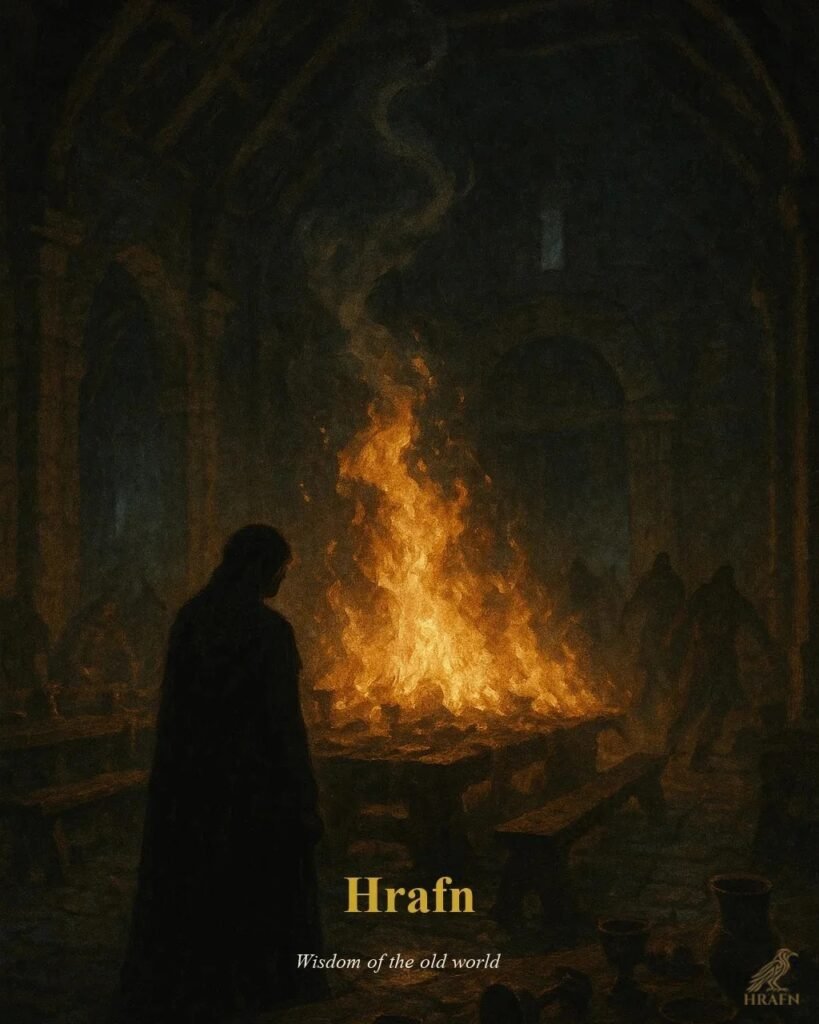
Some grief weeps. Other grief waits–and settles the score.
Gudrun Gjúkadóttir knows both sides. First fate takes Sigurd, her first husband. Then she loses her brothers. Her second husband is named Atli–the legendary figure behind Attila, king of the Huns. He lures Gunnar and Högni into his hall. An ambush.
They seize Gunnar at once. Högni fights back. He kills eight men before they cut the heart from his chest. He dies laughing.
The Coldest Scene in Norse Poetry
What comes next has few equals. The Atlakviða, one of the old Eddic poems, tells it without mercy: Gudrun avenges her brothers. First she kills Atli’s own sons. Then she kills Atli himself. In the end she burns the entire hall down–with everyone still inside it.
At the feast beforehand, she tells her husband whose flesh he has just eaten. The later Atlamál piles on one more cruelty: the skulls of her own sons serve as drinking vessels.
The Price of Revenge
Revenge costs something. Gudrun pays too. She walks into the sea, wanting to die. But she does not sink. The waves carry her to shore, to King Jónakr. A new life begins–but the curse stays loyal to her. Later, Jörmunrekkr has her daughter Svanhild trampled by horses. Her last sons die under a hail of stones.
Behind this poem lies real historical blood. Scholars consider the Atlakviða one of the oldest poems of the Edda–perhaps composed around 900, not written down until around 1270. The core of the story reaches back further still: Attila himself dies in 453, on his wedding night with Ildico.
Gudrun makes a poor role model. She is a warning. Whoever drives revenge to its end burns down their own hall in the end–and everything still living inside it.
Sources
This tale has been passed down mainly through the Poetic Edda and Snorri Sturluson’s Prose Edda. As with all orally transmitted myths, the material was only written down centuries after it originated, so later influences and differing versions cannot be ruled out.