Sigurd and the Valkyrie Brynhild
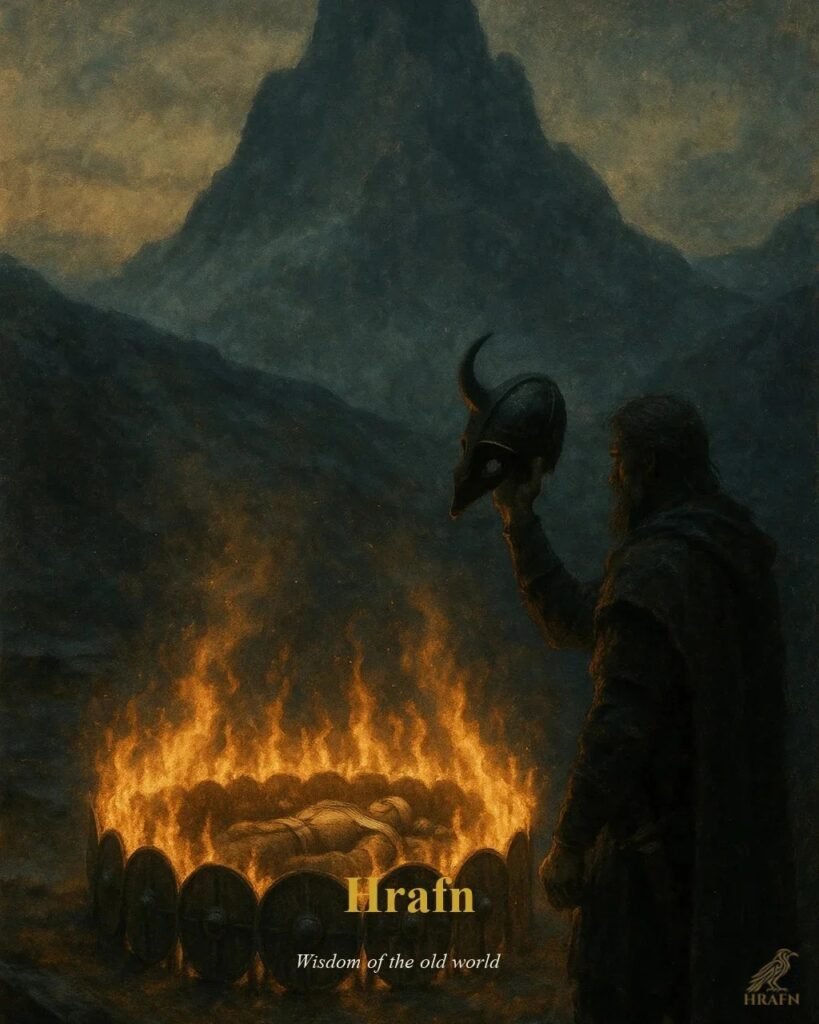
A fire burns on the mountain. Its glow licks up toward the sky. Sigurd rides up Hindarfjall and sees this light from far off. He thinks of plunder. He finds something else.
Behind a wall of shields lies a figure. Full armor, deep sleep. Sigurd steps closer, removes the helmet, cuts the mail open with his sword Gram. Then she wakes–a woman. No ordinary one: a valkyrie, a warrior in Odin’s service, who once led men to victory or to death.
This one defied Odin. She granted victory to a different warrior, not to Hjálmgunnar, the one Odin had promised it to. For this she paid a steep price: a sleep-thorn that forced her into eternal slumber. Never again was she to decide a victory. Marriage awaited her instead. But she swore an oath of her own: only a man without fear should wake and claim her.
No Love Song, but a Lesson
What happens now is no romance. It is instruction. The awakened woman sends Sigurd on his way with rune magic and words of wisdom for life. She doesn’t share her knowledge with just anyone. Only one who rides through fire earns it.
But the story doesn’t end brightly. A potion erases Sigurd’s memory. A false marriage follows, a betrayal in the wooing of another woman, then treachery. In the end, Brynhild stands at Sigurd’s funeral pyre–and dies.
What the Sources Really Say
A look at the tradition reveals gaps. The ending of the poem is missing from the Codex Regius, the most important manuscript. Later paper copies fill the gap–we don’t know exactly how faithfully. The equation of Sigrdrífa, the valkyrie of the poem, with Brynhild also remains uncertain.
Images of Sigurd appear on stones as early as the 11th century. But the awakening scene itself is almost entirely absent there. The image we carry in our heads today–the sleeping valkyrie in a ring of fire–comes chiefly from one man: Richard Wagner and his Brünnhilde.
In the end, a simple core remains. A woman defies a god’s will and pays with her sleep. A man rides through fire to receive wisdom. Neither falls through weakness–they fall for what they forgot.
Sources
This tale has been passed down mainly through the Poetic Edda and Snorri Sturluson’s Prose Edda. As with all orally transmitted myths, the material was only written down centuries after it originated, so later influences and differing versions cannot be ruled out.