The Curse of the Ring Andvaranaut
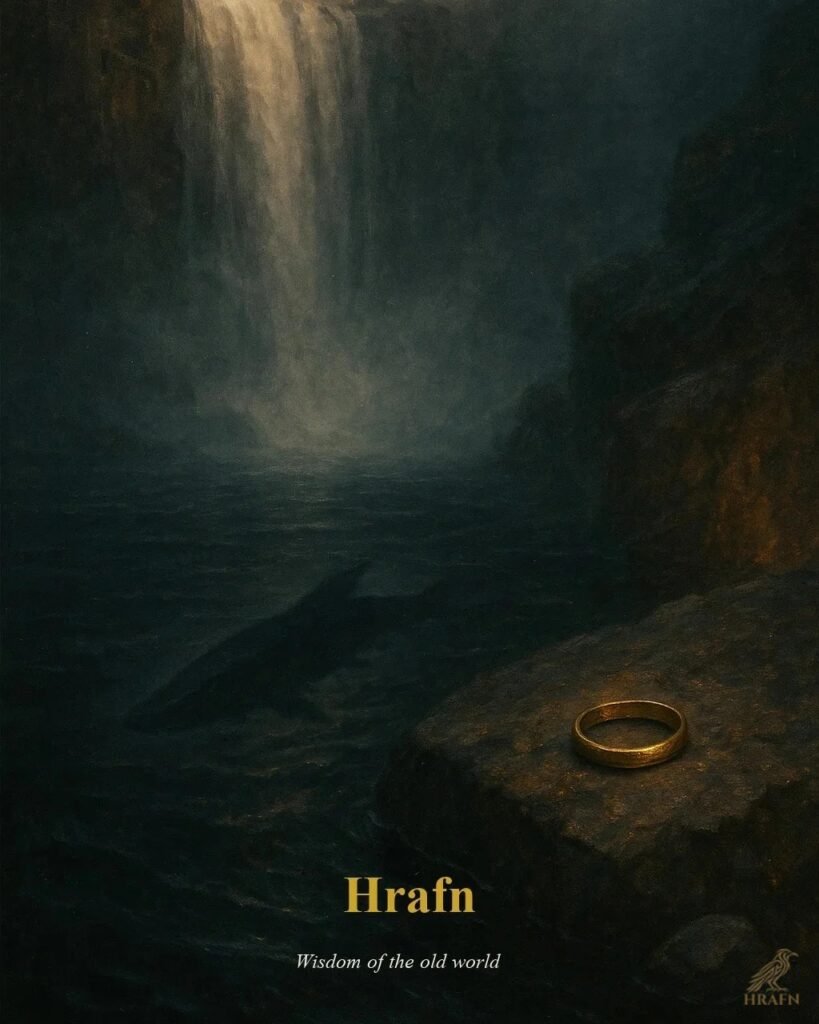
A slender band of gold. Barely bigger than a finger joint. And yet it kills everyone who owns it. Its name–Andvaranaut, “Andvari’s Gift.” It is the North’s most infamous cursed object, born in the twilight of a waterfall.
The story appears in the Poetic Edda, in the Reginsmál, in Snorri’s Skáldskaparmál, and in the Völsunga saga. It begins with a murder. Odin, Hœnir, and Loki kill Ótr, the son of Hreidmar. Ótr had been sleeping in the shape of an otter by the river–the three gods don’t recognize him. Hreidmar demands weregild, the old atonement for killing a man: his son’s pelt must be filled with gold and completely covered.
The Theft and the Curse
Loki gets the gold his own way. With the sea goddess Rán’s net, he catches the dwarf Andvari, who lives in the water as a pike. He squeezes the entire hoard out of him–all but one last ring. That’s exactly the one Loki wants too. It is Andvaranaut, a ring that attracts and multiplies gold. Loki tears it from the dwarf’s finger.
Then Andvari speaks his curse. The ring and the hoard, he says, will bring death to every owner. No empty threat–the curse takes hold at once, without exception.
A Trail of Blood Through Three Generations
Odin himself wants to keep the ring. He covers the pelt with all the gold–except for a single whisker still showing. So the ring has to go on top too. Odin loses it to Hreidmar. The curse begins its work.
Fáfnir, Hreidmar’s own son, murders his father for the treasure. Driven by greed and fear, he turns himself into a dragon and guards the gold from then on atop the Gnita Heath. Years later the hero Sigurd slays him. With his dying breath, the serpent warns: the gold will destroy Sigurd too.
The warning goes unheeded. The ring passes on to Brynhild, then to Gudrun–and in the end Gudrun’s own brothers die in King Atli’s hall. Shortly before, someone wraps the ring in wolf’s hair, one last unheeded sign of danger. It does no good. Greed is stronger than any warning.
A Saga Carved in Stone
This story was no later invention. The Vikings knew it and told it. Proof lies in the Sigurd stones of eastern Sweden. The most famous, the Ramsund carving from around 1030, shows the whole scene chiseled into stone: the dragon, the heart, the hoard.
Centuries later Richard Wagner took up the material and shaped it into his Ring cycle. Some draw a line all the way to Tolkien’s Ring of Power. That’s not proven–just an interpretation that stubbornly persists.
But the old Norse knew better, without needing many words. It isn’t the gold that kills. Greed does.
Sources
This tale has been passed down mainly through the Poetic Edda and Snorri Sturluson’s Prose Edda. As with all orally transmitted myths, the material was only written down centuries after it originated, so later influences and differing versions cannot be ruled out.