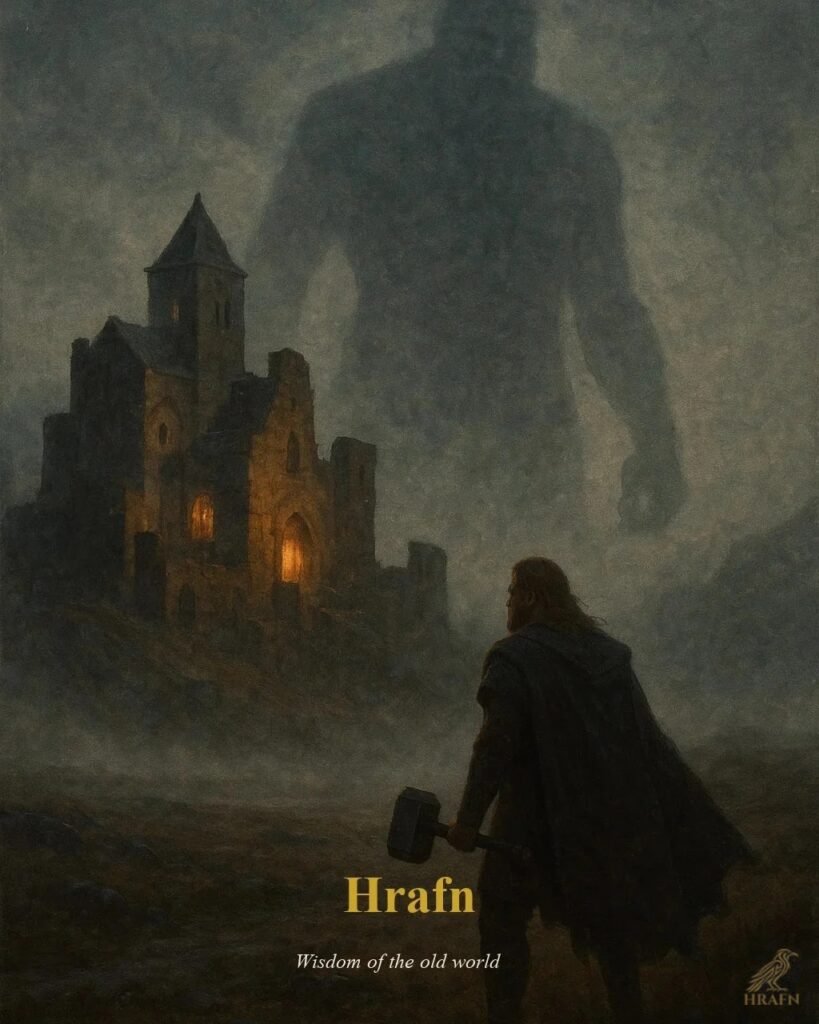
A god transforms into a mare and gives birth to an eight-legged foal. Sounds like a bad joke? That’s exactly Loki. No other god in Norse mythology breaks so many boundaries as he does.
Loki carries a special title: Odin’s blood brother. The two are bound by an oath older than any feud. Yet Loki remains no dutiful brother. He changes shape whenever it suits him. Sometimes he soars as a falcon, sometimes he darts as a salmon through a river. Once he goes even further: he becomes a mare to distract a stallion – and gives birth himself to Sleipnir, the eight-legged horse Odin later rides.
Family
Loki’s own origins cross as many boundaries as his nature: he is the son of the giants Farbauti and Laufey – a giant among gods, an outsider in Asgard from birth. With his wife Sigyn he has two sons, Narfi and Vali, who stay loyally at his side – until fate drags them into Loki’s punishment as well.
With the giantess Angrboda, Loki fathers three very different children: the wolf Fenrir, the Midgard Serpent Jormungandr, and Hel, ruler of the realm of the dead. Warned by a prophecy about their future role at Ragnarok, Odin tears the three from Loki’s care: Fenrir is bound, Jormungandr cast into the ocean, Hel banished to the underworld that from then on bears her name. Snorri tells of this separation in the Gylfaginning. And then there is Sleipnir: unlike his other children, Loki carries this foal himself – born in mare form, it becomes the fastest horse in all nine worlds.
The Troublemaker Who Also Saves
Loki often lands the Aesir in trouble. And just as often, he gets them back out. His tool: pure cunning. He talks his way out of every trap, usually with a trick that his own mischief made necessary in the first place. The gods tolerate him because his wit serves them. But that wit has a dark side.
Over time, Loki’s mockery turns into real malice. His greatest crime: he plots the death of Baldr, the radiant, beloved god. No accident, no mishap – a cold, calculated plan. Baldr dies, and with him dies the gods’ trust in Loki. Snorri recounts Baldr’s murder in detail in the Gylfaginning.
The Theft of the Apples of Youth
Not every one of Loki’s tricks stays harmless. On a journey with Odin and Hoenir, the three fall into the power of a giant in eagle form: Thjazi. Only when Loki swears to deliver the goddess Idun and her golden apples of youth to him does the eagle set him free.
Loki keeps his word. He lures Idun out of Asgard with a pretext, and Thjazi, in eagle form, seizes her and carries her off. Without the apples, the gods visibly age within a short time – grey-haired, stooped, weak. Only under threat of death do the Aesir force Loki to fix his own mistake: he borrows Freyja’s falcon cloak, turns Idun into a nut, and flies back to Asgard with her, Thjazi close behind. At the wall of Asgard, the gods catch a fire that singes the pursuing eagle’s wings – Thjazi falls and dies. Snorri hands down this story in the Skáldskaparmál.
Lokasenna – The Gods’ Quarrel
At a feast held by the sea giant Aegir, to which all the great gods are invited, Loki kills one of the servants out of jealousy. Furious, the Aesir banish him from the hall – but Loki returns, demands his seat at the table, and begins mocking everyone present in turn.
No one escapes his tongue. He calls Bragi a coward, brands Freyja promiscuous, and even accuses Odin of unmanly behaviour and forbidden sorcery. Only when Thor storms into the hall with Mjolnir raised does Loki fall silent and flee. The poem ends with his capture – the prelude to the punishment that follows in the next chapter of his story. The poem Lokasenna from the Poetic Edda records the entire exchange in detail.
Bound Beneath Dripping Venom
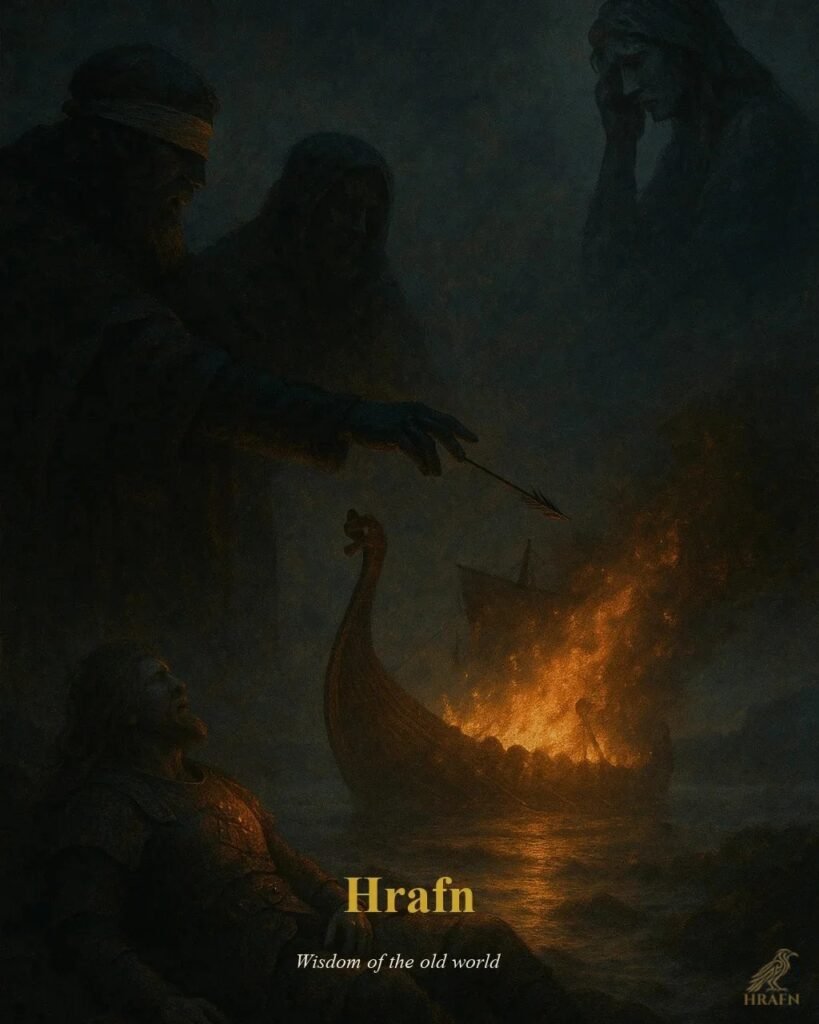
The punishment that follows is harsh and cruel. The gods bind Loki to a rock. They use the entrails of his own son as the ropes. Above him hangs a serpent, its venom dripping steadily onto his face. Not a quick death, but an unending torment. Only his wife Sigyn stays by his side: she holds a bowl above his face to catch the venom. But every time she has to empty the full bowl, the venom drips onto Loki unhindered – and the earth shakes with his cries of pain. So Loki lies, until the world itself breaks apart.
And it does break apart: at Ragnarok, the battle at the end of all time, Loki tears himself free. He leads the armies of chaos, ready for the final fight. In the end, he faces Heimdall, guardian of the gods. Both fall in battle. Neither wins. Snorri describes the binding and Sigyn’s vigil in the Gylfaginning; the Völuspá of the Poetic Edda hints at Loki’s breaking free at Ragnarok.
Loki remains a riddle to this day. Is he friend or foe? Helper or destroyer? Perhaps the answer is simpler than we think: he is both at once. That is exactly what makes him so dangerous – and so immortal in our stories.
In the game: how God of War portrays this figure — and where it departs from the sources — is covered in our mythology check.
Sources
The foundation for this article is mainly the Poetic Edda (including the poem Lokasenna and allusions in the Völuspá) and the Prose Edda of the Icelandic scholar Snorri Sturluson (13th century), especially the sections Gylfaginning and Skáldskaparmál. The separation of Loki’s children with Angrboda as well as his binding and Sigyn’s vigil go back to the Gylfaginning, the theft of the apples of youth to the Skáldskaparmál, and the war of words at Aegir’s feast to the standalone poem Lokasenna. This is supplemented by further Old Norse sagas as well as archaeological and runic evidence. Since this material was only written down centuries after Scandinavia’s Christianization, contradictions and later influences in the sources cannot be ruled out.