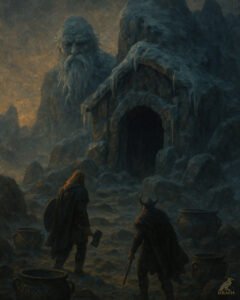
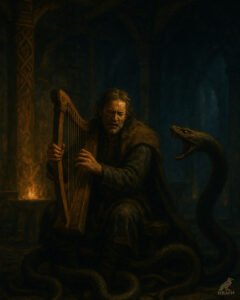
Nine worlds, joined by an ash tree. A race of gods who know their own end and carry on regardless. And behind it all an uncomfortable fact: almost everything we know about it was written down by Christians — two hundred years after the last person believed it.
This page works through Norse mythology and says at every step what it rests on.
There was no holy book. No catechism, no priesthood with binding doctrine, no creed. What we call "Norse mythology" was a body of stories, customs and ideas that varied across centuries and across a territory reaching from Iceland to the Volga.
A farmer in Uppland may have honoured Thor above all. A prince in Denmark rested his rule on Odin. In Iceland, around a quarter of the known settlers carry the god-name Thor in their own names — Odin names are almost entirely absent there.
The closed world of gods we know today is to a considerable degree the work of one man: Snorri Sturluson arranged it into a system around 1220. Before him there were stories. After him there was a mythology.
This does not make the tradition worthless. It only means that whoever reads it also reads the ordering imposed by the man who wrote it down.
Some two hundred years separate the end of the belief from its recording. Iceland accepted Christianity around the year 1000; the decisive manuscripts were produced in the thirteenth century.
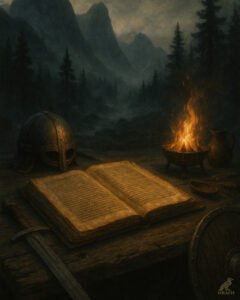
The Poetic Edda is a collection of poems about gods and heroes, preserved in the Codex Regius — a manuscript written around 1270 whose poems are themselves considerably older. It contains the Völuspá, the Hávamál and some thirty further texts. A single codex, rediscovered in the seventeenth century. Had it burned, we would not know most of this.
The Prose Edda was written by Snorri Sturluson around 1220 as a handbook for skalds. It explains myths in order to make poetry intelligible — and orders them in the process. Snorri was a Christian, a politician and a historian. His prologue interprets the gods as deified men out of Troy; a frame of interpretation with nothing to do with pagan belief.
To these are added runic inscriptions as contemporary witnesses, outside accounts such as Adam of Bremen's on Uppsala, and archaeology: graves, sacrificial sites, amulets, picture stones. They occasionally contradict the texts — and that is the most interesting place to look.
The tradition knows two races of gods. The Æsir around Odin, Thor and Frigg; the Vanir around Njörd, Freyr and Freyja. A war between them ends in an exchange of hostages and a lasting union.
What lies behind this account is disputed. An older reading saw in it the memory of a historical encounter between two cults. Current scholarship is more cautious — the war of the Vanir may just as well be a narrative explanation for a state of affairs already found in place.
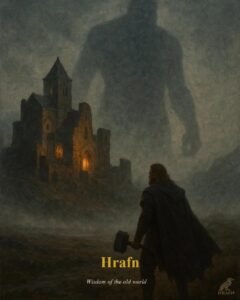
What stands out is how unevenly the gods are represented in the sources. Odin dominates the literary tradition. In runic inscriptions and place names, by contrast, Thor is the more present — he is the only pagan god invoked on runestones. Read the texts and you see Odin's world. Look into the ground and you see Thor's.
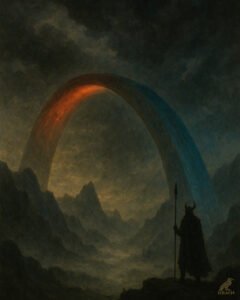
The Völuspá speaks of nine worlds. Which nine it does not say — and no other source lists them in full. The list that circulates everywhere today is a reconstruction from scattered mentions, assembled by scholars of the nineteenth and twentieth centuries.
Named with certainty are Ásgarðr, Miðgarðr, Jötunheim, Álfheim, Niflheim and Muspelheim. For the remainder the lists diverge; some count Svartálfaheim and Niðavellir separately, others treat them as one.
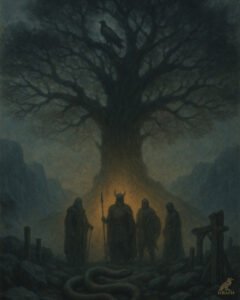
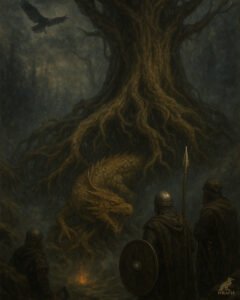
They are joined by Yggdrasil, the world ash. Wells lie at its roots, animals live in its branches, and from its trunk Odin hung for nine nights to win the runes.
Between the worlds move giants, dwarves, elves and beings that fit none of these groups. The boundaries are more porous than later systematising suggests — gods marry giantesses, dwarves forge for the Æsir, and Loki is both at once.
Here too: what looks like an orderly taxonomy of beings is in large part modern ordering imposed on an inconsistent record.
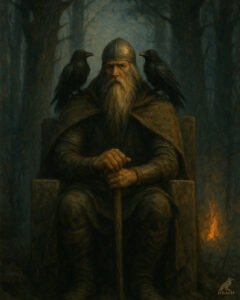
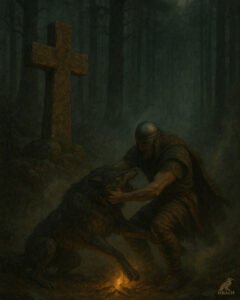
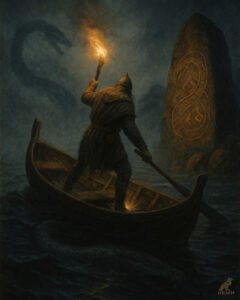
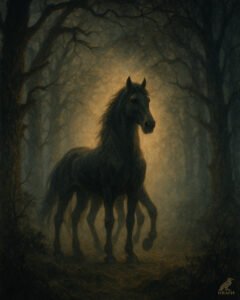
The stories themselves are rarely lofty. Thor dresses as a bride to get his hammer back. Loki turns into a mare and becomes the mother of an eight-legged foal. Odin steals the mead of poetry and escapes as an eagle, losing part of it on the way — the source says by what means.
This coarseness is no accident of transmission but part of the matter. A mythology worth taking seriously must be taken seriously where it is funny as well.
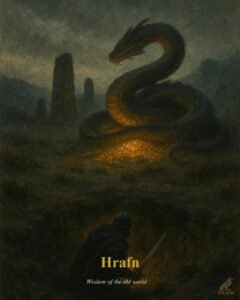
Beside the myths of the gods stands a second body of material: the story of Sigurd, who slays the dragon Fafnir, and the downfall of his line. It is not a tale of gods but heroic poetry — and outside Scandinavia it has a reception history of its own, from the Nibelungenlied to Wagner's Ring.
The Norse and the continental versions differ considerably. Whoever knows Wagner does not know the Edda.
Few mythologies have an ending drawn in such detail. The wolf Fenrir breaks loose, the Midgard Serpent rises from the sea, Odin falls, Thor kills the serpent and dies of its venom. The sun goes out, the earth sinks.
And then it rises again, green, and some of the gods return.
Whether this new beginning belonged to the material originally or is a Christian addition has long been debated. The Völuspá, in which it stands, was written down by a Christian. There is no secure verdict — and whoever reaches one should say what they base it on.
Much of what passes for "Norse" today is younger than the motor car. The winged helmet comes from Carl Emil Doepler's costumes for Wagner's Ring of 1876. The Vegvísir is first attested in 1860, in an Icelandic book of spells. The widespread practice of rune divination goes back largely to a book published in 1982.
Between them lies the political appropriation: völkisch occultism, Armanen runes, the symbolism of National Socialism. And after them comics, series and games that have shaped an image of their own.
None of this is a reason to reject modern adaptation. It is a reason to recognise it for what it is.
The account on this page rests on the Poetic Edda (Codex Regius, manuscript c. 1270) and Snorri Sturluson's Prose Edda (c. 1220), supplemented by runic inscriptions, archaeological findings and contemporary outside accounts.
Where sources contradict one another or scholarship is divided, this is marked on the individual pages. Where a widespread notion arose only after the Viking Age, that is stated alongside it.
As of: September 11, 2026